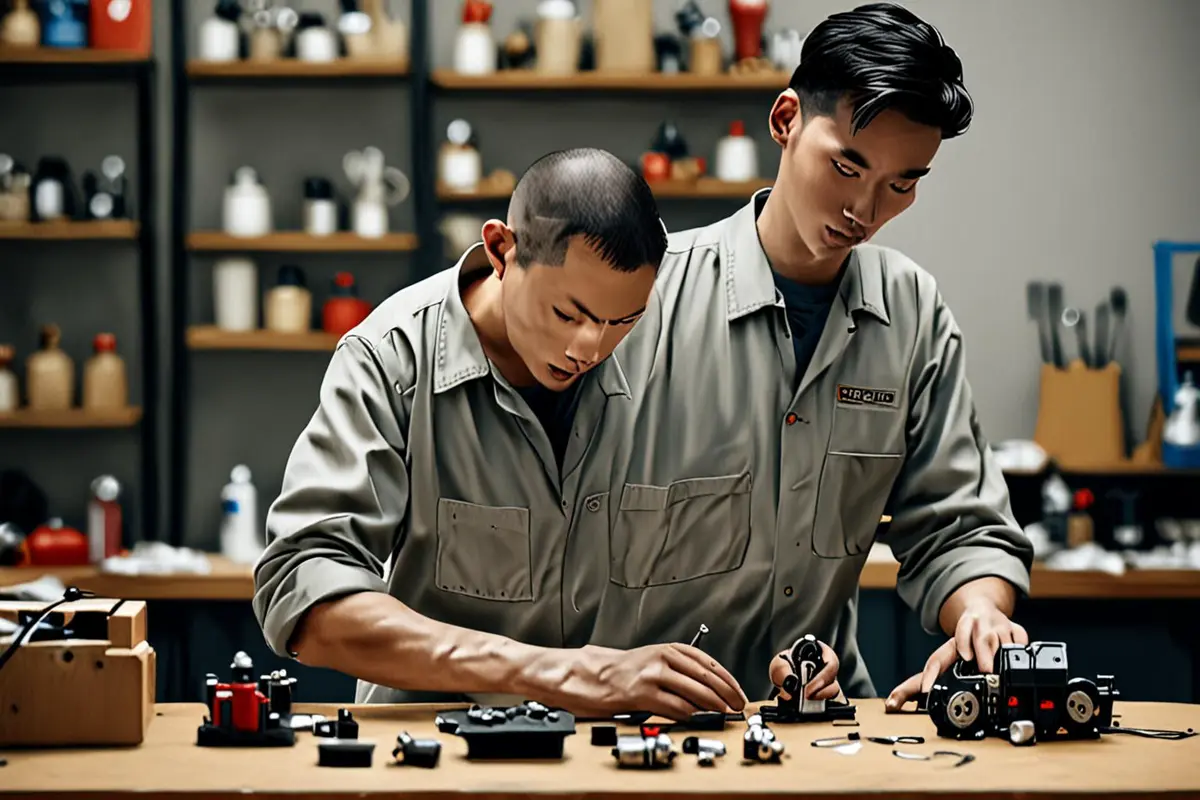
Ask a real engineer to tighten a component, a store employee to greet a customer, or an experienced user to explain a routine, and the result can feel more convincing than asking an actor to imitate the same knowledge. Yet the moment the camera rolls, a familiar action may stiffen. Hands lose their place, eyes wait for approval, and an ordinary sentence begins to sound like corporate copy.
That does not mean nonprofessional talent cannot work on camera. It means authenticity has been mistaken for a lack of design. Their real advantage is not a naturally relaxed face. It is the physical memory built through work, product use, and daily life. The director must give that memory a clear object, obstacle, and finishing point. Camera and edit choices then make the process believable, visible, and usable.
Decide whether you need lived experience or repeatable precision
Nonprofessional talent is not a low-cost substitute for an actor, and it is not the default answer for every project seeking authenticity. It works best when people perform something they genuinely know: how an engineer checks an anomaly, how a barista reads a machine, how a shop assistant hands a product to a customer, or how an experienced user completes a familiar task at home.
Those details are difficult to explain in dialogue. Where the hand pauses, what the person checks first, and when they notice a problem often come from experience rather than acting technique.
Professional actors are usually the stronger choice when a shot demands exact marks, a complex emotional turn, long dialogue, repeated continuity, or many versions in one day. Lived experience and repeatable precision are different abilities. A useful hybrid is to let a real practitioner perform the essential operation while an actor carries the relationship scene and demanding dramatic beats.
Give a task, not an emotion
“Be more natural,” “feel relaxed,” or “look pleased, but not too pleased” gives an untrained performer almost nothing they can do. They begin monitoring whether they look like an ad instead of continuing the activity.
A more useful direction has four parts:
- Task: what must be completed, not which emotion should appear;
- Object: the person or thing the task is directed toward;
- Obstacle: what keeps the task from being effortless;
- Finish: the moment when the action is actually complete.
Do not ask an engineer to “look professional.” Ask them to discover why the device failed the previous check. Do not ask a customer to “be surprised by the product.” Ask them to confirm one detail they had worried about while they are in a hurry. Emotion grows from the distance between a task and its obstacle. When someone is genuinely solving a problem, breath, eyeline, and rhythm often become more credible than a prescribed expression.
Lock the facts, then let people find their own wording
A full page of copy that must be repeated word for word can overwhelm nonprofessional talent. Brands do need to protect product facts, legal conditions, and calls to action, but not every phrase belongs in a person's mouth exactly as it appeared in a marketing document.
Separate the material into three layers.
Facts that cannot change
Product names, key specifications, usage conditions, warnings, and explicit promises must remain accurate. These may work best as short lines, captions, voice-over, or a separately recorded clean version.
Meaning that must survive
The person needs to communicate a judgment, but can use words they would actually choose. Let them explain it in their own order first, then tighten the length. Do not hand over a polished answer and ask for a conversational delivery.
Reactions that can live inside the action
A pause, a self-correction, or a glance toward another person does not always need to be scripted. If it does not alter the facts, it can show thought taking place. That is also why interview edits often feel less human when every hesitation and turn has been removed.
Rehearse to discover the real action, not to sand it smooth
With too little rehearsal, the action may be uncontrolled. With too much, the first genuine judgment can disappear. A practical sequence has three stages.
First, let the person complete the task without filming while the director observes order, gesture, eyeline, and pauses. Next, lock only the moments the shot must preserve: the product's first appearance, the essential operation, and a short hold after the conclusion. Finally, let camera, lighting, and sound adapt to those moments instead of forcing the performer into machinery that was already fixed.
Sony Cine's guide to scene blocking defines blocking as the combined placement of performers, objects, and cameras in anticipation of the edit. Its account of on-set collaboration also notes that reducing the number of observers during early rehearsal can make performer-director interaction less inhibited. For nonprofessional talent, that matters even more. Adjust one variable at a time: action order, scene partner, position, or finishing point.
Let the camera protect the action
Authentic reactions can be brief and difficult to reproduce. Coverage should secure the full chain of action before chasing a more polished close-up.
A useful base is a medium shot that preserves the relationship among person, product, and scene partner; a closer shot that proves the essential operation or reaction; and, when needed, a second camera that catches listening, hesitation, or the moment after completion. The second camera is not there to fill a timeline. It reduces the need to ask someone to reproduce the same fragile moment.
If the project wants a looser, more observational feeling, the camera can respond to the performer instead of forcing identical marks on every take. But following action does not remove continuity. Which hand receives the object, which direction completes the movement, and whether a line lands before or after the operation still need to be recorded. Without those anchors, authentic footage reaches the edit as disconnected fragments.
Authenticity still has to make room for the brand
A believable take does not automatically complete the communication task. Review three questions separately:
- Is the person credible? Are they completing a task or waiting for the camera's approval?
- Is product causality clear? Could a viewer describe what changed by watching the action alone?
- Is the brand information accurate? Has natural language weakened a condition, exaggerated a result, or omitted a required note?
The most natural take cannot be released if it gets a material fact wrong. The most accurate take should not rely on captions to repair an empty human relationship. Capture a natural version, a fact-complete version, and a clean version of the key action, then build the final performance in the edit instead of placing every demand on one take.
AI can extend versions, but it cannot supply lived experience
Generative tools can already provide digital presenters, dubbing, translation, and rapid versioning. TikTok for Business's 2026 Symphony announcement brings video generation, avatars, translation, and dubbing into one suite and says generated outputs are labeled as AI-generated. These tools can help with language versions, concept previs, non-critical inserts, and tightly controlled short delivery.
They do not automatically contain the tactile judgment an engineer uses to feel whether a component is tight enough, or the way a shop assistant changes a handoff when a customer hesitates. When the brand promise depends on that knowledge, real people, real action references, and on-set direction remain the foundation. AI can extend the expression; it should not flatten expertise into a generic performance of realism.
Leave the viewer with more than “that person felt real”
Strong nonprofessional performance leaves a specific relationship behind: this person knows what they are doing, the product genuinely enters the task, and the brand does not turn them into walking copy.
If your brand film needs employees, real users, specialists, or creators on camera, begin with three things: the task they genuinely know, the product facts that cannot drift, and the finishing point the camera must see. ONCE can develop those materials into talent tests, action design, and a complete brand film and commercial production workflow that protects lived experience while making it work as content.