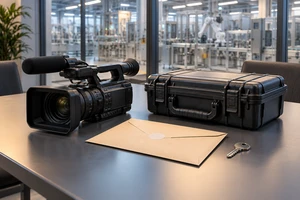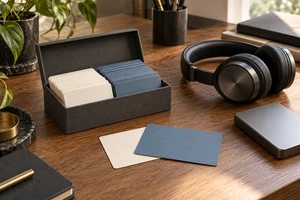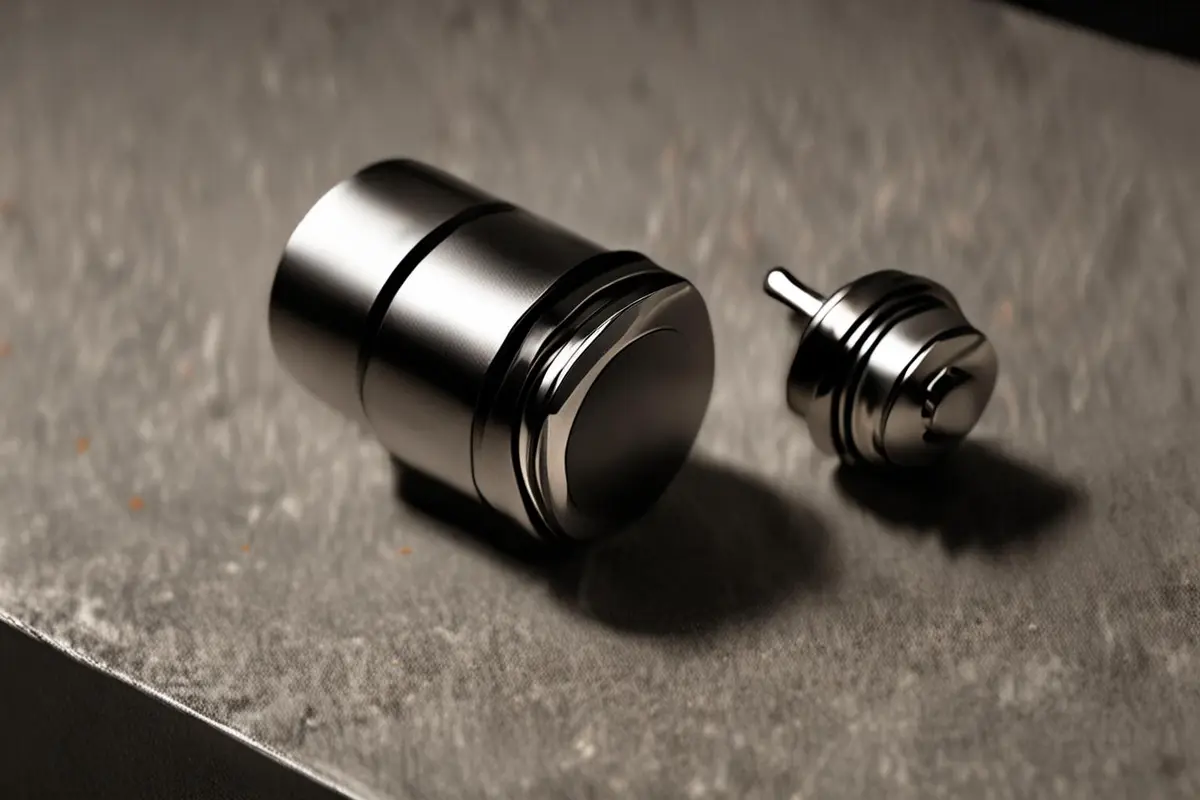
A button clicks. A protective film lifts from glass. A dial passes a resistance point with a faint scrape. Each sound can make a viewer feel the product through the screen. Yet when a tech ad pushes every detail directly into the ear, precision can quickly turn into a sound-pack aesthetic: the mix grows heavier while the product feels lighter.
Tech product ASMR feels premium only when sound distance, physical action, material response, and brand tone belong to the same world. Sound should help the image prove tactility. It should not keep announcing that a sound designer was present.
Start with one question: what is the sound proving?
In a product close-up, sound usually has three jobs. It confirms that an action happened, suggests how a material responded to the hand, and turns an ordinary operation into a moment worth waiting for.
Those jobs do not require every detail at once. When a magnetic part closes, the decisive cue may be a clean, contained low-frequency contact. A plastic lever may need a short, definite attack. A soft insert sliding out of a box may be defined by friction over time, not by an exaggerated impact.
Decide what the sound must prove before deciding which details come forward. Otherwise every track competes with the image, and the audience notices the effort instead of the product.
Match sound distance to camera distance
A macro shot earns the right to sound close. When the lens travels along a dial, magnified friction, fingertip movement, and a mechanical detent feel consistent because the image has already placed the viewer on the product surface.
The relationship breaks when a tabletop medium shot shows a hand gently placing a device, but the sound seems to come from a microphone hidden inside the chassis. Viewers may not identify the technical mismatch, but they can feel that the product has been dubbed rather than physically triggered.
This is not an argument for strict realism. Advertising can exaggerate. The exaggeration still needs to respect the space established by the camera. A useful test is to close your eyes and estimate the distance implied by the sound, then open them and compare it with the camera position. If they are far apart, adjust proximity, ambience, and low-frequency weight—or make the abstraction explicit in the visual style as well.
When the action performs too hard, sound steals the product
Much of the cheapness does not come from poor recordings. It comes from performance and sound design overacting together. A finger strikes harder so a button will “feel satisfying.” A magnetic closure becomes a layered impact to signal luxury. Every packaging layer receives a similar crisp accent.
The performer ends up demonstrating the sound instead of using the product.
Tech products often benefit from restraint. Where a finger pauses, whether a nail touches the surface, how the wrist turns, and whether the device shows inertia all affect our reading of material and build. Effective ASMR begins in performance direction: establish credible force first, then decide whether that instant deserves magnification.
If an operation must be performed more aggressively just to be audible, do not immediately ask for a harder take. Move the microphone, record a contact layer separately, or accept that the action should remain quiet. Not every product value needs a thump.
Give each material a sound fingerprint
The easiest mismatch to hear is a collection of different materials treated as the same “premium sound.” Glass, anodized aluminum, matte plastic, silicone, and molded pulp cannot all be expressed by the same metallic click, heavy low end, and airy tail. The more polished the image, the more obvious the template becomes.
A material fingerprint can be judged through three intuitive dimensions: how quickly the sound begins, how hard or soft its main body feels, and whether the tail stops immediately or leaves some space. The audience does not need to become an acoustics engineer, but the creative team should be able to explain the difference.
A light plastic latch can have a clear attack without an oversized sub-bass tail. Thick paperboard friction should retain fiber and resistance rather than becoming smooth plastic. A metal dial does not need to sound like a jewelry box at every step; precision can also come from quietness, stability, and consistency.
Foley can rebuild a detail that production audio missed, but its job is to restore material logic. RODE's guides to recording Foley and audio for film frame Foley as a way to add realism and note the limits of repairing overloaded recordings in post. For advertising, that is a reason to preserve a clean real-world trigger during production. Creative augmentation works better when it has a physical reference.
ASMR is not the same kind of intimacy for everyone
ASMR moves the audience close. Whispers, breath, fingertips, and friction create a private listening distance. Some people experience that as immersion; others experience it as intrusion. More intimate does not automatically mean more premium.
An ESADE summary published in 2024 discusses research in the Journal of Retailing and Consumer Services. Under that study's conditions, general participants responded negatively overall to whisper-based ASMR advertising, while people who experience ASMR responded more positively. The experiment tested whispering, so it should not be generalized to every product click, scrape, or unboxing sound. Its useful lesson is narrower: ASMR selects a relationship with the audience. It is not a universal luxury filter.
An established brand may use proximity to create familiarity and companionship. A new brand may feel overly intimate before it has earned trust. Subtle triggers are more likely to work for headphone listeners already comfortable with the format. On a phone speaker, in a shared room, or inside a fast-scrolling feed, the same close sound can prompt an immediate swipe.
That is why the review should not happen only on good studio headphones. Listen on headphones and a phone speaker, then watch once with the sound muted. Ask how close the brand actually wants to stand to the viewer.
Create space before deciding what to magnify
The scarce resource in ASMR is not the number of sound effects. It is the space between them. When every action is filled, the audience loses hierarchy. When music occupies the whole spectrum, subtle triggers must become louder. When transitions, text animation, and product gestures all make noise, immersion becomes a contest for attention.
Reduce the sound hierarchy to one question: what should the audience feel in this second? If the answer is the controlled resistance of a dial, music can recede, ambience can thin out, and incidental hand movements do not need individual accents. If the answer is calm spatial stillness, the dial may not need to sound at all.
This is different from deciding that an entire film should have no score. One choice creates a local listening focus; the other shapes the narrative system of the whole piece. The principle remains the same: silence is not an absence to repair. It is a way to give one sound meaning.
AI Foley can accelerate options, not material judgment
Generative audio is useful for rapid exploration. Adobe Firefly's official guide to generating sound effects with a voice performance, updated August 18, 2026, shows how text can define the effect while a vocal guide controls timing and energy. That is valuable for storyboards, previs, and direction comparisons before a final mix.
Correct timing does not guarantee correct material. An AI result can be dramatically convincing while remaining physically vague: a tiny component gains too much low-frequency weight, a soft surface receives a hard attack, or the same product changes sonic character from shot to shot. The model can propose an option. It does not automatically know whether the brand should feel restrained, intimate, or forceful.
A safer workflow keeps one real action as an anchor, then lets AI or a Foley artist explore around it. Review each option against four questions: Is the distance plausible? Does the sound match the force of the action? Is the material continuous across shots? Is the relationship with the audience right for the brand?
Premium sound is not louder. It is more credible.
Premium tech product ASMR comes from a credible scale shared by image and sound. Close shots reveal detail; medium shots preserve space. Actions are restrained; materials remain distinct. Important moments are magnified, while unimportant ones are allowed to stay quiet. AI can accelerate exploration, but final judgment returns to the product.
On the next ASMR review, mute half the tracks before adding anything. If the product suddenly feels heavier, the problem was probably not a lack of sound. It was a lack of decision about what deserved to be heard.
If you are developing a tech product film, unboxing sequence, or a hybrid workflow that combines production sound with generative audio, ONCE can shape the logic from performance and capture through Foley and final mix. Explore our commercial video production services and bring an existing storyboard or cut for a more credible sound direction.