Silence in a brand film is not an empty timeline. It is the deliberate removal of something that has been interpreting the images for us.
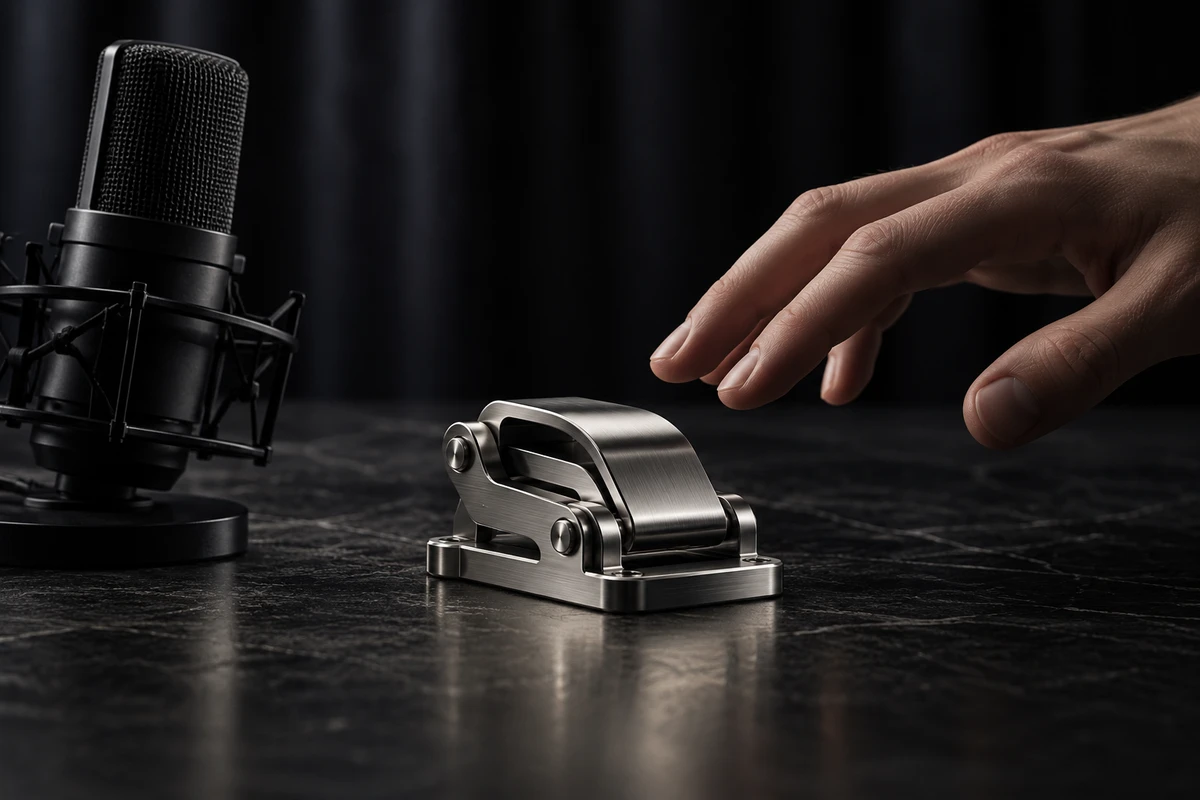
Imagine a product close-up. A finger pushes a metal latch; it closes, and the shell gives a subtle rebound. With music running continuously, the action may become one more beat in an established rhythm. If the score leaves half a second before contact while the room remains audible, the friction of the fingertip and the click of the latch move to the foreground. Precision is no longer a claim in the voice-over. It becomes something the audience can hear.
But if every sound drops to digital zero without preparation, viewers may first suspect a playback fault. Silence works only when the film knows what should speak in its place, why the change happens now, and how the soundtrack will return.
Continuous music makes it harder for a moment to truly change
Music is excellent at organising separate shots into one emotional direction. That strength can become a limitation. When the score maintains the same density, pace and energy across the entire film, the audience gradually treats it as a stable background. The image changes, but the relationship between sound and image does not. A supposedly important moment then has to compete through larger type, faster cutting or a louder effect.
A 2020 study using self-assessment, eye tracking and pupillometry found that a soundtrack provides an interpretive framework for visual scenes, influencing how viewers read actions, emotions, intentions and possible outcomes. The study does not prove that silence improves advertising conversion. It does show why music should not be treated as neutral decoration: it is continuously framing what the image means. Read the Frontiers in Psychology study.
Removing music, then, is not a shortcut to making a film feel premium. It is a way to stop explaining for a moment. A product action, a performer's hesitation, the distance of a room or one decisive line can finally arrive in its own sound.
Powerful silence usually contains sound
Editing systems commonly separate dialogue, music, sound effects and ambience into different classes. Adobe's current Essential Sound documentation uses exactly those categories, a useful reminder that “silence” can be shaped by removing one layer rather than deleting the whole world. See Adobe's official audio workflow.
For most brand films, the most dependable form is music withdrawal with the world left intact. Air-conditioning rumble, fabric movement, breath, footsteps, mechanical feedback and room reflections remain. The rhythm tightens, yet the audience still believes the person and product occupy a continuous physical space.
This is different from designing ambient sound for continuity. Ambience answers, “Does this world remain coherent?” Music withdrawal asks, “What must we hear in this second?”
A complete sound drop is a stronger and riskier device. It can signal subjective disorientation, a structural break, approaching danger or a sudden shift in understanding. Without preparation, however, it can resemble a technical fault. Used repeatedly, it quickly becomes a predictable editing gesture.
Silence needs an expectation before it can interrupt one
Music withdrawal carries weight because viewers have already heard the score and begun to expect it to continue. Laboratory studies of predictable sound omissions show that the absence of an expected sound can itself elicit a measurable response. Those studies examine controlled auditory prediction tasks, not brand outcomes, so they should not be turned into the claim that stopping music automatically makes an ad more effective.
The practical creative lesson is narrower: without an established expectation, there is no perceptible departure.
If a film has no score from its first frame, that is an overall style. If music establishes a pattern and then stops before a product reveal, the silence becomes an event. That event needs a legible entrance: a phrase resolving, low frequencies leaving first, room tone moving closer, or an on-screen gesture triggering the score's departure. Cutting a music track at an arbitrary edit point usually exposes the seam rather than strengthening the image.
Silence also needs an exit. The product's feedback sound can cue the score's return. A performer looking up, a door opening into a larger space or the arrival of the brand's final proposition can do the same. The returning music does not need to be louder. It might return as a reduced motif, enough to tell the audience that the interval has finished its work.
Decide what silence will move to the foreground
Before removing music, the director and editor should be able to finish one sentence: “This passage should make the audience hear…”
Product action: turn feedback into evidence
The resistance of a dial, the pull of a magnetic lid, a blade passing through material or a fan moving from high to low speed can make function perceptible. The goal is not simply to enlarge the effect. It is to make the beginning, contact and result of the action intelligible. Foley can repair weak production sound, but it must still match the material, camera distance and scale. A massive metallic impact under a lightweight button can destroy credibility even if it sounds impressive.
Performance: give hesitation and decision time to exist
A breath, a pause, a swallow or a sentence held back can disappear beneath a score. Music withdrawal can shift a performance from “being carried by emotion” to “making a decision now.” It cannot compensate for an empty performance. If the gaze, action and dramatic situation do not change, quietness alone does not create meaning.
Space: let the location explain its own scale
The reflections after a warehouse door opens, the distance in exhibition-hall footsteps or the sudden widening of outdoor wind can tell us how large, hard or exposed a location feels. A 2024 experiment on film scene transitions found that visual, action and sound cues work together in helping viewers identify settings. For brand-film craft, the useful inference is that removing music should not also remove the cues that locate the audience in space. Read the Frontiers in Communication study.
Silence belongs in the script, not only in the rescue edit
When the decision to remove music is made only after filming, the weaknesses are familiar: the key action has no usable sync sound, room noise jumps between angles, the performer did not hold the pause, and the editor can create only a stiff gap instead of designed silence.
A more robust sound script records three decisions beside the shot: the beat on which music leaves, the sound that takes focus, and the action that allows music to return. Production should capture isolated product actions and clean room tone for each principal location. Performance takes need enough genuine stillness for the edit to breathe.
During the first assembly, make a no-score pass. This is not necessarily a delivery version. It is a test of whether the images contain action, performance and spatial information of their own. Then restore the music and ask where it supplies essential structure, and where it exists only because the filmmakers are afraid of open space.
AI can generate video with audio, but it cannot make the brand's decision to leave space
As of October 2026, Google's current video-generation documentation describes video and audio being generated together from a text description. This can produce useful candidates for ambience, action sounds and a complete soundscape. See the official Gemini API documentation.
Yet generative capability naturally makes it easy to fill every describable moment. Silence depends on subtraction, contrast and temporal relationships. Even when a model produces synchronised footsteps, wind and machine sounds, someone still has to decide which layer should recede, when the score should leave, and whether the generated sound matches the product's material and camera distance. AI can produce audio material. It does not replace the brand's authorship of attention.
Judge silence by listening, not by looking at the waveform
An effective music withdrawal should make an action clearer, bring a performance closer or give a space sudden scale. It should also survive ordinary listening conditions: phone speakers, headphones and a meeting-room display. If the idea can be perceived only on studio monitors, it may be too fragile for the places where the film will actually be watched.
The final question is simple: after the music leaves, does the image gain new information and weight? If the sequence merely has one fewer audio layer, the silence has not done creative work. If an action, breath or room becomes the one fact the audience cannot ignore, the departure was worth designing.
If your next brand film needs visual storytelling, production sound, foley, music and platform versions to operate as one creative system, start with ONCE's video production solutions and bring the team the business objective as well as the desired feeling.