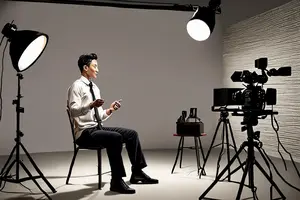
The easiest part of a product ad to overact is often the joke. The performer raises an eyebrow before anything unusual happens. The music announces that a punchline is coming. The edit rushes to an exaggerated reaction. Every department tries to help, and the audience ends up watching a group of people work very hard to be funny.
Serious acting does not mean turning a performer into a blank-faced mannequin. It means protecting a believable everyday world. When the character sincerely accepts the situation, the small deviation caused by the product becomes easier to see. The audience is not laughing because the actor tells a joke. They are laughing because a normal world has been nudged slightly off its axis by a product feature.
Research gives teams a useful reason to stay disciplined. Martin Eisend's meta-analysis of humor in advertising found that humor tends to improve attitudes toward the ad, attention and positive affect, but it does not automatically guarantee that the brand message will be remembered. Experiments by Madelijn Strick and colleagues found that humor can improve product liking through association. Neither finding means that every joke helps viewers understand a feature. The more useful creative question is what a viewer can still explain after the laughter fades.
The funny part is not the straight face
Imagine an ad for a quiet desktop fan. Everyone in an office continues working at a normal pace while one lightweight note slowly drifts across a boundary it should not cross. The performer does not shout or wink at the camera. He pauses his pen, watches the note move, then returns to work. The humor comes from a small conflict between the fan's effect and the rules of the office.
If the actor signals from the first second that the scene is absurd, viewers read the performance before they read the product. When the character keeps trying to preserve ordinary life, however, the product's effect becomes the one thing that needs explaining.
The benign violation theory offers a useful boundary. Something is more likely to feel funny when it breaks a rule while still feeling acceptable and safe. Bigger exaggeration is not automatically better. The deviation needs to be legible, and it should not impose real harm on the character. Otherwise, surprise can quickly become discomfort or contempt.
The performer is not doing less work
Deadpan performance is often mistaken for doing nothing. In fact, the performer has more to hold together. The work simply should not ask the audience to laugh directly.
Give the character a real task
The person should be trying to finish something specific: clear a desk, complete a report, prepare breakfast or pack a suitcase. Precise behavior makes the world credible. If the performer merely waits for the product to enter, the body reveals the advertising setup and the anomaly loses its reference point.
Do not judge the joke before the viewer does
Avoid previewing the punchline with a comic expression. After the event, a small breath, a delayed glance or a brief attempt to continue can leave more space than a wide-eyed reaction. The audience needs a fraction of time to compare what should normally happen with what just happened. If the actor supplies the conclusion too early, that comparison is over.
Make every reaction clarify cause and effect
Small is not always sophisticated. If the product's consequence is difficult to read, the performer can complete the causal chain through action: confirm the product state, notice the change, then adjust behavior. When one link is missing, the joke can feel like a random accident.
This differs from our earlier discussion of failed actions in product advertising. A failed action makes a functional difference visible. Comic performance controls how a person believes, absorbs and responds to a consequence that the product has already caused.
The product must be responsible for the joke
One risky approach is to write a complete sketch and bring the product into the final shot. Viewers may remember the character but have no reason to connect the scene with this particular product.
A tougher test is to replace the feature. Does the joke still work in exactly the same way? If it does, the product is sponsoring the sketch. If it does not, the feature has entered the comic structure.
The product can carry causality in three ways. It can start the anomaly, as noise-cancelling headphones make someone misread the surrounding activity. It can escalate the anomaly, as suction continuously rearranges the objects on a desk. Or it can resolve the anomaly, as one simple function suddenly contains a growing problem. In each case, viewers should see the feature inside the joke instead of waiting for an end card to explain it.
The product should also appear before the causal turn becomes confusing. Our earlier article about when to reveal a product focused on establishing recognition before the transformation. That matters even more in comedy. If viewers have not identified the product, the anomaly has no stable cause.
Restraint protects comic timing
Comic timing is not an empty gap that an editor shortens by instinct. Performance, composition, shot duration and sound establish it together.
Let the frame explain the normal relationship before the anomaly enters. Avoid cutting away just before the critical action. A reaction shot earns its place only when it adds information. If it merely repeats surprise that viewers have already seen, it dilutes the product action.
Sound does not need to mark every joke with a musical accent. Natural ambience can preserve the serious world while a product sound becomes evidence that something changed. Comic music introduced too early is the audio equivalent of a wink. Yet a scene with no sonic hierarchy can make a physical action feel weightless. The task of sound design is to clarify the moment of change, not label the scene as funny.
During production, it is useful to record three timings for the key action: one at realistic speed, one slightly more restrained, and one with a longer hold. The edit is not choosing the version that performs comedy most loudly. It is choosing the version that makes causality clearest without making viewers wait too long.
Cross-border humor should survive without the pun
Verbal humor travels poorly when it depends on shared references. Radhika Mamidi's study of humor in bilingual Amul advertisements shows how puns, altered proverbs and popular-culture parodies depend on both linguistic and contextual knowledge. Literal translation can preserve the information while removing the comic mechanism.
This does not mean that global ads must rely on silent slapstick. A more portable foundation is a visible relationship: who is seriously trying to do what, which rule the product changes, and how the person adjusts. Language can add a second layer, but it should not carry the entire cost of understanding.
Teams should also reconsider who becomes the target of the joke. Humor built around a consumer's incompetence, accent or lifestyle may feel familiar in one market and condescending in another. Letting the product create the surprise is often more transferable than asking a social group to absorb the humiliation.
Live action, CG and AIGC should carry different risks
Live action is strongest at capturing small physical judgments: when a gaze leaves the task, how a breath pauses, and how a person tries to behave as if nothing happened. These micro-decisions determine whether serious performance feels credible.
CG is useful when a product must cause a physical exaggeration that cannot be safely repeated on set: objects following a controlled trajectory or a material changing form at a precise moment. Its value is not to make the frame busier. It is to make the anomaly measurable and revisable while preserving the connection between character and product.
AIGC can explore environments, preview the strength of an anomaly or create non-critical background variations. It should not replace every performance decision or the final timing review. In a 2026 preprint, Po-Ming Law, Weizhi Li and Arpit Narechania asked six professional editors to evaluate 70 AI-generated cinematic ads. Their editing framework covers narrative progression, audiovisual coordination, composition, shot continuity, brand coherence and temporal rhythm. The editors also identified cases where polished individual shots failed to connect through movement, action or camera motion.
Those limitations matter acutely in comedy. A glance held a few frames too long, a hand that changes position between shots, or ambience that fails to bridge a cut can break the joke. A more practical hybrid workflow uses AIGC to widen the option space, live action to lock performance, CG to execute high-risk anomalies, and human editing and sound design to unify the timing.
The final test is what viewers can repeat
The goal of product ad humor is not to prove that a brand can tell jokes. It is to make the feature, the character and the brand's tone form a relationship that cannot easily be substituted.
During review, first mute or remove the captions and ask whether viewers can explain what the product changed from the action alone. Then remove the product and brand from the scene and ask whether the sketch still feels complete.
If the first answer is no, the causal chain is still unclear. If the second answer is yes, the product has not entered the joke deeply enough.
If you are developing a humorous campaign that must balance a product feature, nuanced performance and cross-market use, talk to ONCE. We can help align the concept, storyboard, live-action production and post-production so the joke happens because of the product, not beside it.