Corporate interview films often fail in a strangely polished way. Every answer is grammatically complete. Every “um,” pause, and restart has been removed. The pace is steady and the message is technically correct. Yet after fifteen seconds, the speaker sounds less like a person and more like a company script being played through a human face.
The problem is rarely a lack of expertise. The edit has removed the visible process of someone thinking and choosing their words. Authenticity does not mean preserving every verbal distraction, and it does not require refusing to edit. A stronger approach works on three layers at once: the core point, the trace of thought, and the visual evidence that carries the point into the real world.
First ask why this person must say it
Not every piece of corporate information needs a face. Founding dates, specifications, and service lists can often be delivered faster through narration, graphics, or captions. An interview earns its place when the viewer encounters a judgment that a table cannot replace: how this person understands a problem, why they made a trade-off, and which statement they are willing to own.
The first editing decision is therefore not “Which sentence is most complete?” It is “Which idea only works because this person says it?” An engineering lead might explain why the team would delay a release rather than skip a test. A founder might admit that the original direction was unclear until a customer problem changed the team's view. The value comes from position and reasoning, not perfect syntax.
If any executive could deliver the same line and the meaning would survive without the speaker, it may belong in voice-over. Save the interview for information that carries a human choice.
A complete sentence can remove the person
Conversation is not an article. People pause, replace a word, add a qualification, or restart a thought. Those changes are not all mistakes.
A 2026 study in Language and Speech found that pauses, repetitions, discourse markers, and self-repairs serve different functions in spontaneous speech. Some help speakers plan; some divide speech into manageable thought units; others add emphasis or correct meaning. A study in Applied Psycholinguistics also found that listeners' responses to pauses depend partly on whether they are attending to delivery or meaning. Neither finding means that more hesitation is automatically more authentic. They do show why an editor should not treat every irregularity as the same kind of waste. (Language and Speech study; Applied Psycholinguistics study)
In practice:
- Remove clusters of filler that add no meaning.
- Prefer a natural first answer over a mechanical repetition produced by asking for the line again.
- Consider keeping a short pause before a conclusion, a meaningful self-correction, or the moment a vague word becomes precise.
- Never remove a qualifier that changes responsibility, conditions, or causality just to improve pace.
One test is useful: after the cut, are we hearing a clearer version of the same person, or a smoother version of someone else? The first is editing. The second may already be rewriting.
Edit the answer in three layers
The core point
Start by extracting the smallest complete judgment from the transcript, not by cutting at punctuation. “We test before shipping” is information. “Even when the schedule tightens, we do not move this test into random sampling” contains a choice. The second line is worth hearing from a person.
The trace of thought
The trace of thought is not every “um.” It might be an inhale, a quick look toward the interviewer, a brief downward glance before the speaker returns, or the phrase “More precisely.” These moments show the idea taking shape. Remove all of them and the speaker can look as if they already know the next caption.
The visual handoff
When someone says, “We care more about stability,” do not automatically cut to a beautiful factory wide shot. Find the action that answers, “Where does stability become visible?” Show how an anomaly is logged, how a second person checks it, how a status changes on screen, or what must happen before a product moves forward.
This is where interview editing meets brand-film sound design. Voice and image should not take turns explaining the same sentence. The voice provides the judgment; action and production sound provide the consequence.
Looking into the lens or toward an interviewer
Eye line is not a simple measure of professionalism. It defines the relationship the speaker is building.
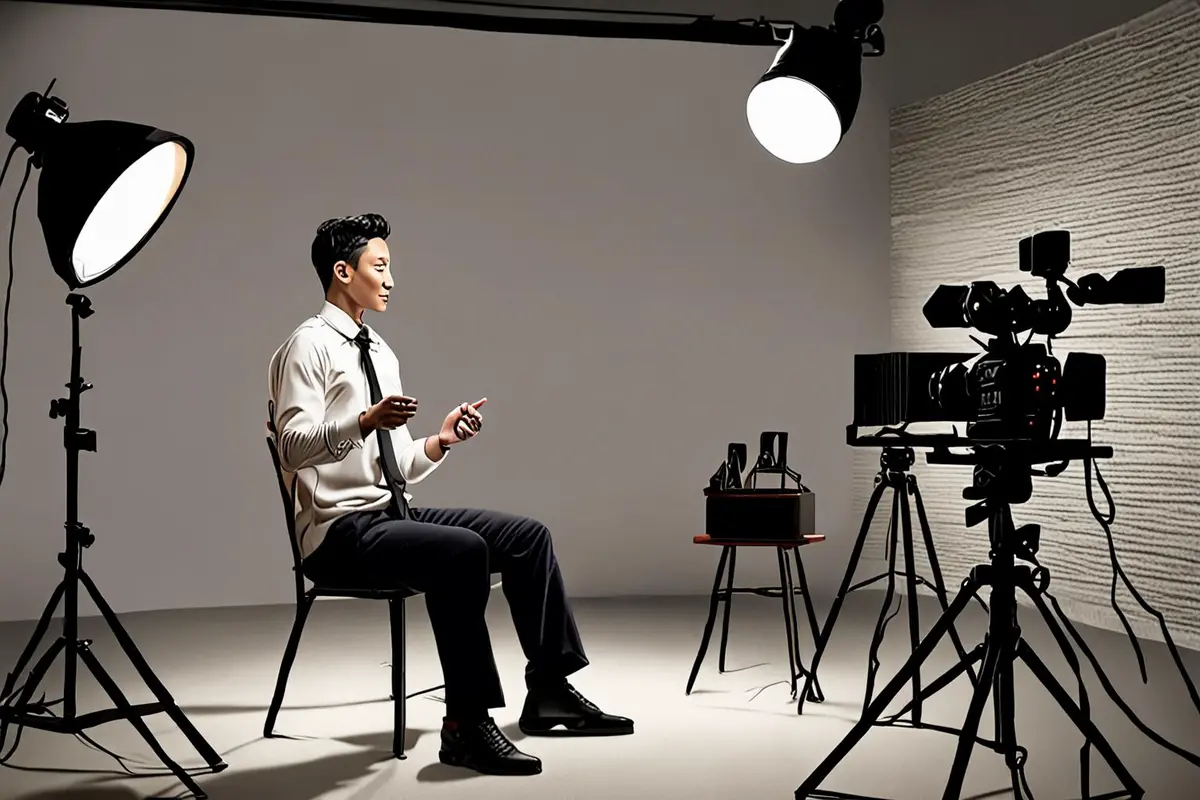
Direct-to-camera delivery feels like a public address or promise. It works for welcomes, invitations, and firm statements. It also increases performance pressure. When a subject is remembering lines, controlling expression, and maintaining eye contact with the lens at the same time, speech can become rigid.
Looking toward an interviewer feels more conversational. The speaker can respond to another person's attention, adjust pace, and explain a complex judgment without carrying the full burden of direct address. Princeton's documentary interview guidance recommends positioning the interviewer close to the lens and staying consistent, which protects both the relationship and edit continuity. (Princeton interview guide)
Neither choice is universally better. Decide the relationship before the shoot. If the main film uses an off-camera interviewer but a short social cut needs one direct line, record that line separately. Do not alternate eye-line relationships inside the same thought.
B-roll is evidence, not a cloth over the cut
Corporate films call supporting footage B-roll, but it should not exist merely to hide jump cuts. Strong supporting images do argumentative work: the speaker makes a claim, and the image shows who acts on it, what changes, and what result remains.
Plan actions around the interview topics instead of filming generic “people at work.” For collaboration, film how a document changes hands, where a disagreement appears, and who makes the next decision. For research and development, film a comparison, a record, or an adjustment after failure. Wide office shots, keyboards, and nodding meetings can establish place, but rarely prove a point by themselves.
Princeton recommends shooting for the edit, including relevant surroundings, subject details, and processes from multiple angles. PTC's public video-capture guide also calls for uninterrupted room tone after an interview. The first creates visual options; the second gives the editor sonic material for breaths and repairs. J-cuts and L-cuts can then carry a voice across real action without forcing every visual transition to interrupt the thought. (PTC video capture guide; Adobe guide to J-cuts and L-cuts)
Cross-sentence edits may organize speech, not manufacture a position
Most corporate interviews combine material from different answers. The ethical and editorial risk is not that a cut exists. It is that the cut changes the meaning.
Before combining phrases, check four things: Are they about the same subject? Do they refer to the same period? Has a condition disappeared? Has the strength of the conclusion increased? Turning “On this project, we tried…” into “We always…” produces a cleaner sentence and a different fact. Moving “We are still validating” behind a confident result can also make an immature capability sound established.
A bilingual version needs another check. Subtitles or English voice-over should not turn “may,” “under certain conditions,” or “we hope” into a firm promise for the sake of brevity. Lock the source-language claim units and timecodes first, then translate the meaning. If necessary, make the subtitle shorter and let the image carry more context; do not rewrite the responsibility the speaker is taking.
AI eye-contact correction, transcript-based editing, and Morph Cut can solve technical problems, but they cannot decide the human relationship. Adobe notes that Morph Cut works best with one subject, a fixed shot, and a relatively static background; greater movement or lighting change can produce artifacts. Microsoft likewise presents eye-contact correction as a processed video effect with practical visual limitations. A tool can conceal an edit. It cannot decide whether the resulting sentence still belongs to the speaker. (Adobe Morph Cut guidance; Microsoft Windows Studio Effects)
The most natural interview is not the least edited one
A corporate interview does not need to preserve every raw verbal habit, and it should not become so seamless that the speaker appears never to think. Mature editing removes noise while keeping the person. It clarifies the idea, preserves the breathing, eye line, and turns that make the idea human, then hands the statement to images of real work.
When viewers believe not only that “the company speaks well” but that “I can see how this person judges, and I can see where that judgment touches action,” the speaker and the brand finally become part of the same story.
If you are planning a corporate film, founder interview, or brand story, begin with three materials: the judgments the subject must own, the real actions that can carry those judgments, and the conditions the edit must never change. ONCE VISUAL can help shape those materials into a coherent interview, production, and post-production approach.