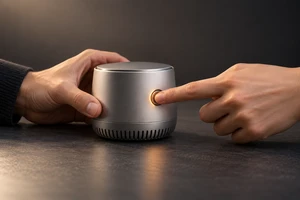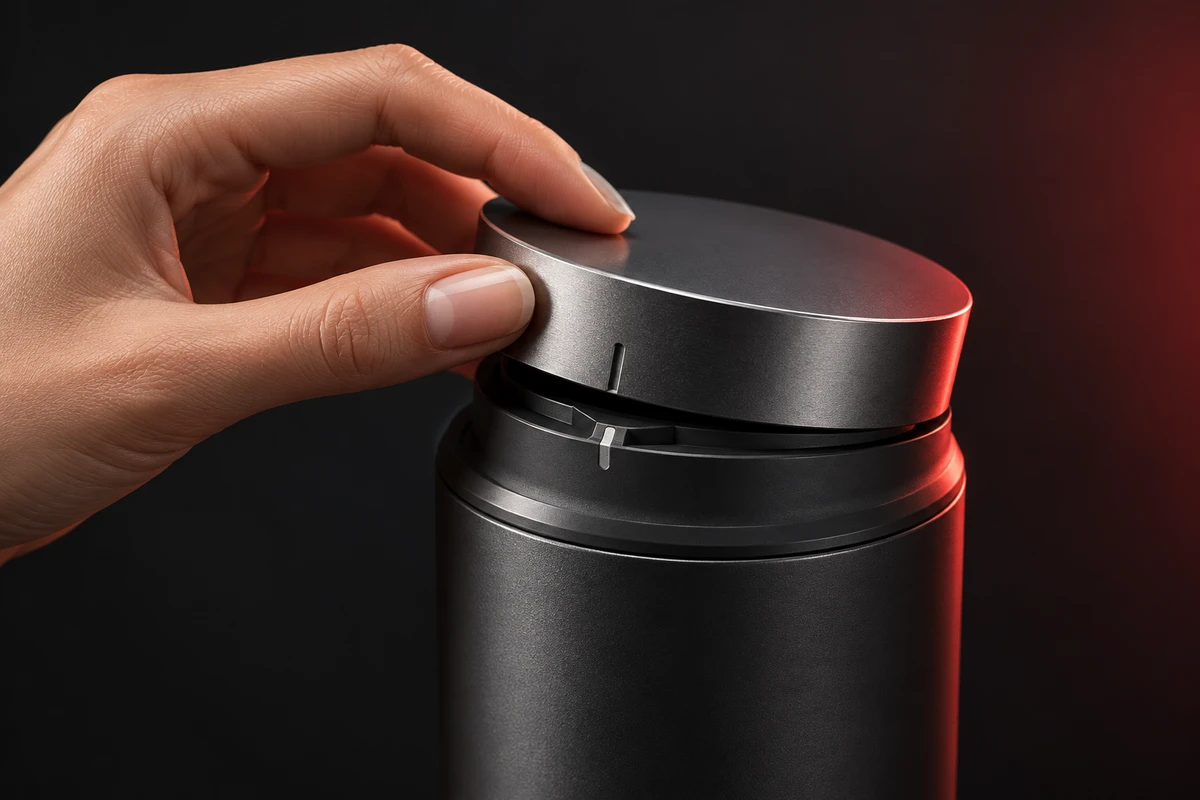
Imagine that a person fails to align a lid on the first try. The product does not open. They pause for half a second, notice the locating notch, rotate the lid, and hear a clean click. That small mistake does not necessarily weaken the product. When the cause, feedback, and correction are all visible, it can show viewers how the product works, how misuse is avoided, and what a completed action should feel like.
A failed attempt is also risky. Viewers may interpret the user's mistake as poor usability, a slight misalignment as a structural fault, or remember the awkwardness but forget the solution. The question is not whether advertising is allowed to be imperfect. It is who caused the failure, how serious the consequence is, what feedback the product provides, and whether recovery genuinely occurs.
Perfect demonstrations give answers, recovery gives reasons
Conventional product demonstrations prefer first-time success: the hand reaches in, lands on the control, opens the mechanism, and gets an immediate result. This is efficient for presenting the ideal path, but it often removes the questions a first-time user actually has. What happens if I miss the alignment? Does the product show its state? Can I recover without help?
A 2021 BMC Neuroscience study on observational motor learning asked participants to watch pinching actions. A mix of erroneous and correct actions led to better subsequent proximity to the target force than correct actions alone, while error-only observation performed worse than the correct model. This was a motor-learning experiment, not an advertising-effectiveness study, so it does not prove that ads with mistakes sell better. Its useful creative implication is narrower: an error supplies information only when viewers also have a clear correct reference and can see how the action returns to the goal. (BMC Neuroscience)
A failed shot therefore cannot end with failure. It must quickly return attention to the correct action and product feedback.
Decide who failed before deciding whether to film it
Not every unsuccessful attempt carries the same meaning.
A correctable expectation mismatch
The user follows a familiar habit, but the product requires a different direction. A slight resistance or signal prompts a correction. This can reveal a learning process, provided that the correct route is discoverable and the product offers readable directional, tactile, visual, or audible feedback.
A minor environmental obstacle
Wet hands, a dark surface, or a noisy room may obscure the first attempt. The user adjusts grip, angle, or attention and completes the action. Context can make a feature feel real, but it should not become scenery that excuses a product defect.
A product-caused failure
A jammed mechanism, dead control, dangerous overheating, or irreversible damage should not be reframed as a friendly learning curve. A 2016 study of product failures with 366 participants found the least favorable brand evaluations when the failure was attributed to the brand. Severe outcomes also reduced positive evaluation even when consumers were assigned responsibility. The scenarios do not represent every ad, but they show why responsibility and severity matter to brand interpretation. (University of Rhode Island DigitalCommons)
A practical test is to replace the performer with an ordinary first-time user. If the mistake remains plausible, the consequence is minor, and the recovery path is clear, it may be filmable. Otherwise, it is more likely a quality problem than creative material.
A credible failed attempt needs five connected beats
Intention
Viewers must know what the person is trying to achieve. Without intention, the error is random motion. The hand's destination, the performer's gaze, and the previous shot should establish the goal.
Deviation
The mistake needs a visible form: the direction is wrong, the force is insufficient, the order is reversed, or one step is missing. Do not ask an actor to frown while a caption explains the error. The product and action should show it.
Feedback
The product must respond to the deviation. A mechanism remains open, an indicator stays unchanged, resistance shifts, or an expected sound is absent. Specific feedback helps viewers understand that the product is communicating a state, not refusing at random.
Correction
The second action must change one clear variable: direction, alignment, force, or sequence. It is not a repetition of the same gesture. It shows that the performer has read the feedback.
Result
The successful state should contrast with the failed state. Closure, light, sound, bodily release, or the next product function should make the result verifiable. For a deeper look at how grasping, pressing, opening, and placing communicate function, see our guide to hand acting in product ads. This article focuses on what happens after the action deviates.
Performance should look like judgment, not punishment
Failed actions easily become comedy: exaggerated force, repeated retries, or anger at the product. Unless that tone belongs to the brand, bigger acting directs attention to the performer's embarrassment instead of the product feedback.
The stronger performance is often smaller. The motion stops. The eyes return to the contact point. The fingers release slightly, search for orientation, and complete the action. That moment of recognizing the deviation matters because it turns a mechanical change into human judgment. Without it, the successful take feels like an editor happened to find better footage.
Framing should serve the same judgment. A wide shot explains environment but may hide alignment. An extreme close-up shows fingertips but loses the reason for the retry. A medium close shot can preserve intention and reaction, followed by a product insert for deviation and feedback. If the product's first appearance is still undecided, our article on product reveal timing offers a separate narrative framework.
Editing cannot cheat for the product, and sound cannot succeed early
Failure and recovery need one basic order: cause before feedback, correction before result. If the hand is still misaligned in one take and the product is already open in the next, the edit has skipped the difficulty rather than shown recovery.
Adobe's official action-sequence tutorial recommends arranging shots so that one action leads to the next in a natural, believable way, using eyelines and continuity to prevent disorientation. In product advertising, continuity has a more specific responsibility: the same component, direction, and state must remain stable across shots. Irrelevant waiting can be compressed, but the frame that establishes product causality cannot. (Adobe Premiere)
Sound must also respect state. If a confirmation sound arrives during failure, the image says incomplete while the soundtrack says complete. Preserve contact or environmental sound during the deviation, then reserve the confirmation cue for the real closure, start, or unlock. A silent version needs visible feedback so that one click does not carry the entire explanation.
Give live action, CG, and AIGC different jobs
Live action is strongest for real contact, resistance, hesitation, and recovery. Whether a slight catch reads as product failure often depends on tiny timing relationships between finger pressure, component movement, and performer response. A shared physical set naturally holds those relationships together.
CG can explain mechanisms the camera cannot see. After a live-action correction, a cutaway may show why a latch closes only after alignment. It should not invent a safety feature the real product lacks or exaggerate feedback beyond the sample.
AIGC is useful for exploring error scenarios, framing, and performance rhythm, but it should not own the decisive hand-object correction by itself. CVPR 2025 methods such as ManiVideo explicitly model hand and object motion to improve manipulation consistency; that specialization is a reminder that interaction is not automatically solved by general video generation. Google Research's September 24, 2026 work on coherent long-form video generation likewise treats object state and cross-shot continuity as explicit tracking problems. If a button, open state, or operating hand drifts between generated shots, viewers can no longer diagnose the failure.
A safer hybrid uses live action to lock intention, deviation, contact, and the successful result; CG to explain invisible mechanics; and AIGC for environment extension or early concept exploration that does not alter product facts.
Test whether viewers assign the cause correctly
Show the cut to someone who has not read the script. Ask three questions without explaining the concept: Why did the first attempt fail? What feedback did the product provide? What changed on the second attempt? If the answers depend on captions, a director's explanation, or prior product knowledge, the causal chain is incomplete.
Watch it again without sound. If failure and success look identical, the visual feedback is too weak. Finally, remove the correction. If the failed shot still works while the product becomes irrelevant, the film may preserve only embarrassment. If removing the correction also removes the product proof, the recovery is carrying real value.
Product advertising does not need people who are always right, and it should not disguise faults as friendliness. The useful mistake is minor, legible, and genuinely recoverable. It lets viewers see not only that the product succeeds, but how the product helps a person return to success.
If you are developing a product film around real user friction, start a conversation with ONCE. Bring the sample, common misuses, and target context so we can decide which mistakes deserve a place in the frame.