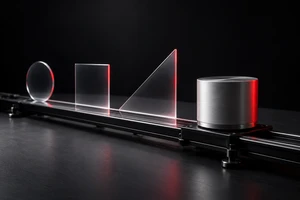
Place a product on a white surface, lower the camera, add a bass hit and slow down the landing. The image may look expensive while the product still feels hollow. The problem is not a shortage of effects. The viewer has not seen weight acting on the person, the object or the environment.
Weight in a product film is not a filter. It is a causal chain: how the hand prepares before contact, how the object accelerates when lifted, how the support surface responds when it lands, and how sound confirms the contact. When one link is missing, slow motion and bass can create mood, but not convincing mass.
Weight appears before the product moves
Viewers do not wait for a product to leave the table before judging its weight. Approach speed, finger spread, wrist angle, body balance and grip position all reveal the resistance the performer expects.
A 2020 study on reaching and grasping found that object weight and visual material properties altered movement planning and the adjustment period before contact. Heavier cups were transported more slowly, while grip position shifted toward the expected centre of mass. The experiment was not an advertising shoot, but it offers a useful production insight: weight changes the structure of an action, not just the performer's facial expression. (Frontiers in Psychology)
When filming someone lifting a tool, speaker or metal device, asking them to “look strained” is rarely enough. Break the performance into visible preparation: the hand finds support, the forearm builds tension, the shoulder joins before the object moves, and the first centimetre off the surface is the slowest. The performer does not need an exaggerated grimace. Continuity before and after force is what makes the weight believable.
If the real product is light but the brand wants a more substantial presence, that does not justify pretending it is a safe. Reduce casual one-handed tossing, stabilise the grip and avoid weightless changes of direction. The film is expressing composure, not falsifying a specification.
Motion must show who is applying force
Slow motion is often used to suggest mass, but slow does not automatically mean heavy. A feather can move slowly. Weight comes from resistance to force and from what happens after that force stops.
Research on rotational inertia found that when a virtual object appeared to rotate faster than the physical object being wielded, participants judged it as systematically lighter. Both visual and haptic changes affected perceived heaviness. (Psychonomic Bulletin and Review via PubMed) A 2023 screen-based experiment likewise found that slower lifting made an object feel heavier, while an object that remained suspended after release was judged lighter than one that fell. The authors also found that merely increasing fall speed beyond zero did not keep increasing perceived heaviness. (Frontiers in Psychology)
These studies do not provide a universal shot recipe. They do support a practical principle: viewers infer weight from acceleration, resistance and subsequent motion.
Starting
A substantial object should not reach full speed at the instant of contact. A short accumulation of force before displacement usually feels more credible than uniform motion. If a robot arm or rig moves the product, its pull direction should make physical sense too.
Carrying
During transport, mass is conveyed by stability and restraint, not by slowing every axis. A substantial product can move steadily through frame, but frequent snap stops, sharp turns or camera-matched floating will make it feel like a weightless model. Rotation is particularly revealing: excessive angular speed and inertia-free starts expose CG and compositing quickly.
Stopping
The end of the action is often neglected. Real mass transfers energy elsewhere: the wrist absorbs it, a tabletop vibrates, a pad compresses, packaging deforms or nearby small objects shift. Stopping is not simply setting velocity to zero. It is letting the environment receive the force.
The support surface is the second performer
If a product lands in a world that never responds, viewers can only guess its weight from prior expectations. A specific support surface makes mass easier to read.
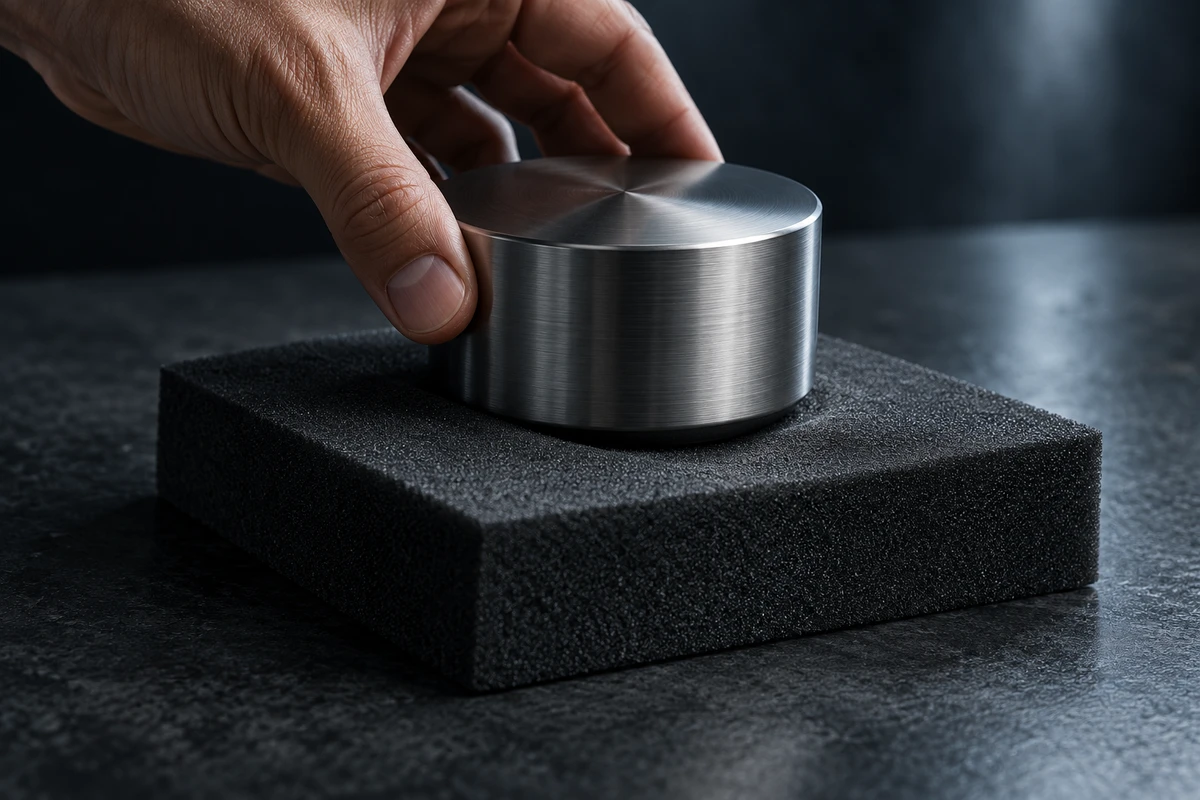
A hard tabletop can confirm impact through a brief vibration, a reflection change or a nearby object's movement. Fabric, foam and leather communicate force through indentation, rebound and folds. In a packaging shot, the depth at which a product presses into an insert, and where the hand supports it from below, can be more persuasive than a dramatic dust effect.
Environmental response must still remain plausible. If a compact speaker lands and sends waves through the entire table, the shot may become more spectacular while the real product turns into a fantasy prop. Before production, ask what this object would actually change, by how much, and whether that change can be made visible within a few frames.
This is also a useful line between live action and CG. Real contact, soft-material compression and small vibrations are often worth capturing in camera. Cutaways, internal structures and extreme motion may be better built in CG. Either way, contact point, force direction and response timing need to belong to the same physical event.
Louder does not necessarily mean heavier
Weight is often reduced to “add more low end.” A 2018 experiment found that objects paired with higher-pitched sounds were perceived as lighter and those paired with lower-pitched sounds as heavier, while loudness did not produce the same difference. (Perception via PubMed) This does not mean every heavy product needs a cinematic boom. It means pitch, timbre and temporal structure deserve more attention than volume alone.
Sound should answer three questions: on which frame did contact occur, what materials touched, and how did the energy decay? A metal housing landing on wood and a fabric product settling into foam cannot share the same “premium impact” preset. If sound arrives early, it feels triggered rather than caused. If the tail is too long, it exaggerates both object size and room size.
Start with the production sound, then layer a low-frequency body, material detail and a room tail only where needed. Review the picture silently to see whether the action already works. Then listen without picture to judge the implied material. Finally, combine them and check whether they confirm each other.
What live action, CG and AIGC each tend to lose
Live action captures genuine contact well, but a lightweight prototype can make the performer’s effort contradict the final product specification. The answer is not unlimited sound design. Rehearse with appropriate ballast, establish the grip and record complete starts and stops.
CG offers precise control over mass, centre of gravity, friction and collision. Yet default simulation is not the same as a credible final image. Camera movement, time remapping and art direction can undo the inertia. Keep a live reference showing how an object of comparable size is lifted, rotated and placed, including the response of hands, surfaces and sound.
AIGC can quickly produce the atmosphere of weight while losing causal continuity: fingers slide across a contact point, the grip changes behind an occlusion, deformation jumps between frames, or impact sound misses the collision. Do not review only attractive still frames. Track the force through the entire shot: where it begins, what it passes through and where it ends.
Review every shot as a causal chain
Write each weight-critical shot as one sentence: who applies force, how the product responds, what receives the energy, and how sound confirms it. For example: “The palm secures the base, the product leaves the foam slowly, the insert rebounds, and a short, low friction sound completes the action.” This directs performance, camera, art, CG and sound more effectively than “make it heavier and more premium.”
Not every product should feel cumbersome. A thin device may need precision and stability; a tool may need resistance and control; furniture may need support and spatial occupation. The team does not need one bass preset. It needs agreement about the physical rules the product follows in this brand world.
For more production thinking, explore ONCE's video production insights. If you are planning a film that combines product action, materials, CG and sound, bring the sample, its real weight and the intended brand feeling into the first creative discussion. ONCE can start with brand film and product advertising production and turn “substantial” into shots that can be filmed, heard and reviewed.