One of the quickest ways to call a take unusable in a product commercial is to let a character say no. They frown, push the product back, or fail to accept it the moment someone offers it. The worry arrives immediately: does this make the brand look unconvincing?
What usually weakens the brand is not refusal. It is the absence of choice. When everyone smiles at a product on sight, the ad moves smoothly but avoids the useful question: what friction does this product actually resolve, and for whom? A specific, temporary refusal that the product can answer through action can make that question visible.
A useful no rejects a condition, not the brand
Hesitation, failure, and refusal may look similar on screen, but they perform different dramatic jobs. Hesitation means the character lacks enough information. Failure means the character has acted but the desired result did not occur. Refusal means the character understands the offered choice and does not accept it under the current conditions.
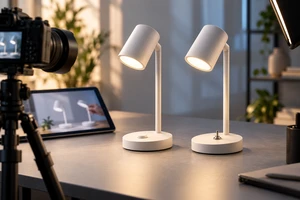
Imagine a fictional desk-lamp commercial. One person refuses to switch on the main light because their partner is asleep. They are not opposed to illumination, and they do not need a voice-over promising more brightness. They reject a way of using light that would disturb someone else. If the product then creates a controlled local pool of light, the product has answered the refusal. The causal chain is legible: a concern appears, the product changes the condition, and the character makes a new decision.
This is different from a campaign in which a brand asks people to buy less. That is a statement about the brand's stance toward consumption. Here, the question is whether a character inside an ordinary scene is allowed to judge fit. A product does not need to suit everyone, and a commercial does not need to erase every no.
Do not invent an objection that exists only to collapse
The cheapest version of refusal has a character say, "I do not need this," only to be persuaded one second later by a benefit they already knew. Nothing new has been proved. The character has simply been made slow so the product can look clever.
A filmable refusal needs to be specific enough to affect behavior: an object feels too heavy, so it never enters the bag; the sound may disturb another person, so a hand stops before the switch; the operation requires two free hands, so a parent holding a child does not accept it. Once the reason becomes physical, copy alone cannot answer it.
A screenwriter can test the scene by replacing the product with any close substitute. If the solution works exactly the same way, the refusal has not reached a distinctive product value. If the choice changes only because of a visible, verifiable feature of this product, the story belongs to it.
For a related look at gaze, weight, and physical contact in performance, see Should Talent Look at the Product or the Camera?. Refusal is not an extra facial expression. It is a body interrupting its original course of action.
Let the product answer before the character changes
Commercials often cut away from refusal because a few quiet frames appear to waste time. The part to compress is not the decision. It is the explanation.
A product response can happen in three beats: the character stops an action; the product enters a visibly different state; the character continues or leaves because of the result. A lamp narrows its light, a storage object closes fully inside a tight drawer, or a control remains usable while the user's other hand is occupied. These are hypothetical examples, but they share one rule: the change must occur in the image rather than be announced by narration.
Direction should also be expressed as an objective, not a mood. "Do not wake the person next to you" is playable. "Dislike it, then be amazed" is an instruction to manufacture two expressions. ScreenSkills describes the director's role as drawing out performance while coordinating the technical work required to film the scene. In a product commercial, that means the actor's objective and the product proof have to be rehearsed together.
Do not let the camera answer for the brand
If the music rises as soon as the refusal appears, the light snaps into a heroic rim, and the camera rushes toward the product, the audience receives the approved answer before the character does. Choice becomes a test whose correct response has already been highlighted.
A stronger scene leaves the refusal inside the relationship for a moment. Complete the stopped action. Show how another person or the environment responds. Let the product change enter after that. A close-up should clarify causality, not turn every transition into a launch reveal.
Sound needs the same restraint. Real operation sound, cloth movement, and a short breath can preserve the situation better than a generic "question" cue. Editing can increase information density, but it should not turn a decision into an automatic reaction. The point of stepping back is not to create mystery. It is to leave room for a choice.
Allow three endings, not one shared smile
Refusal does not have to end with persuasion.
In the first ending, the condition changes and the character accepts the product. In the second, the product moves to someone for whom it is a better fit, while the original refusal remains valid. In the third, the character still says no and the ad clarifies the product's range of use. The third is the hardest, but it can also be the most honest. A professional tool need not be ideal for a first-time user. A highly isolating experience may not suit a situation that requires constant awareness of the surroundings.
This is not an instruction to magnify defects. Research on two-sided messages suggests that acknowledging an opposing consideration can, under particular topics and audience conditions, increase openness. It does not prove that naming a limitation always improves sales. The useful question remains narrower: does this refusal help the intended viewer understand the choice, preserve product truth, and treat a poor-fit user as a person rather than a joke?
AIGC can transfer performance, but not choose for the character
Generative performance tools can transfer facial movement, speech, and some gestures from a driving performance to another character. Runway's current Act-Two guidance also notes that input type changes the available gesture control, while greater facial expressiveness can introduce visual artifacts. The tool can transfer motion. It does not know why a character is refusing.
If the decision depends on exact hand-to-product contact, two people's reaction order, or a very small pause, it is safer to establish the performance rhythm with real rehearsal. AIGC can extend the environment, handle a non-critical transition, or stylize a character. In the decisive shot, drifting eye lines, incorrect contact, or an expression that arrives too early will turn a person who is choosing into a figure waiting for the animation to finish.
Final review: remove the smile and see whether the choice survives
During review, mute the voice-over and music. Then cover the final smile. From action alone, can a viewer answer three questions: why did the character refuse, what did the product change, and why did the character choose again or continue to leave?
If subtitles have to supply every answer, the refusal never entered the image. If the product changed no condition, the turn is only advertising copy. If everyone must agree in the final frame, the characters are still amplifiers for benefits rather than people with goals.
A good product commercial is not afraid of one no. It is afraid that the product has not answered, while the character has been told to nod anyway.
If you are developing a product commercial with on-screen characters, send ONCE the product, the real use friction, the intended audience, and the action that must read clearly. We can begin with script causality, performance, and shot design to decide which refusal deserves to remain and which product response must be visible.