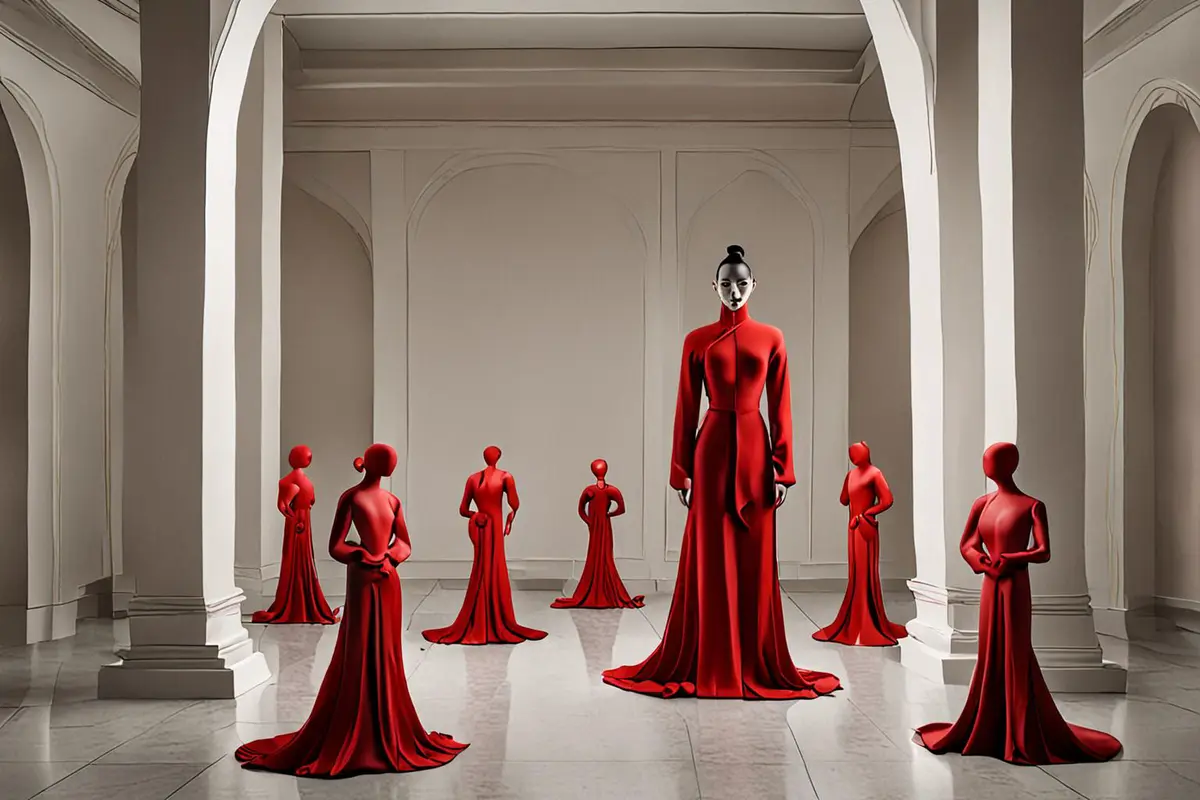
Some brand films return to the same action, composition, or sound twice. The first appearance may seem to establish an ordinary routine. The second can suddenly reveal a relationship, a product reason, or the film's point of view. Effective repetition is not replay. It gives the audience a rule, then uses the return to test or rewrite that rule.
This is especially useful in short films because it can increase the meaning of existing material without adding more characters or locations. The difficulty follows from the same economy. If the second shot is too similar, it feels redundant. If too much changes, the two moments are no longer comparable.
The first appearance establishes a rule for comparison
The first shot should make one thing memorable enough to compare later: an action path, a compositional relationship, a sound cue, or a way of using the product.
Imagine a character arriving home each day and placing keys in a tray by the door. The camera, lighting, and order of actions remain stable. The scene does not need a dramatic peak. Its job is to establish a routine. When the film returns to the same position, the audience will search for a difference. Why is there no sound of keys? Why is the tray empty? Why does the character stop outside?
This is why the first appearance cannot carry every possible variation. If camera movement, performance, props, and sound all compete for attention, viewers do not know what the second shot asks them to compare. Clarity in the first appearance gives the return its force.
The second appearance keeps the skeleton and changes one decisive variable
A useful writing model is A and A-prime. The two images share a recognizable skeleton, while the second changes one or two variables that alter the interpretation.
The camera and action can remain constant while the result changes. The composition can remain constant while a relationship changes. The image can repeat under different sound, or a stable rhythm can break on its final action. The return feels meaningful not because it is more elaborate, but because the audience can place new information inside a structure they already understand.
Film history offers many versions of this device. The British Film Institute's discussion of Alfred Hitchcock's The Wrong Man describes how the ending repeats a sequence from the opening about duty. By then, the character's situation and relationships have changed, so the same form acquires another meaning. The ending does not merely copy the beginning; it makes a familiar pattern carry a different context.
Advertising research gives the mechanism a more direct name. In a 2011 study, Jeffrey Loewenstein, Rajagopal Raghunathan, and Chip Heath examined what they called a repetition-break plot structure: a stable pattern is repeated and then broken at a consequential moment. Across their advertising corpus and experiments, this structure produced greater engagement and more favorable brand attitudes and purchase intentions under the study conditions. It is not a universal formula, but it clarifies the mechanism: prediction must come before meaningful surprise.
Three repetition structures solve different creative problems
Exact return shifts the emotion
The image and action remain almost unchanged, while sound, context, or what the viewer knows has changed. This can express a relationship shift, elapsed time, or a reversal in understanding. The return needs enough distance from the first appearance for intervening events to change its interpretation.
Altered return brings product value into lived use
The action retains the same goal while the conditions change. The first attempt might happen in an ideal environment; the second happens in low light, with occupied hands, or under time pressure. The purpose is not to inflate a feature claim, but to turn an abstract benefit into a visible difference between comparable uses.
If the return involves performance or an outcome, the conditions and action chain still matter. Editing cannot manufacture causality. ONCE's discussion of action timing and real product time offers a related way to decide which steps can be compressed and which must remain visible.
Repetition followed by a break makes the turn visible
Two or three iterations establish a stable rhythm, and the final iteration changes the ending. This works for humor, suspense, and product intervention, but the break must connect to a brand reason. If a character repeatedly fails and then suddenly succeeds without a new product action or changed condition, the audience may remember the joke rather than the brand.
Repetition starts in the script, not as an editing ornament
The structure should be defined before storyboarding, rather than discovered by accident in the edit. For every paired moment, the team can record five things: the skeleton that stays constant, the variable that changes, what the audience learns the first time, what the return adds, and why the brand or product belongs inside that change.
The production must preserve enough consistency to make comparison possible. Matching a camera position involves more than placing the tripod in roughly the same area. Focal length, camera height, blocking, prop placement, and light direction all contribute. If sound carries the change, production should also record stable room tone and decisive action sounds instead of relying entirely on music added later.
Performance should resist over-signaling the difference. A longer pause, a shifted eyeline, or an unfinished action may be enough. Because the audience remembers the first occurrence, a small deviation can become large.
Short-form versions preserve the comparison, not necessarily every frame
Two scenes separated by twenty seconds in a hero film may not survive intact in a fifteen-second cut. Simply keeping the more dramatic second appearance removes the reference point. A better cut compresses the first moment into one memorable skeleton, then lets the return call back to it quickly.
Vertical adaptation also requires a fresh comparison test. A relationship established through left and right positions in a wide frame may disappear when cropped. Foreground and background depth, a hand action, or a sound cue can replace it as the repeating signal. ONCE's article on the conditions for effective short-form video provides further context on comprehension load and cutting pace.
When AIGC or CG contributes to the film, the repetition structure raises the continuity requirement. If two images must be recognized as versions of the same pattern, product proportions, key materials, wardrobe, and spatial relationships cannot drift between generations. Creative variation should be concentrated in the defined variable rather than allowing the entire image to regenerate unpredictably.
The practical test is whether viewers can say what changed and why it matters
In an internal review, do not begin by asking whether the second shot is beautiful enough. Ask someone who has not read the script three questions: What stayed constant? Which change did you notice first? What does that change have to do with the brand or product?
If the answers diverge, the audience is not necessarily inattentive. The comparison rule may be unclear. The first occurrence may contain too much information, the return may change too many variables, or the brand may only be attached at the end. The useful response is to simplify the structure, not to add more explanatory captions.
Repetition in a brand film is a visual agreement with the audience. The first appearance teaches them how to look; the second rewards them for noticing the change. When that change advances character, product reason, and brand point of view together, one shot earns a second life.
If you are developing a brand film and want to test whether a repeated action, visual motif, or sound cue can support the story, share the audience, product reason, current script, and principal delivery formats with ONCE. We can examine the relationship across script, storyboard, production continuity, and multi-format editing.
References
- Jeffrey Loewenstein, Rajagopal Raghunathan, and Chip Heath. "The Repetition-Break Plot Structure Makes Effective Television Advertisements." Journal of Marketing, 2011.
- British Film Institute. "Hitchcock at Work: The Wrong Man." Updated 2024.