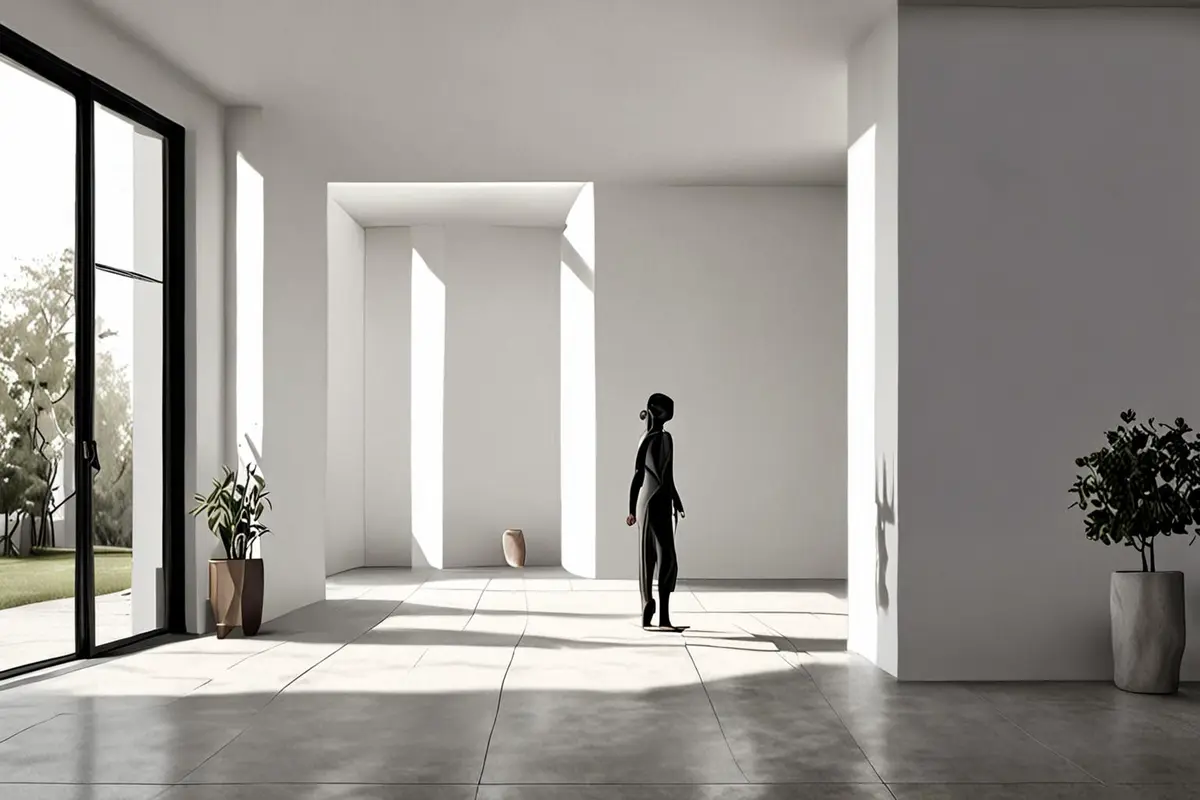
A character opens a door and enters a room. The product has not appeared, yet the audience already understands that the story has entered a new phase. In another film, a character keeps watching a product through glass. Both occupy the same frame, but they seem separated by a life that has not yet been reached. Elsewhere, two people simply walk along a corridor: the direction stays constant while their relationship quietly moves closer or farther apart.
Doors, windows, and passages are not blank spaces for production design to decorate. They divide space into here and there, and they naturally carry actions such as entering, leaving, glimpsing, waiting, being blocked, and arriving. In a brand film, their value is not that they make an image look more cinematic. Their value is that one visible movement can replace a paragraph of explanation that would be harder to write, perform, and remember.
A threshold is a verb before it is a prop
The same door can be resistance when closed, permission when opened, hesitation when left ajar, and departure when a character leaves it behind. Its meaning does not live in the shape alone. Meaning comes from what it allows someone to do.
That is why placing a beautiful arch in a set does not automatically create narrative. If the character never sees it, approaches it, or crosses it, and if the audience gains no new information because of it, the arch remains decorative geometry. Spatial storytelling needs at least one real change: a character learns something, the distance between person and product shifts, someone enters a different role, or the audience finally sees a world that had been withheld.
In a British Film Institute interview with director Moufida Tlatli, the discussion notes how what cannot be spoken may find expression through mise-en-scene, framing, and camera movement. That idea is especially useful in brand filmmaking. When a script is explaining a move from chaos to calm, or from unfamiliarity to confidence, space may already be able to make that change shorter and more concrete.
Doors, windows, and passages do not share one grammar
All three can divide an image, but each answers a different question. Deciding which relationship the story needs is often more important than choosing a location first.
Doors put a choice on a line
A door is ideal for asking whether someone will enter. It has a clear before and after, and it gives a character a place to pause. Opening a door can connect a problem to a solution. Turning back to close it can end an old state. An automatic door can turn a product capability into welcome, recognition, or frictionless access.
The danger is familiarity. A person walking from darkness through a bright doorway does not automatically signify rebirth, and a grand lobby does not automatically communicate premium value. Credibility comes from the specific difference between the two sides. Does the light change? Does the sound change? Does movement become easier? Can the character do something that was impossible before crossing?
Windows preserve distance between seeing and reaching
A window is useful when a character can see but cannot yet enter. It can let a person study a product, bring the outside world into an interior, or layer present reality with a reflected desire. Unlike a door, a window usually does not offer full passage, so it suits curiosity, waiting, comparison, and imagination.
If the brand promise is immediate use, watching a product through glass may make it feel too remote. If the story concerns anticipation, design inspiration, or a relationship with the city, that psychological distance can be valuable. Reflections also need discipline. They are not cinematic simply because there are more of them; they earn their place when they add a second readable layer of information.
Passages turn relationships into duration
Corridors, stairs, narrow lanes, conveyor lines, and aisles between shelves are all passages. They do not emphasize one opening or closing action. They emphasize what must happen on the way from A to B. Two people walking side by side, one behind the other, or in opposite directions immediately create different relationships. A product handed across several workstations can turn collaboration into a continuous route.
Passages are particularly useful in corporate and manufacturing films because they make an abstract process visible as direction, distance, and relay. But a character wandering through a corridor beneath grand voice-over is not automatically meaningful. Each step should change position, permission, or understanding.
A crossing needs a real before and after
To test whether a doorway shot is doing useful work, temporarily remove the music, performance detail, and set dressing. Compare the action before the crossing with the action after it. If both sides contain the same behavior, the doorway may be only a transition. If ability, attention, or relationship changes, it is carrying story.
A smart-home film, for example, does not have to begin with a product close-up. A person moves from a noisy hallway into the home. The door closes, exterior noise recedes, and the environment responds within the same action. The point is not that the home has a door. The door completes a scene change, a sound change, and the first demonstration of product capability.
For an outdoor speaker, the same threshold might communicate expansion instead. The sound and rhythm remain consistent as the product moves from indoors to outside. In both cases, the spatial change must correspond to real product value. Production design cannot invent a capability on the product's behalf.
Camera position decides which side belongs to the audience
When a character crosses a threshold, the camera has three basic relationships to the action.
First, it can wait on the far side. The audience knows the new space before the character does, so entry feels like acceptance into an existing world. This suits welcome, arrival, and reveal, though it reduces uncertainty.
Second, the camera can follow the character through. The audience discovers information at the same moment, which strengthens identification and works well for first-use experiences, product onboarding, and service journeys. Smooth stabilizer movement is not enough, however. The first look after crossing needs a clear object of attention.
Third, the camera can stay behind and watch the character leave the frame. The character receives the new space while the audience remains in the old one. This naturally carries departure, independence, or suspense. Brand films use this restrained option less often, but it can be more resonant when the change has already happened and the film no longer needs to keep explaining the product.
The camera can also remain still while depth changes: a person inside a doorway moves from blur to focus, or a product outside a window shifts from reflection to physical object. Unlike our recent article on symmetry in product advertising, the concern here is not whether an image is centered. It is which side of the threshold the audience occupies and when information becomes available.
A small studio does not need to impersonate a large building
Spatial storytelling does not require a complete room. For a short film, one wall with an opening, two layers of framing at different distances, and separately controlled foreground and background light may be enough.
A useful compact set resolves three questions first: Is the threshold instantly legible? Do the two sides support different actions? Can the camera photograph the opening from both directions and create different relationships? Surface finish, hardware, and trim can be refined later. If the movement path does not work, detailed art direction will not rescue it.
Light can separate two times or moods without relying on a simple dark-to-bright contrast. Warm and cool light, hard and soft sources, or moving and static illumination can all create difference. Sound matters just as much. Footsteps can move from reverberant to intimate, exterior low frequencies can disappear when a door closes, and machinery can become distinct on entering a workspace. These shifts let the body feel that space has changed.
ACMI's discussion of German Expressionism shows how sets, shadows, and distorted spaces can actively shape emotion instead of merely housing characters. A commercial film does not need to imitate Expressionist design, but it can use the same principle: space should participate in a character's situation rather than provide an expensive background.
Products can cross thresholds too, without becoming characters
How a product enters a space changes the audience's first judgment. It can slide out from behind a partition and feel discovered, enter a light zone on a conveyor and feel completed, or move from a pocket to a tabletop and shift from private habit to shared action. One movement can establish scale, user, and context.
The product does not need a full hero's journey. For a precise product with a clear function, excessive spatial metaphor can slow comprehension. A threshold should serve one specific transition: stored to active, private to shared, material to finished object, or indoor to outdoor. If the transition cannot be named, direct demonstration is probably stronger.
AI and CG can extend the world beyond a doorway, change the season outside a window, or connect spaces that cannot be built continuously. The geometry of the crossing still needs to hold: footsteps, hand position on the handle, product contact with a surface, and light direction must remain coherent. The stranger the world becomes, the more credible its physical anchor at the threshold needs to be. Otherwise viewers notice the generation error before they notice the brand world.
A vertical cut cannot simply crop away the frame
In a horizontal composition, a complete doorway clearly establishes inside and outside. When the sides are cropped for 9:16, the person may simply walk in from offscreen and the spatial relationship disappears. Preproduction therefore needs to identify which threshold cues must survive inside the vertical safe area: a handle, one side of the frame, a floor-material change, or a line of light between the two spaces.
If horizontal and vertical versions both matter, design two camera positions for the same action instead of expecting one wide master to solve every ratio. The horizontal version can describe architecture. The vertical version can preserve the crossing through a closer hand action, a sound change, and the character's eyeline. Adaptation is not shrinking the space. It is selecting a different set of readable cues.
Rehearse the threshold without dialogue
Before the full shoot, record one phone video with no dialogue, music, or effects. Show where the character comes from, why they stop, when they cross, and what they do first on the other side. Give it to someone who has not read the script and ask only two questions: What changed, and why did the character need to pass through this place?
If the answer is only that the location changed, the threshold is not yet carrying story. Change the direction of travel, the pause, the camera's side, or the first action after crossing before adding voice-over. Once the spatial relationship is readable, copy can contribute information unique to the brand instead of rescuing the image.
Space in a brand film is not a display of production value. It is an arrangement of action. Doors carry choice, windows carry distance, and passages carry process. Each can turn an abstract promise into one concrete movement.
If your brand story involves entering a new routine, expanding into another context, connecting different people, or revealing a real process, ONCE can begin with the core action and the locations you already have. Explore our video production insights, then bring us the transition that is hardest to express. We can decide what the location, set build, CG extension, and vertical adaptation each need to contribute.
Sources and scope
- Australian Centre for the Moving Image, Out of Darkness: The Influence of German Expressionism, 2021.
- British Film Institute, Keeping a Distance: Chantal Akerman's Jeanne Dielman, 2021.
- British Film Institute, Moufida Tlatli on The Silences of the Palace, 2021.
- Academy of Motion Picture Arts and Sciences, Architecture, Space and Design program description, 2019.
- Academy of Motion Picture Arts and Sciences, Academy Gold Education Video Guide.
These sources support the discussion of mise-en-scene, framing, camera movement, and production design as narrative tools. They are not fixed advertising formulas. Product truth, location constraints, duration, audience, and platform format should determine the final spatial language.