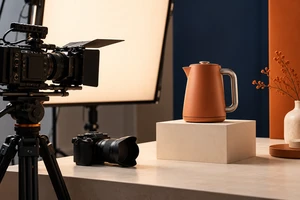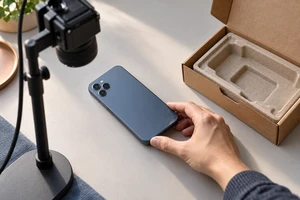
One recurring argument in product-ad storyboards is not whether the product appears, but whether it must appear in full, centered and front-facing from the first second. That approach is clear. It can also remove the act of discovery: the audience understands everything at once, while every later move, turn and reveal becomes decoration.
Occlusion is useful when it controls the order of attention. A viewer may first recognize a contour, a point of contact or a material cue, then meet the complete product. The image shifts from displaying an object to discovering one. But the concealment must pay off. If viewers can only guess, or if the hidden area contains the evidence that makes a feature credible, suspense quickly becomes missing information.
The goal is not to hide more, but to leave a shape viewers can continue
A 2020 Journal of Marketing paper, Leaving Something for the Imagination, examined visual concealment across six experiments. The authors found that partially hiding aesthetic products can arouse curiosity and transfer the resulting positive affect to product evaluations. The boundary matters: the effect works when viewers' initial inferences about the fully revealed product are already positive and emotionally congruent with that curiosity.
The research concerns aesthetic evaluations in specific experimental settings. It does not mean every product video should hide a fixed percentage of its subject. The more useful production principle is this: before concealing the product, give viewers a reliable recognition anchor. That anchor could be the shoulder of a bottle, the arc of a headphone band, the proportion of a lens ring or a familiar brand color block. It does not replace a logo. It preserves identity while the product is incomplete.
Vision science calls our ability to perceive a complete object from visible fragments amodal completion. A 2023 Frontiers in Psychology experiment found that completion based on local contour continuity and completion based on global symmetry do not make the same demands on visual awareness. When a visible fragment suggests one clear local continuation, completion is easier under the study's conditions. This was not an advertising-effect study, so its safest creative translation is modest: preserve a contour that can be followed near the occlusion edge, and avoid leaving several incompatible shape answers at once.
Foregrounds, hands and movement conceal different information
A blurred object near the lens, a hand wrapped around the product and a set wall passing through frame are all forms of occlusion. They do not communicate the same thing.
Foreground occlusion creates a spatial relationship
A foreground says, in effect, "you are looking from somewhere." A doorway, plant, glass reflection or set element can add depth and place the product inside an environment rather than against a contextless backdrop. Adobe's photography framing guidance likewise describes framing as a way to direct attention through what is included and excluded.
This type of occlusion can cover a broad product surface, but it should not erase the only distinctive edge. A foreground with too much sharpness or contrast also stops being a frame and becomes a competing subject. One simple check is to view the composition in grayscale: does the eye land on the foreground first, or on the remaining product anchor?
Hand occlusion gives scale and explains use
A hand does more than make a shot feel lived-in. It tells viewers how large the product is, where it is gripped and where force enters the object. Yet the places most naturally covered by a hand are often buttons, ports, hinges or areas of tactile feedback.
Assign the shot one primary task. If it carries mood and use context, natural hand coverage may be right. If it must prove button travel, opening direction or the exact contact point, add a separate unobstructed angle. The same hand cannot always look natural and leave every structural detail perfectly exposed.
Motion occlusion creates a timed reveal
Motion makes concealment temporal. A performer crossing camera, a product rotating into shadow or a lens sliding out from behind a set piece can turn "not visible" into "about to be visible." This is more dramatic than a static crop and more dependent on continuity: position, orientation and speed must connect before and after the blockage.
If the product reappears at an inexplicably different angle, viewers register an editing jump before they experience a reveal. Our guide to product-ad action timing makes the related point that causally important time cannot simply be styled away.
A full reveal must repay the wait
A good reveal does more than finally show the entire object. It adds information. After a bottle emerges from shadow, a scale may become legible. After the back of a device clears the foreground, viewers may see how a cable retracts. After a shoe's forefoot is uncovered, the landing may reveal how the material deforms.
Treat one concealment as five storyboard moments: what is recognized first; what enters the frame; what remains at maximum coverage; what new information arrives at the reveal; and how long the image holds afterward. That final hold matters. If the edit cuts the instant the reveal is complete, viewers may enjoy the flow without assigning the new fact to the product.
Nor should every shot repeat the hide-and-reveal pattern. The first occlusion can create desire, the second can explain a use relationship, and later shots should take on clearer functional or brand work. Repeated curtains quickly turn the technique itself into the star.
Aesthetic desire can leave space; functional evidence cannot rely on imagination
Occlusion is best suited to moments in which the product already generates a positive expectation, remains recognizable and offers an aesthetically meaningful reveal. Fragrance, jewelry, footwear and consumer electronics can often establish attraction through one curve, reflection or material detail.
Other information usually should not be left to inference: the number and direction of ports, button placement, actual volume in a transparent container, medical or safety-related parts, assembly order, and actions meant to prove speed, force or sealing performance. Viewers may complete a silhouette. They should not be asked to complete a product fact.
This is why a campaign film and an e-commerce information shot can divide the labor. The hero film may use concealment to create desire. Product pages, A-plus modules and sales demonstrations still need stable, complete and checkable views. Neither is inherently more sophisticated; they answer different questions.
AI and compositing tend to fail at the occlusion edge
In hybrid images that combine live product photography with generated backgrounds, the occlusion edge is often more demanding than the background itself. Adobe's current Firefly API documentation highlights edge accuracy, masking, lighting, shadows and texture harmonization in its product-compositing tools. Those capabilities can accelerate the work, but they do not replace a structural review of the product.
A safer method begins with one complete, accurate product reference, then decides which areas a foreground or person may cover. Review whether edges suddenly soften, reflections reverse direction, fingers intersect the object, or concealed structures return in a different shape. Establish the complete truth first; design the occlusion second.
When a scene needs to communicate softness, rebound or grip, the concealment must also preserve the force relationship. Our article on tactile product advertising offers related methods for showing action and deformation without hiding the cause of the sensation.
Occlusion is an arrangement of attention, not a filter
A product is not simply visible or invisible. Viewers can recognize it, approach it, confirm it and only then understand why it deserves a complete view. Occlusion determines the distance between those steps.
When developing a product-ad storyboard, choose one detail worth discovering and one structural or functional fact that must never be obscured. Bring the sample, the feature action and the current boards to ONCE's Shenzhen product video team. Testing foreground, hand and motion occlusion before the shoot is usually more productive than repeatedly cropping around the problem in post.
Source note: the marketing and perception studies cited above are used within their original scopes. Static experiments do not, by themselves, establish video conversion effects.