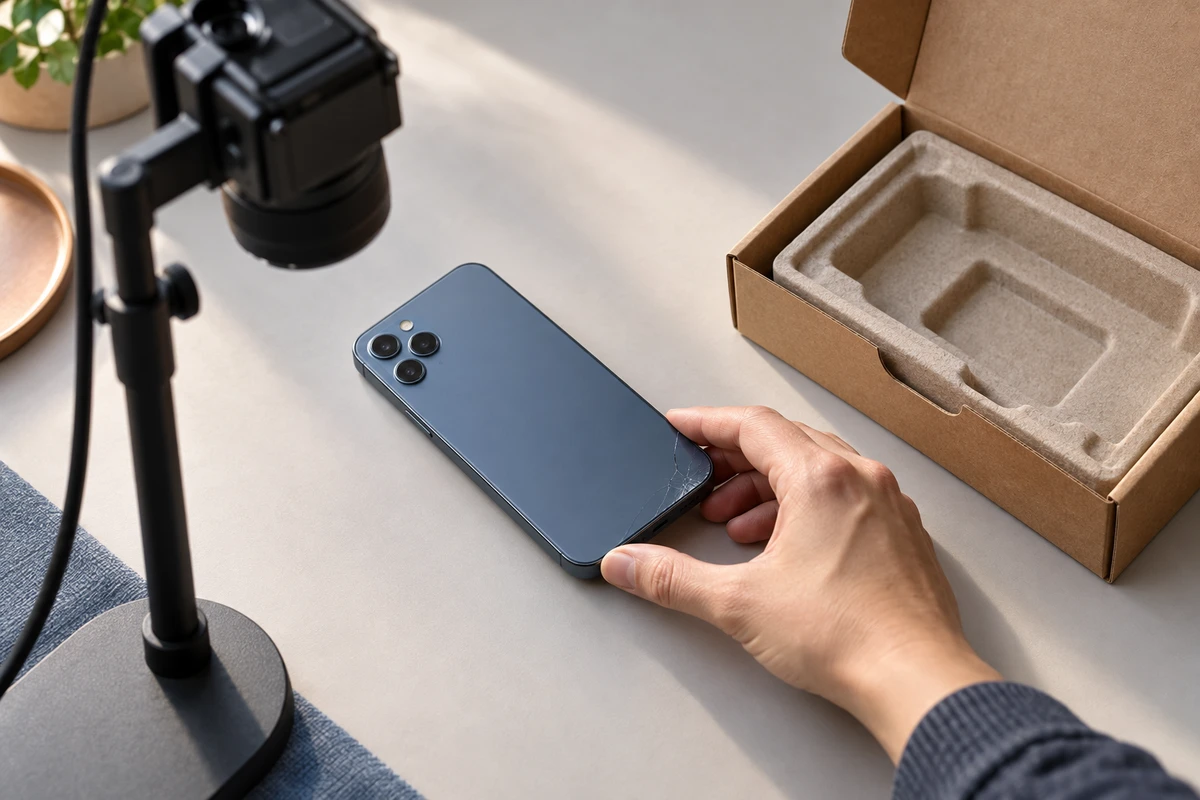
A brand sourcing devices from customers needs more than a persuasive “find your trade-in value” ad. The harder creative handoff comes later: the owner notices damage while packing, the receiving team finds a different condition, or the customer cannot tell what the displayed amount actually means.
For overseas brands working with a China-based production partner, this is a briefing problem before it is an editing problem. The team making the acquisition film needs the real assessment questions and post-shipping process—not just a pristine sample device and an attractive offer screen.
What the current evidence does—and does not—establish
Back Market’s US guide, “How do I best describe the condition of my device when I trade it in?”, distinguishes appearance and functionality and provides device-category criteria. Read on October 25, 2026, it supports explaining the actual assessment rather than treating an attractive image as a complete device test.
Its counteroffer guide describes inspection after receipt and circumstances in which a mismatch may produce a revised offer. It also lists limits on acceptable counteroffer reasons. Neither “the initial amount is guaranteed” nor “the receiver can change it for anything” is an accurate summary.
These are one platform’s service arrangements, not evidence that a particular film reduces disputes. ONCE’s recommendation is narrower: commission content that keeps the customer’s selected answer, visible condition and next action connected. Apply your own current program rules; do not borrow another operator’s commitments.
ONCE’s three-part pre-shipping review
For each condition that matters to your program, build a small content record with three connected fields:
- The answer. Copy the exact option from the live assessment, with the product category and market. Do not invent friendlier grading labels that the form does not use.
- The demonstration. Show what a customer can reasonably recognize, and separate it from what requires inspection. A close-up can locate a crack; a screen lighting up is not a full functionality assessment.
- The route forward. State what to do if the answer was wrong or the device changed. The destination must match whether the item is still at home, already shipped, or under review.
This is a proposed editorial review method, not a grading certification or an existing ONCE package. It works because the acceptance question becomes concrete: can a person who encounters this condition find the correct next step?
Follow one exception through the entire creative journey
Imagine an owner who discovers a corner crack just before sealing a phone into its box. This is a hypothetical production scenario, not a customer result.
Review the acquisition ad first. If the amount depends on assessment and inspection, its presentation should not turn it into an unconditional payout. Put the relevant qualification where the offer is understood, rather than expecting an unreadable closing frame to repair the impression.
Next, review the assessment demonstration. Establish the corner in a wider view, then show the detail. Keep reflections from concealing the crack, but do not let dramatic magnification imply that the production team has determined its grading consequence. That decision belongs to the program’s actual criteria and responsible staff.
Now follow the person who discovers the mismatch. Back Market’s US misdescription guidance separates reassessment before shipping from assessment and response after shipping. The useful creative lesson is the stage-specific explanation—not permission to copy its turnaround or return promises into another brand’s film.
If the tutorial shows the crack beautifully but the viewer still cannot find where to correct the declaration, the journey has failed its editorial review. A more cinematic close-up does not fix that missing route.
Keeping a photograph is a different task from uploading it
Back Market’s US pre-shipping photo guide requires customers to retain photographs, rather than submit them in advance. It covers device views and the labelled package. A tutorial that invents an upload step would teach a different process.
For your program, establish the actual retention or submission requirement before filming the interface. Explain what the images are for without promising that they settle shipping liability, full device functionality or final value. Do not substitute video for photographs explicitly required by the relevant service.
Demonstration assets should use non-personal package information. Real customer records should not become public campaign footage by default. AI can help plan a storyboard or create a clearly conceptual process illustration; it should not erase damage in a condition record or fabricate a successful diagnostic screen for a real device.
Buy coverage of decisions, not an arbitrary number of videos
Scope the work around three moments: entering the assessment, preparing the shipment, and understanding the review outcome. They may share footage or live within one experience. They do not necessarily require three films.
Ask a China-based production team to identify what it needs from your local operations team: approved condition examples, the current form, an interface demonstration, support review and ownership of future updates. Quote those tasks explicitly. There is no universal production price or proven saving in this method.
After launch, consider observing assessment completion, pre-shipping corrections and support contacts following review. These are proposed measures, not reported ONCE data. More corrections can mean people now catch mistakes earlier—or that the form remains confusing. Read the reasons before calling either direction an improvement.
The next brief for ONCE’s production team can begin with one real assessment form and one recurring review question. Agree on what the owner should understand and do, then decide how the acquisition creative should look. A strong invitation to trade in should lead to a process the customer can actually follow.
Source check: October 25, 2026. The four Back Market US Help Center pages display relative update labels, not precise publication dates established here. Platform-specific conditions must be checked for the relevant market and program. The original AI cover is conceptual, not a record of a customer device, inspection or payment.