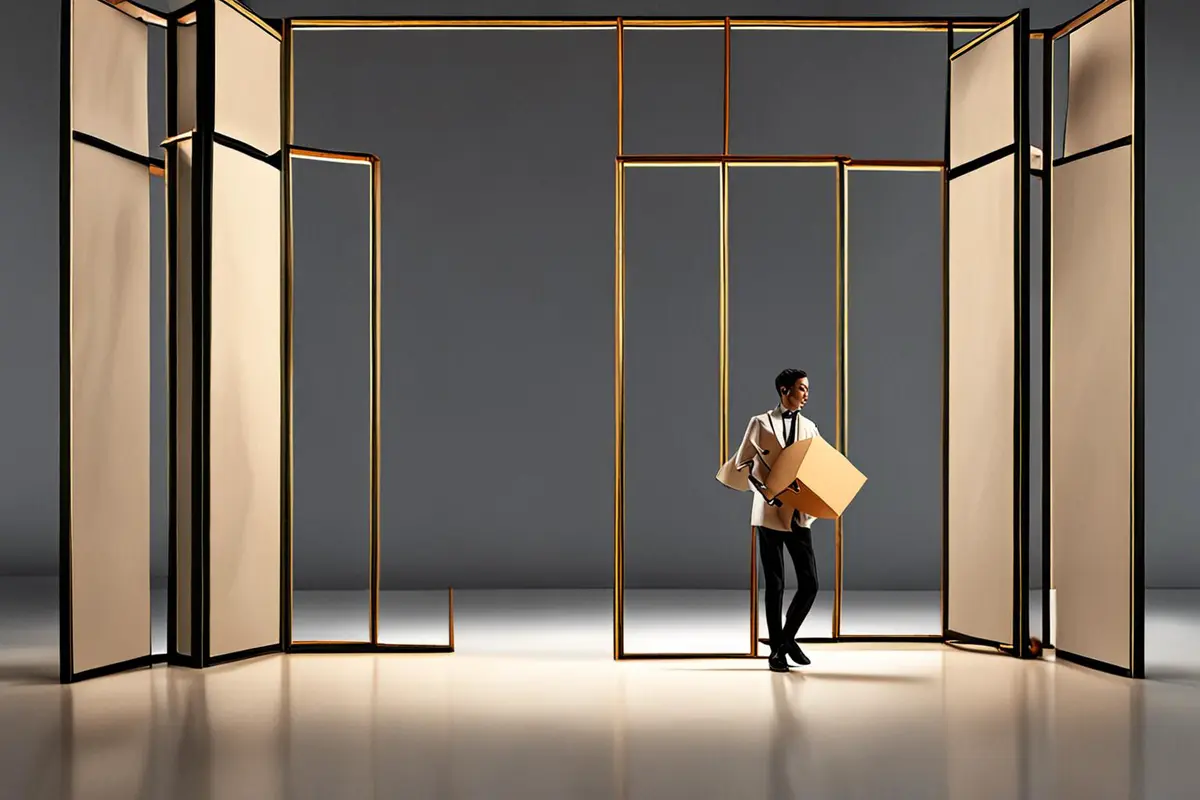
Put a landscape action into a 9:16 frame without redesigning it and the result rarely feels tighter. More often, the performer reaches the edge before the action has finished. An arm is clipped, the product flashes past, and the camera pans sideways to keep up while the background adds no new information.
Vertical video does not remove space so much as shorten the lateral runway. At the same time, it strengthens another route: as a performer approaches or retreats from the lens, the face, hands and product change scale quickly, and foreground, midground and background can hand the action from one layer to the next.
That is why vertical ad production needs more than a 9:16 frame guide. The action itself has to be rewritten: who appears from which depth, when the product enters the foreground, whether the viewer reads the face or the hand first, and where the frame settles after the action.
9:16 changes the entrance for action
A landscape frame can hold a performer entering from the left, crossing the set and completing an action on the right. The environment, a second person and the product may remain visible side by side. In a vertical frame, the same route is exhausted quickly. After a few steps the performer is already at the edge, and a lateral follow compresses the location into a narrow strip.
A more useful vertical entrance often works along the lens axis. A performer can advance from the background, enter a midground action zone and raise the product as they approach. Or a hand in the foreground can pass the product to someone in the middle distance, who then retreats with it. The movement has not become smaller; it now travels through the space instead of merely crossing the frame.
This does not require everyone to walk straight toward the camera. A diagonal route is usually more natural: start from one side of the background, pass near the central action zone, then bring the product into the opposite foreground. On the floor it is a diagonal line. In the image it creates a clear shift in depth.
Assign three depth layers before placing the performer
Vertical compositions often stack every element in the centre: face at the top, product at chest height, table below and a flat patch of colour behind. All the information is present, but the scene has no spatial argument. A better starting point is to give three depth layers distinct jobs.
- Foreground is the trigger. A hand, door frame, shelf edge or soft obstruction can begin the action from the viewer's side or receive the product at the end.
- Midground is the performance zone. Expression, the main operation and the product promise can remain readable together here.
- Background is the destination. It need not be elaborate, but it should explain where the performer came from, where they are going, or why the next action occurs.
The layers do not have to compete at the same time. A foreground hand may appear for less than a second. A background target may be no more than an open doorway or a pool of light. What matters is that each layer owns a different beat: the foreground withdraws, the midground performer takes over, then a step forward reveals the next person or use context behind them.
Depth comes from the handoff, not from adding more props.
Keep the face, product and hands out of one vertical stack
A common vertical setup puts the face in the upper half and the product directly below it. The composition is stable, but it can resemble a livestream demonstration. Face, hands and object form a single column, so the viewer reads them as separate items rather than one relationship.
Instead, let the three elements form a triangle that changes with the action. The performer's gaze creates one side. The operating hand moves the product slightly away from the body to create another. Product orientation, light or the second hand completes the third. The frame now has direction even when the camera is locked.
Moving the product toward the lens changes its scale rapidly. That is a vertical advantage and a risk. Bring it forward too soon and it covers the expression; too late and the selling point becomes a rushed close-up. A more legible rhythm is to show why the performer reaches for it, let the product travel from midground into foreground, then hold it long enough for its key structure, mark or result to be read.
Wardrobe can either clarify or erase this triangle. For more on silhouette, fabric movement and performance, see ONCE's guide to wardrobe and performance in brand films.
Height is an underused resource in vertical blocking
The tall frame gives more room to vertical relationships than to long lateral routes. Sitting and rising, reaching down for an object, lifting a product to eye level, or approaching on stairs can redistribute body and product naturally. When the change grows from a real task, it carries more meaning than an arbitrary crane or gimbal move.
The point is not simply to add motion. Height should change the information hierarchy. When a performer bends, the face may briefly leave the dominant area and the product on the table gains attention. As the performer stands, the object returns to chest or eye level, reconnecting function with attitude. The two poses should answer different questions.
Platform interfaces still matter. TikTok's June 2026 auction in-feed ad specifications recommend 9:16 vertical for non-Spark ads and explain that safe zones vary with dimensions, caption length and additional formats. Google likewise recommends native vertical assets in its YouTube Shorts ad guidance. Those documents help reserve space; they do not direct the performance.
The camera does not have to follow every step
When a performer moves through depth, one tempting choice is to preserve the same camera-to-subject distance. A stabilised rig retreats continuously, holding the performer at a constant size, and the visual meaning of “approaching” disappears. The opposite mistake is a constant push that enlarges background, face and product together, erasing the order in which they should be read.
Move the camera only when the relationship needs to change. Let a locked shot describe the performer advancing from background to midground. When the product is about to obscure the face, make a short lateral correction to give the hand and object their own space. Once the handoff is complete, stop and let the second performer carry the product away.
ONCE's earlier essay on camera movement and blocking in advertising asks what information a move adds. Vertical blocking makes the companion question more precise: what can the performer's path explain before the camera moves at all?
Automatic reframing can keep a subject visible, but it cannot redesign the action. Adobe's April 2026 Auto Reframe documentation notes that complex sequences with multiple points of interest or rapid movement may require manual keyframe refinement. Its guidance for enterprise video reframing also favours clear subjects and limited movement when attention shifts between multiple people. A tracker can keep a face inside the crop; it cannot know that a foreground hand, a product exchange or a reaction is the dramatic turn.
A horizontal and a vertical version need different blocking
When a campaign needs both 16:9 and 9:16, lighting, production design and performance intent may be shared. The action's start point, handoff point and final pose often cannot.
The landscape version may keep two people walking side by side, use a lateral follow and preserve a longer environmental relationship. The vertical version can stagger the performers in depth and use approach, occlusion and yielding space to deliver the same idea. A side-to-side handoff in landscape can become a product travelling from midground into foreground before a foreground hand receives it.
This is not two unrelated commercials. It is one creative action with three positions deliberately re-mapped: where the performer first enters, at what depth the product becomes dominant, and who occupies the most informative position at the end. Monitoring both ratios at phone size on set is more reliable than asking a crop box to chase faces later.
Give the vertical frame a route worth following
Mute a vertical scene and watch only the changing distances. Can the relationship between performer and product already tell you who needs it, who uses it and who receives its value next? If all that remains is one permanently centred person, a smooth camera move may be doing nothing more than keeping the subject in bounds.
Effective vertical blocking does not have to be large. One approach from background to midground, one pause as the product enters the foreground, and one handoff between depth layers can give the narrow frame real space. It is not a compromised landscape version. It is a redesigned route for action.
If you are planning horizontal and vertical assets for a launch, social campaign or brand film, ONCE can develop the script, storyboard and blocking previs as one production system. Explore our advertising video and brand content production services, or send a brief with the core action and required aspect ratios.
Source note
Platform-format statements were checked against TikTok Ads Manager, Google Ads Help and Adobe's Premiere and Firefly documentation in October 2026. The blocking method is ONCE's creative analysis of frame shape, movement and information hierarchy; it is not a platform guarantee or a performance claim.