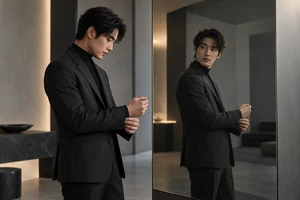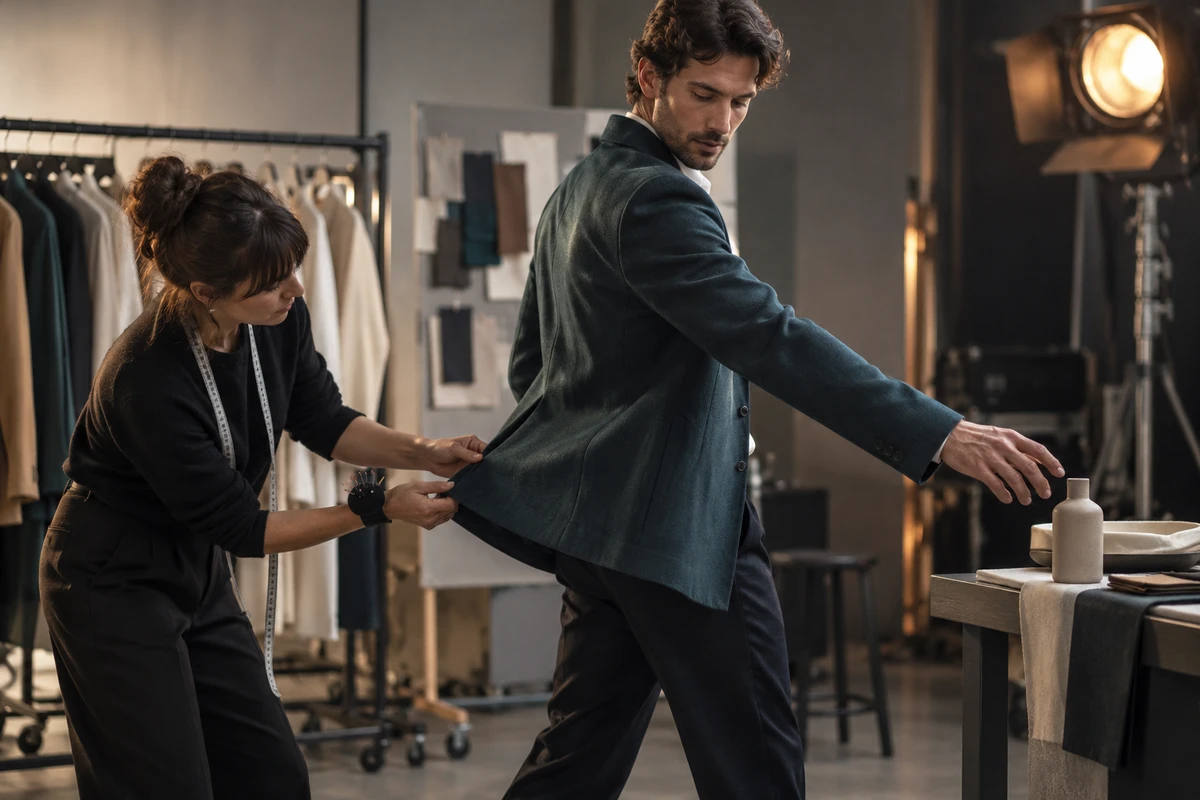
A costume fitting can create a false sense of certainty. The actor stands against a plain backdrop, the colors align with the brand palette, and the silhouette looks clean. Everyone approves the look. On set, however, the coat bunches up when the actor sits, a cuff hides the hand operating the product, and the shoes produce a walk that belongs to a different character. The performance starts serving the clothes.
The clothes may be perfectly attractive. The problem is that they were judged as a still image. In a character-led brand film, costume is first a set of conditions for the body. It changes how a performer stands, how far they step, where their hands rest, and how close they come to another person. If a fitting only produces front, side, and back photographs, the part that matters most to performance has not yet begun.
The Body Changes Before the Audience Reads the Character
Put the same actor in soft-soled shoes and rigid leather shoes and they will enter a room differently. A jacket with pockets gives the hands somewhere to settle; a fitted garment without pockets makes every hand gesture more exposed. A heavy collar can reduce the range of a turn. Wide cuffs can make a small product harder to handle. A narrow hem can turn sitting down into a cautious action.
These are not minor wardrobe details. They determine how the character occupies the frame. In a Film Independent costume design masterclass, Arianne Phillips and director James Mangold describe the first fitting as part of an actor's early journey into the character. Clothes have to respond to the performer rather than merely execute a reference image. ScreenSkills similarly places fittings, actor collaboration, photography, and director approval inside one costume workflow.
These sources concern film and television craft, not evidence that a particular wardrobe increases advertising performance. Their useful lesson is narrower: costume and performance begin to shape each other during the fitting.
Turn the Fitting Into a Small Performance Rehearsal
Still photographs can answer questions about color, proportion, and basic fit. A useful fitting asks the actor to perform the actions that define the role and the product. Generic instructions to walk, turn, and pose are not enough.
Five verbs offer a practical starting point: stand, walk, sit, handle, and dress or undress. The point is not to create a mechanical checklist. It is to observe what the garment makes the body do. Does the shoulder line push a listening character into an overly formal posture? Does a skirt or trouser leg shorten the walk toward a table? Does the coat cover the product when the actor sits? Do cuffs, rings, or gloves interrupt an operation? Can removing a layer express a change of state rather than become a continuity problem?
Imagine a commuter-headphone film in which the protagonist remains contained in a crowded elevator, then relaxes after leaving the office. Instead of explaining the change with narration, the costume can place it in the body: a fastened coat limits the arms in the first section; outside, the actor opens the coat, takes out the headphones, and lengthens their stride. This is a creative hypothesis, not a proven advertising formula. It has to be rehearsed with the performer, the real product, and the location.
Judge the Relationship Between Clothes and Product Through Action
Matching the brand color is rarely the costume's most important job. More important is whether the product action remains legible. A sleeve may hide a watch. A dark glove may swallow the outline of a black device. Metallic jewelry may create a stronger highlight than the product surface.
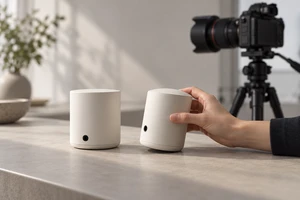
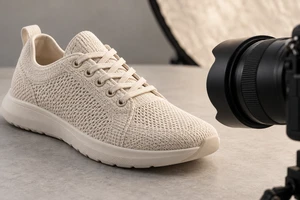
For that reason, costume approval should not happen without the product. The actor should work with an object that approximates the final size, weight, and reflectivity, then open, wear, touch, store, and hand it over. The camera should be present as well. A subtle texture that reads beautifully to the eye may disappear in a medium shot; white fabric may lose separation against a bright set; a dense pattern may behave differently across capture and delivery conditions.
In the Television Academy interview with Janie Bryant, the costume designer discusses character, set colors, and the other costumes in a scene as one visual system. That is why dressing every actor in the brand palette can make a scene flatter, not stronger. Color may be coherent while the hierarchy of action remains unclear.
Camera, Production Design, and Light Share the Same Body
Costume is not a finished object that photography later makes beautiful. How fabric absorbs, reflects, or transmits light; how the silhouette separates from the set; and how the edge behaves in motion all require a shared decision among costume, production design, lighting, and camera.
In a Focus Features interview about Nosferatu, costume designer Linda Muir explains that different fabric weights were made for the same nightgown because one version had to work while the character ran in rain. She also selected materials with night photography in mind. This is a feature-film example, not a recipe for a commercial. It demonstrates that material, movement, weather, and light cannot be designed independently.
For a brand film, the most informative test is often not a larger palette board but the actor performing the key movement under lighting close to the final setup. Backlight can give sheer fabric a beautiful edge or let it overpower the product. Hard light can reveal useful structure in folds or make the character feel tense. The director has to decide whether that bodily feeling belongs to the role.
Horizontal and Vertical Frames Read Costume Movement Differently
A horizontal frame can hold the full stride, the distance between characters, and the relationship between wardrobe and set. A vertical frame is more likely to retain the upper body, hands, and a partial silhouette. If one shoot must serve both a horizontal hero film and vertical cutdowns, the costume action cannot work only in the wide composition.
Consider a character placing both hands in a large coat. In horizontal framing, that action may communicate defensiveness or distance. Crop it to a vertical close-up and the hands leave the frame; only an unreadable face remains. The reverse can also happen: a small relationship between collar, cuff, and hand becomes expressive in vertical framing but disappears in a horizontal wide shot.
Continuity is part of the performance, not merely a wardrobe log. The UK National Occupational Standard on maintaining costume continuity covers scripted looks, changes during shooting, and reliable records across takes. For a short film, the creative issue is not only whether every button matches. It is whether the action remains logical across the edit: a sleeve being rolled up in one shot cannot be fully lowered in the next, and a layer removed after a relationship changes must have a readable moment of change.
AIGC Can Previsualize a Look, Not Validate the Body
Generative tools are useful for exploring silhouettes, color directions, and combinations of character and set. They can help a team compare visual worlds quickly. But a good single frame says little about what will happen when cloth meets hands, turns, occlusion, and continuous action.
Research on video virtual try-on makes that limitation concrete. A CVPR 2025 paper treats pose interaction and consistency between frames as central problems. Later work continues to address fine garment dynamics and background integrity. These benchmarks are not tests of commercial-production tools, so they do not justify a blanket claim that AI wardrobe is unusable. They do support a careful production inference: when a selling point depends on how fabric takes force, how a cuff clears a product, or how a performer runs and removes a layer, the critical movement should be validated with the real garment and performer.
A more reliable hybrid workflow uses generated images to explore the world and silhouette, fitting videos to lock the body and product actions, and CG or generation for selected backgrounds, transitions, or otherwise impractical shots. A wardrobe reference for a recurring character should include front, side, back, sitting, walking, hand occlusion, and the decisive action—not only a polished portrait.
A Good Costume Lets the Actor Forget the Costume
Costume becomes narrative not when viewers can name its label or color code, but when the character's behavior feels inevitable. Clothes give the person a way to stand, a habit of touching the product, and a reason to move closer or step away. The camera simply makes those changes visible.
At the next fitting, set the still palette aside for thirty seconds. Ask the performer to enter, meet another person, use the product, and leave while wearing the candidate look. Then ask the more useful question: is the costume helping the character act, or forcing the character to keep looking after the costume?
If you are developing a character-led brand film, ONCE can bring character movement, costume fittings, product handling, and horizontal and vertical framing into the same pre-production process. Explore our video production solutions and share the script, character notes, product sample, and delivery formats so the movements that matter can be tested before the shoot.
Sources reviewed October 23, 2026. The film-industry guidance and computer-vision research above explain creative and technical conditions; they do not establish that any wardrobe choice will produce a specific marketing or sales result.