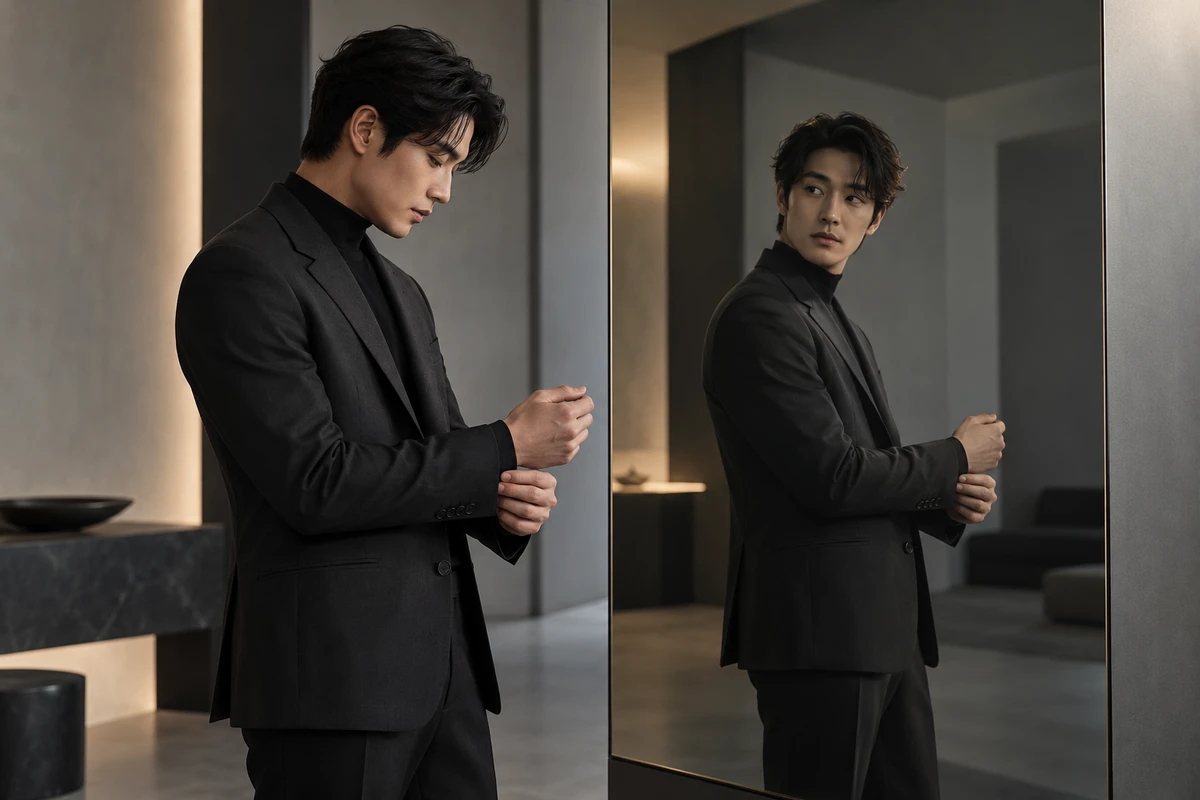
Imagine a character standing at a bathroom sink. The camera can see both a profile and a full face in the mirror. If both views merely repeat the same expression, the mirror is probably an expensive decoration. If the profile remains composed while the reflected eyes reveal doubt, the reflection has started to do narrative work.
The value of mirror composition is not that one image becomes two. It is that two layers of information can exist at the same moment. The direct view shows what a character is doing; the reflection can show what they are withholding, failing to notice or becoming. In a brand film, that second viewpoint can carry identity, relationships and time. It can also place a product inside an experience instead of interrupting the story with an isolated beauty shot.
A mirror is not a symbol. It is a second frame with a job
“The mirror represents the self” is too broad to storyboard. A more useful creative question is: what must the audience learn from the reflection that the direct image cannot tell them?
The answer usually belongs to one of four relationships. First, an information gap: a person or object outside the direct frame appears in the mirror, so the audience knows something before the character does. Second, a viewing relationship: a character looks at themselves while the mirror reveals someone watching them. Third, an identity gap: the live action and reflection differ in a controlled way to represent memory, imagination or self-judgment. Fourth, a product relationship: a product changes the field of view, light, clarity or character behavior, making the reflection a consequence of the product rather than atmosphere beside it.
Classical mise-en-scène often uses mirrors to give the viewer extra knowledge. A Sight and Sound analysis of The Egyptian describes a shot in which the mirror helps the audience understand a desire the character himself does not recognize. The staging makes the point without adding dialogue.
Advertising cases show the same principle: a mirror becomes powerful when it belongs to the central idea. WPP’s account of Dove’s Reverse Selfie explains how a story told backward ends with a girl facing a mirror, placing the tension between social-media alteration and self-image in one final relationship. In Framestore’s production account for Pepsi’s “Mirrors”, different eras of Beyoncé appear in the mirrors and perform with her present self. The reflections carry time and identity rather than simply duplicating choreography.
Write the reflection sentence before drawing the beautiful frame
Before developing a mirror sequence, complete one sentence:
In the direct image, the audience sees ____. In the reflection, they discover ____. That changes how they understand ____.
For example, the direct image could show a founder adjusting a collar before a launch while the mirror reveals a team still moving equipment behind them. A polished entrance becomes a moment held up by other people. Or a character removes a pair of headphones while the reflected city gradually appears calmer, making the product’s role a change in perception. These are explicit creative hypotheses, not client cases. Their purpose is to test whether the reflection adds causality.
If the three blanks produce “the character, the same character, and a good-looking character,” the mirror is unlikely to justify the extra set, art and post-production complexity. It does not have to be a full dressing-room mirror either. Shop windows, dark screens, vehicle glass, water and polished metal can all create a second frame. The smaller the reflective area, however, the simpler its information should be. A sliver of reflection can reveal a person early; a wall of mirrors has enough space to hold fractured identity or layered time.
Camera, character and mirror must form a controllable triangle
A mirrored set exposes a practical truth: anything the audience can see may also include the camera and lights. Camera position cannot be solved by “hiding it later.” It has to be previsualized with the story.
Lock the object that must appear in the reflection first, then work backward to the mirror angle, performer position and camera height. The edge of the mirror can remain visible so the audience understands which area is reflected. Alternatively, focus, exposure or the order of movement can create hierarchy. The arrangement to avoid is one in which the direct view and reflection are equally bright, sharp and active. Two information centers then compete instead of cooperating.
Eye lines need separate design as well. Looking into one’s own reflected eyes, looking at a product in the mirror and looking at another person behind the mirror require different angles. If the reflection carries a discovery, the performance should be editable: complete the original action, register the gaze shift, then let the body respond. Asking a performer to “act emotional at the mirror” often produces one continuous expression with no precise cutting point.
An American Society of Cinematographers interview about Cyrano offers a useful production example. The filmmakers wanted to look into a carriage and preserve window reflections without photographing their own crew. They shot the character without glass, captured separate reflection plates and combined them. Elsewhere, angled mirrors let one character see another moving through a space. The method supported a recurring theme: how people see themselves and how others see them.
Light and art direction should make the reflection informative, not noisy
A mirror pulls offscreen space back into the frame. Crew, flags, stray objects and unintended light sources can reappear. A pale wall may make the reflection brighter than the character. The solution is not simply to clean the glass. It is to decide how much reality the reflection needs.
If the mirror reveals a character, their reflected face needs a readable eye line and silhouette; the direct image can recede slightly. If it represents memory or an idealized self, color temperature, contrast, focus or timing may differ from reality, but the difference must remain stable. When a product is also reflected, the brand team should verify logo orientation, screen content, material highlights and any functional detail that could become misleading after flipping or compositing.
Framestore’s Pepsi account notes that each mirror required a separate plate. The team established a previs approach with the agency, editor and director, then used motion control, survey data and 3D reconstruction to combine the elements. The lesson is not that every brand film needs complex VFX. It is that the more narrative responsibility a mirror carries, the less safely its technical questions can be postponed to post.
Editing must protect direction; versioning must protect information
The most common editing problem in a mirror scene is not rough rhythm. It is the moment when the audience no longer knows who is looking at whom. Before cutting into a reflection, retain a stable cue: a mirror edge, a head turn, an eye-line target or a continuing action. After cutting out, verify that screen direction and body movement have not become confusing because the image was visually reversed.
In a widescreen hero film, a character and reflection can occupy opposite sides of the frame. A center crop to 9:16 may remove one layer completely. A stronger plan is to design two relationships during storyboarding: side-by-side information for widescreen, then vertical stacking, a tighter reflected view or a sequential reveal for portrait. Not every mirror shot deserves to survive the cutdown. Keep the one that can complete its information gap independently.
This is why mirror-led creative cannot be treated like ordinary footage extraction. It depends on an internal relationship inside the frame. When approving the hero-film storyboard, the brand team should review horizontal and vertical safe frames as well as whether the sequence remains understandable without dialogue. The broader ONCE video production journal contains related methods for planning framing, performance and multi-format work.
AIGC can extend the mirrored world, but it should not invent its physics
Mirrors remain a stress test for generated video. The 2026 research project MirrorWorld separates the difficulty into two questions: what content should be reflected and how that content should be arranged geometrically. Its authors show that a general video inpainting method may produce a plausible-looking scene while placing the wrong content in the mirror or letting the spatial relationship drift over time.
When a brand film needs a real person, an exact product and a verifiable action to coexist in a reflection, live action, controlled reflection plates or measured compositing remain the safer choices. AIGC is better suited to stylized transitions, brief memories, abstract extensions of space or low-risk previs. Even then, review left-right relationships, hands, product geometry, logo orientation and the way a reflection changes with camera movement frame by frame. A model may help imagine a second world; it does not automatically make that world obey the physics of the first.
The final test: what disappears when the mirror is removed?
The most useful test of a mirror idea is not whether the shot looks premium. Remove the mirror. Does the audience lose necessary information? If the only loss is a little visual polish, a simpler composition will often be more honest. If the audience loses a person, a period of time, a misunderstanding or a change in viewpoint caused by the product, the mirror has become part of the story.
If you are developing a brand idea into a hero film, cutdowns and horizontal and vertical versions, start with the relationship among character, product and reflected information. Explore ONCE brand-film and video production services to decide what that second frame genuinely needs to say.