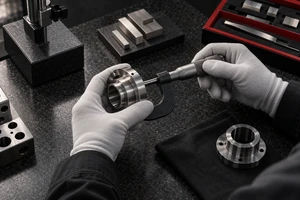
The meeting is over and everyone has left the frame. A swivel chair is still turning back into place, condensation marks the edge of the table, and the projector holds on a slide that has just been revised. There is no person in the shot, yet it is not empty. The decision made moments earlier is still moving through the room.
Empty shots in brand films are often mistaken for transition footage. A director records a corridor, a window, or a row of machines, and the editor uses the material whenever two scenes do not connect cleanly. The image may be beautiful, but if it changes neither our reading of the previous scene nor our expectation of the next one, it is a pause rather than a piece of narrative.
An empty shot is not simply a frame without people
An establishing shot usually gives us time, place, and scale. A cutaway leaves the main action to show something related and may also provide useful editorial coverage. An empty shot is better understood as a relationship: the audience expects a person or an action, but the frame directs attention to the space, objects, and traces left behind.
The same exterior of an office building can therefore be geographic information or a shot charged with pressure. If the previous image shows an employee pressing Send and the next image is a single office window still lit at night, the space carries the consequence of that action. Adobe's overview of establishing shots, cutaways, and long shots is useful here: shot categories offer functions, but meaning is created by the position of a shot in a sequence.
A practical question is: who or what is absent, and what remains because of that absence? If the answer is unclear, the shot is probably attractive coverage rather than a necessary part of the story.
Three time relationships make an empty space active
Before someone enters: the space waits
An empty shot before an entrance should not merely tour the location. It gives the space a direction. Elevator numbers approach the right floor. A moving reflection appears outside an automatic door. A conveyor belt runs empty just before the first product arrives. Each clue points attention toward an action that has not happened yet.
These shots benefit from restraint. The more competing detail there is, the harder it becomes to know what we are waiting for. One clear entrance, a change in light, or an unfinished movement often creates more anticipation than elaborate blocking. The shot does not have to be wide; a medium or close view of a door gap, tabletop, or machine indicator can establish waiting just as well.
After someone leaves: the space keeps the consequence
An empty shot after an exit can show that the event did not end when the person left. A chair remains pushed away, a row of lights is only halfway off, a package carries a new crease, or a material keeps changing after the operation is complete. The action survives as a visible trace.
The essential ingredient is a difference in state. Establish a baseline before the action: the door was closed, the cup was full, the sample was sealed. After the exit, at least one change should be legible. Without a baseline, the trace is set dressing. With one, it becomes a result.
While someone stays offscreen: the space responds
The third type can feel the most active. A person or product remains outside the frame, but the world inside the frame responds: lights switch on in sequence, a draft lifts a sheet of paper, a machine starts before the product arrives. The audience completes the unseen action.
This is valuable in both brand films and product advertising because capability can be shown as an effect on the environment. The frame does not always need to contain the operator, product, and result at once. The causal timing must remain precise, however. If a change happens too early, too late, or could have several sources, the audience reads atmosphere rather than action.
State change is what makes the space do something
An empty shot is not more sophisticated merely because it is still. Effective stillness contains time. Steam thins, a shadow moves, a material returns to shape, water stops flowing, or a production line lights up from one section to the next. These changes let the audience feel a process without a performer in the frame.
In a storyboard, replace a note such as “empty office, cool palette” with “the last desk lamp switches off as morning light reaches the tabletop.” The first describes a style. The second gives art direction, lighting, camera, and edit departments a beginning, change, and endpoint.
For corporate storytelling, an empty shot should do more than provide architectural polish. It can carry a decision through a physical system. Our article on spatial storytelling in corporate brand films examines how a task travels through offices, meeting rooms, and factories. Empty shots take a different step: they remove the people and preserve the physical result of their decision.
Move the camera only when the event is still unfolding
A locked camera lets the audience compare before and after, making it well suited to anticipation, aftermath, and subtle motion. A moving camera needs something to discover: it can travel from an empty chair to a machine that is still operating, or from a closed storefront to a newly illuminated interior. Without new information, a push, pull, pan, or track merely makes the filler look more like an advertisement.
There is no universal duration. The shot needs enough time for viewers to recognize the baseline and then notice the change. Cut too early and no state difference forms; hold too long and anticipation drains away. One useful edit pass is to mute the sequence, identify the exact frame at which the visual information becomes complete, and then decide how music and ambient sound should enter.
Apple's Final Cut Pro documentation describes a cutaway as a clip connected to the primary storyline. That software relationship suggests a useful creative test: an empty shot should be able to name the action to which it is attached. If it can be moved anywhere in the film without changing meaning, it is probably not specific enough.
Sound can extend a person, but it cannot invent a purpose
Footsteps can precede an entrance. Dialogue can continue over an empty office. The sound of a machine shutting down can land on a still production line. Sound connects the visible and invisible parts of a space. Our recent article on ambient sound in brand films explores how room tone, directional sound, and audio transitions preserve spatial continuity.
But if the image offers no readable state or direction when muted, the shot may depend too heavily on post-production explanation. A sturdier design gives the image one clear relationship first; sound then adds distance, direction, and emotion. The core change remains understandable during muted playback, while audio makes the space richer when sound is available.
In short-form video, an empty shot should arrive with a question
TikTok for Business currently presents hook, body, and close as a useful three-part structure. It is not a formula every film must copy, but it is a reminder that an empty shot in a feed cannot merely give the viewer a rest. An opening empty shot should immediately create an unfinished question: why is one space missing from the shelf, or why is only one machine still running?
A mid-film empty shot can make a result tangible; a closing empty shot can leave an afterimage. The goal is not faster cutting. It is faster comprehension of absence, change, and cause. Brand identification does not have to be forced into every frame. A product can first be felt through its effect on the space, then be identified clearly with its benefit in the shots that follow.
Generative video can vary the environment, but it should not guess continuity
Generative video is useful for exploring weather, time of day, material, and spatial mood. It can also produce quick visual studies of unoccupied environments. Yet empty shots depend on exact state differences, which exposes a current weakness of generative workflows: the angle of a door, the position of objects on a table, or the state of a material may drift between shots.
In September 2026, Google Research described identity drift, unstable environments, and cascading failures as practical problems in multi-shot video generation, and presented persistent world-state tracking as part of its response. This research is not a production guarantee. For a brand film, the pragmatic method is to lock the key objects, framing, and before-and-after states first, then decide which environmental layers can be generated. Verified product appearance, functional action, and critical detail should still come from dependable source material.
Run a position test in the edit
Move the empty shot one cut earlier or later. If its meaning remains identical, it is probably atmosphere. If the move changes anticipation into aftermath, or cause into result, the shot has formed a narrative relationship. Then remove it. If the human action still makes sense but the sequence loses a layer of time, emotion, or causality, the empty shot is doing real work.
A strong empty shot never announces that it is time to admire the scenery. It keeps us following the previous decision, or makes us feel the next event approaching. Space is not a background used when the story pauses. It is a character that keeps working after the action leaves the frame.
If you are planning a brand film and want the location, product action, and performance rhythm to form one clear visual narrative, explore ONCE's brand video production services or contact us to shape the script and shot relationships from the beginning.