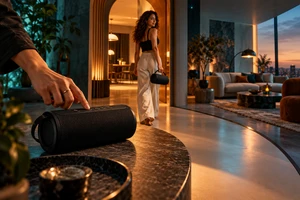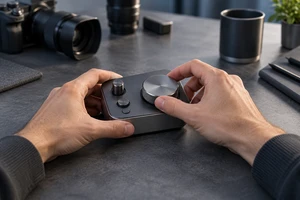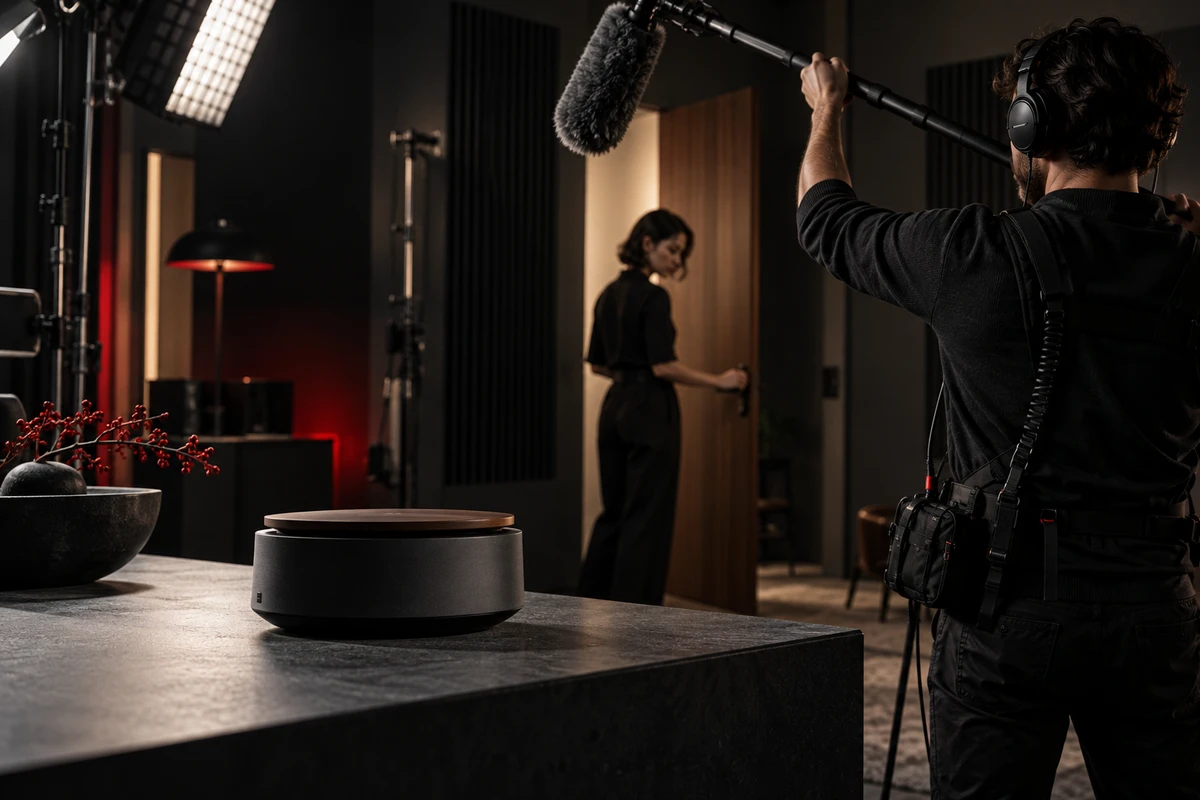
The same office, three camera angles. The first shot carries air-conditioning hum and distant keyboards. The second leaves only a perfectly clean voice. The third suddenly introduces traffic outside the window. The desks, people, and light have not changed, yet the room is rebuilt every time the edit cuts.
That is why ambient sound matters in a brand film. It is not optional noise under the music. It is evidence that the space continues to exist. Viewers may never say, “the room tone is discontinuous,” but they can feel that an interview has been assembled, a factory sounds like a silent stage, or an exterior has no air.
Good ambience is not necessarily louder. It gives each place a distinct distance, material, and rhythm, then preserves that world through the edit.
Ambient Sound Keeps an Empty Frame from Becoming a Vacuum
A location is not silent when nobody speaks. Ventilation, lighting, elevators, leaves, roads, machinery, distant people, and room reflections create a baseline. In production audio, a dialogue-free recording of that environment is commonly called room tone.
Shure's Audio for Video guide describes room tone as dialogue-free ambience that is crucial for smooth edits. The reason is simple. When an editor removes a pause, joins two answers, or lays B-roll over an interview, a sudden disappearance of background noise can reveal the cut before the image does.
Room tone is not “silent footage.” It carries room size, wall reflections, equipment, and distant activity. The quiet of a conference room is different from the quiet of a studio, workshop, or hotel corridor. One generic background track may fill every gap, but it also erases the difference between places.
Music, Sonic Identity, Ambience, and Foley Have Different Jobs
Brand films often hand every audio problem to music. If the picture feels empty, make the score fuller. If a transition is weak, add a beat. If a product action feels small, add an impact. Rhythm becomes clear, but the location does not become believable.
Four types of sound should carry different tasks:
- Music organizes emotion and time.
- Sonic identity supports brand recognition.
- Ambience tells us where we are, how large the space is, and what continues around the action.
- Foley and action sound reveal contact, weight, material, and force.
If a machine runs steadily on screen, its continuous mechanical bed can define the space. When a worker activates a component, the action sound moves forward. A brand motif can wait until the section resolves. All three do not need to compete for maximum level.
Our article on sound memory in brand films focuses on reusable sonic identity across multiple films. This article asks a different question: even when every campaign uses a different sound palette, how can offices, factories, exteriors, and interviews remain spatially continuous inside one edit?
Put Space in the Script with Four Sound Layers
Ambience does not need to wait for post-production. During the recce or script stage, give each scene a four-layer sound map.
Constant bed: what the space is always doing
The constant bed may be ventilation, distant traffic, canopy wind, or the low-frequency body of a production line. It establishes basic size and density. It does not need to attract attention, but it should not vanish without cause when the camera angle changes.
Directional events: what exists outside the frame
Footsteps approach from the right. An elevator chime comes from behind. A reversing truck is heard through a factory door. Directional events keep the world alive beyond the frame and can prepare the next location before the picture cuts.
Sound can also establish a product before it enters the image. Our guide to off-screen product presence explores that reveal. Here, the goal is not suspense; it is making adjacent shots share the same audible floor plan.
Action detail: who touched what
Handles, paper, keys, clothing, footsteps, and product controls reveal material and distance. Foley can make an action clearer, but its force must match the picture. Making lightweight plastic sound like heavy metal may feel premium while misleading the viewer's product judgment.
Transition sound: when the space changes hands
Sound can arrive before the new image or remain after the old one leaves. Adobe's explanation of J-cuts and L-cuts describes this basic relationship. In a brand film, letting the next location arrive through sound makes a transition feel entered rather than pasted on. Holding the previous ambience for half a beat can preserve the emotional residue of the scene.
Record the Location, Not Only the Dialogue
Clear speech is the first priority in an interview, but “cleaner” should not mean deleting the location. Lavaliers, boom microphones, and a separate recorder can each contribute speech, direction, and spatial reference. Post-production can then decide how much to retain.
Whenever the camera position, equipment state, or location changes, record a stable ambience pass. Nobody should pack gear, walk, or talk. Note whether ventilation, production equipment, doors, windows, and crowds match the state used in the take. The most useful room tone is often captured immediately after the scene, before conditions change.
Record wild tracks as well: the same machine at several distances, the corridor outside an office, a product on different surfaces, or traffic layers from near to far. The point is not to build a bigger generic library. It is to preserve the real location's sound grammar.
Leave clear sync references. If post-production receives only a vague action noise buried under dialogue, the editor cannot reliably know which touch, distance, or material it belongs to. A short brand film still benefits when picture and sound departments design these relationships together.
Editing Ambience Is More Than Looping One Bed
Ambience must be continuous, but it should also change. When a character moves from a corridor into a meeting room and closes the door, high frequencies and distant voices should shift. When a factory film cuts from a machine close-up to a wide floor view, clarity, reverberation, and density should change with distance.
Adobe's overview of sound effects for video defines ambience as the background sound of a specific environment and notes that different locations need different foundations. Adobe Audition's current guidance treats ambience as its own mix type, with controls for room-tone character and stereo width. Tools are not creative answers, but they point to the right judgment: ambience combines distance, width, reflection, and direction—not just volume.
Before adding music, listen to dialogue, actions, and ambience alone. Does the room jump when the camera angle changes? Does a person walking away still sound attached to the microphone? Does the outside world change when a door closes? Once the spatial logic works, bring the score back.
Music laid across the whole timeline can hide these problems. A film may feel smooth because the score covers every seam, not because the space has been built.
AI Can Generate Candidates, but It Does Not Know the Location
Generative video systems increasingly include audio. Google's current Veo documentation supports prompts for sound effects, ambient noise, and dialogue. Google DeepMind's video-to-audio research explores generating synchronized sound, music, and speech from moving images. These tools can help with concept development, candidate generation, and first-pass sound for silent generated footage.
But synchronization is not the same as belonging. A model can add cups, chatter, and street noise to a café. It does not know the real air-conditioning frequency, the road direction outside the window, the door material, or the actual response of a product control. The common failure is not always an obvious error. It is excessive completeness: every action is emphasized, every place is dramatic, and the real hierarchy disappears.
A practical division of labor is clearer. Location recordings establish spatial truth and product behavior. Foley improves readability. Licensed libraries supply elements that are hard to capture. Generative audio expands options and creative exploration. A sound editor still needs to resolve direction, distance, material, rights, and scope of use.
Sound-Off Viewing Does Not Make Ambience Irrelevant
Short-form feeds and web pages are often viewed without sound, so the core proposition should still be understandable through image and captions. That does not excuse a careless soundtrack. The silent version protects access and entry; the sound version adds space, tactility, and emotion.
When ambient sound carries material information—a warning outside a door, a machine stopping, or a character reacting to something off-screen—captions should communicate it. The US government's Section 508 synchronized-media guidance calls for captions equivalent to speech and other audio information. Legal requirements vary by market, but the creative principle travels well: do not hide a decisive story beat in a channel that part of the audience cannot receive.
Conversely, even when all facts remain legible on mute, ambience can still create presence. It does not need to repeat the selling point. It lets viewers hear how the space surrounds the person and how the product touches the world.
Three Listening Tests
First, turn off the picture and listen to three adjacent shots. Can you tell whether they share a location or move into a new one?
Second, turn off the music. Do interview cuts, action timing, and scene changes suddenly become exposed? If so, the score may be concealing missing spatial work.
Third, mute the whole film. Is the core message still understandable, and are essential sounds represented by captions or visual response?
Strong ambient sound does not make viewers praise how full the mix is. It lets them believe that after the camera cuts away, the room remains, the corridor remains, the machine keeps running, and the people still inhabit the same world.
If you are planning a corporate brand film, product ad, or multi-location campaign, ONCE can design the spatial relationship from recce and sound map through production and mix. Explore our brand video production solutions and submit a project brief.
Sources and Scope
This article reviewed Shure's Audio for Video material, Adobe's sound-effects and Audition ambience guidance, Google's Veo audio documentation, Google DeepMind's V2A research overview, and Section508.gov's synchronized-media accessibility guidance. The four-layer sound map and listening tests are ONCE's creative analysis, not a guarantee of advertising performance.