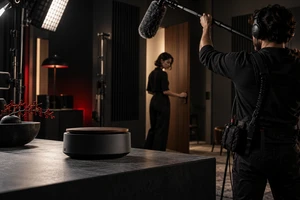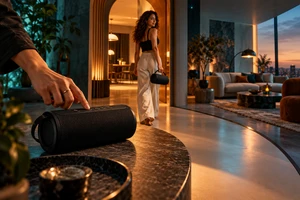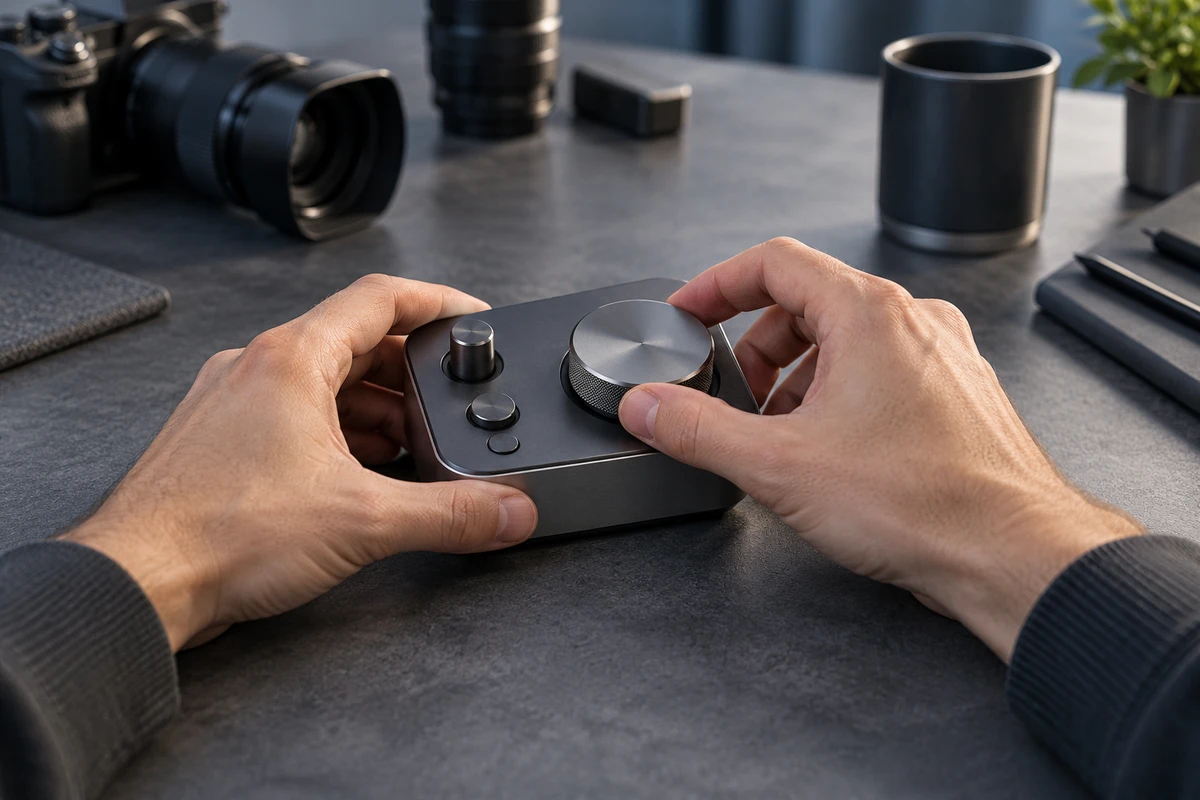
First-person perspective is excellent at putting a viewer inside an action. It is much less reliable as the only way to prove every product fact. The camera can reach, approach, open, and press on the viewer’s behalf, but an outside angle is often still needed to show what the product looks like, how the body uses it, and whether the promised change actually happens. A strong POV product ad does not strap a camera to an actor from beginning to end. It changes position deliberately between subjective experience and objective proof.
POV is not a shaky-camera style. It decides who owns the view
Adobe defines a point-of-view shot as a view through a character’s eyes, with handheld or stabilized movement available to imitate natural head motion. That describes a piece of film grammar, not a performance guarantee. The useful creative question is simpler: in this moment, should the audience be the user, an observer, or someone evaluating the product?
First person has a natural advantage. An action does not need to be explained by a facial expression before it makes sense. A hand moves toward a handle and the viewer expects it to open. The camera looks down at a button and the viewer waits for feedback. Intention and action occupy the same viewing position, so the film can enter the experience quickly.
POV also creates a natural loss. The viewer cannot see “their” own body. Is the wrist angle comfortable? Is the product proportionate to the body? Is the user applying force through the back or shoulder? How large is the product in the room? Those facts can easily fall outside the frame. The stronger the feeling of participation becomes, the weaker some product evidence may become.
It is important not to confuse two related ideas. A 2024 advertising study ran three experiments comparing first- and third-person narration and found that effects on brand attitude depended partly on product involvement. But the experiments mainly changed the narrator’s use of “I” and “she” in roughly 1.5-minute story ads. They did not test whether a head-mounted camera outperforms an objective shot. The responsible takeaway is that perspective can change the audience’s relationship to a story; the individual shots still have to prove the product.
A clear POV product ad changes position three times
Enter the action subjectively
The opening is good at carrying intention: walking toward the product, taking it from a bag, reaching for a switch, or moving attention from the room to one important detail. The whole exterior does not need to be explained yet. The audience only needs to understand why “I” am about to touch it.
This is also where POV can work naturally in vertical video. TikTok’s official home and lifestyle creative guide treats customer POV as one storytelling option, while still recommending that creators make the product name, unique selling points, and viewing context clear. POV can make a piece feel lived-in without hiding the product’s identity.
Complete one readable operation
Do not overload the operation. One pickup, one lock, or one adjustment is usually more believable than four features compressed into a few seconds. The hand should enter from a position that makes physical sense. The contact point should remain visible. After the action, the product needs a readable response: a light changes, a mechanism settles, a sound ends, or the content state updates.
What matters is an action loop, not an elegant gesture. Intention appears, the hand contacts the product, the product changes, and the user receives a result. If any step only exists in captions, the POV has not yet made the experience clear. For a broader treatment of evidence in demonstrations, see ONCE’s article on using hand close-ups to communicate an operation.
Step outside the POV to verify the result
The objective shot should not merely repeat the action. It should restore facts the POV could not show. A side medium shot can verify ergonomics. A stable product close-up can confirm the interface, scale, or final state. A wider environmental view can show how the product actually occupies the room.
A useful test is to keep only the first-person shots and ask whether a new viewer can answer three questions: What is this? How is it used? What changed after use? Add the shortest possible objective shot for the missing answer instead of adding another paragraph of voiceover.
Choose perspective by the fact that must become visible
POV is usually strong for approaching, searching, picking up, wearing, opening, selecting, and discovering. These actions are all about what I am preparing to do. An outside view is usually stronger for scale, posture, force, relationships between people, spatial distance, the whole product, and comparable results.
The same action may need both positions. With earbuds, first person can show picking them up, opening the case, and bringing one toward the ear. But a side or three-quarter view is better for showing fit and proportion. With a coffee machine, POV can put the button, cup, and hand into one immediate relationship. A wider view is better for showing steam range, counter footprint, and the operator’s stance.
This is not the same decision as camera height. Height changes the power and scale relationship between audience and product; POV changes the role the audience plays in the action. The two decisions need to work together. ONCE’s discussion of the relationship between actors and products in TVCs offers a useful adjacent perspective.
The body must feel credible or the POV becomes a floating camera
First-person shots expose four inconsistencies quickly: the camera height does not match the character, head turns move at an implausible speed, hands enter from physically impossible positions, or the camera notices something the character could not reasonably have seen. Any one of them can move the viewer from “I am using this” to “someone is carrying a camera.”
A simple production test helps. Let the performer complete the action without wearing a camera. Record the approximate eye path, pauses, and turns. Only then decide whether the shot needs a head mount, chest mount, handheld rig, small stabilizer, or a simulated POV camera. The camera does not need to reproduce every vibration of a human head. It needs to preserve bodily intention without transferring all of the body’s instability to the viewer.
Hands should not occupy the frame continuously either. They have information value when contact, force, or confirmation matters. At other moments, giving the product a clean silhouette is often closer to how a person actually looks at it.
Landscape, vertical, and cutdowns should not share one POV move
A landscape frame can use peripheral space to help the viewer judge direction. A vertical frame puts the hand, product, and captions into the same narrow central corridor. Cropping a landscape POV into portrait often removes the wrist, hides the product’s full form, or makes a modest head turn feel too aggressive.
The subjective action should therefore be redesigned for the frame, not merely protected with a larger safe area. Landscape can let attention scan the environment before landing on the product. Vertical should reduce lateral searching and bring the product toward the center earlier. A six-second cutdown may only keep one intention, one contact, and one result. POV is not a universal wrapper for one master film. It is a viewing path tied to format.
AI can generate POV, but it cannot judge whether body and product truly connect
Generative video is useful for dangerous camera positions, surreal movement, or environments that are difficult to build. Yet POV magnifies consistency problems: the number and direction of hands, the product’s position relative to the body, the state before and after contact, camera height, and movement inertia all have to remain coherent.
Current vendor documentation offers more control. OpenAI’s Sora 2 prompting guide recommends one clear camera move and one clear subject action per shot, with image references available to anchor composition and style. Kling VIDEO 3.0 documentation shows custom multi-shot control, an explicit first-person rider example, and element binding. These tools can accept a more precise division of shots; that does not mean their outputs replace verification against a real product.
A safer hybrid approach is to shoot real contact, force, and final state with the real product. Use AI for environment extensions, impractical movement, or conceptual transitions, then return to the approved sample in an objective verification shot. Product color, structure, interfaces, and operating feedback should still be checked against the approved sample and brand documentation.
The final distinction: first person says “I am doing this”; the outside view says “it really works this way”
When reviewing a storyboard, label each shot with one word: experience or evidence. If the entire film is experience, the product may become atmosphere. If the entire film is evidence, the audience may never enter the action. Effective POV does not trap the viewer behind one pair of eyes. It invites the viewer into a product relationship and steps back at the exact moment the facts need to become visible.
If you are planning a product ad that needs POV, live-action product proof, and multiple aspect ratios to work together, share the approved claims, product sample, target channels, and references with ONCE. We can first decide which moments belong to subjective experience and which require an objective verification shot.