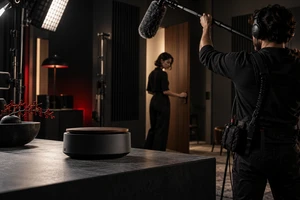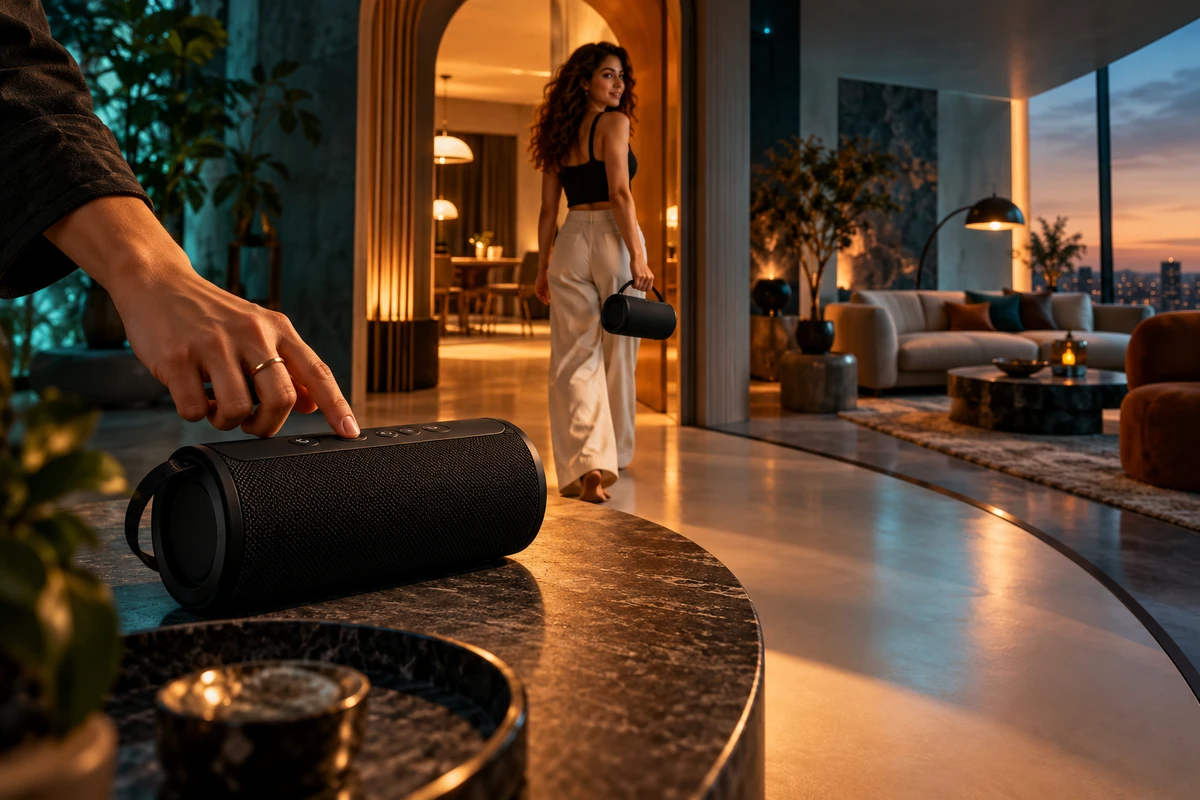
A one-take product ad works when continuity proves something worth seeing. The audience watches a product move from one state to another, change a space, or complete a task without an edit hiding the middle. That continuous time can make an experience feel credible. If the product needs comparison, magnification, or several different contexts to be understood, forcing everything into one shot usually turns the camera into the hero.
The real design problem is not how long the film can avoid a cut. It is how three paths stay synchronized: the product's changing state, the audience's moving attention, and the relay among performers, props, lighting, focus and sound. Break any one of them and the long take becomes an expensive camera move.
A one-take film proves continuity, not every product claim
Editing can compress time, compare details and combine several successful moments into one ideal process. A one-take film gives up some of that freedom in exchange for a narrower promise: the audience sees an action travel from its starting point to its result in the same stretch of time and space.
That makes it useful for continuous relationships. A folding device moves from storage to use. A cleaning tool crosses different surfaces along one route. A lighting product gradually changes the depth of a room. A coffee machine connects preparation, activation and the wait for the first cup.
Continuity is not automatic proof of performance. Performers rehearse, props can be preset and crew members can work outside the frame. The shot only shows that the pictured process was continuous. It does not establish general durability, speed or results, so a brand still has to separate a creative demonstration from product testing.
Draw the product cause-and-effect line before the camera path
Many long-take storyboards begin with the camera: push through a doorway, orbit a performer, pass behind foreground objects and arrive at the hero product. The path may be elegant, but it does not say what the viewer learns at each stage.
Start with the product line instead:
- What is the initial state?
- Which action triggers a change?
- Where can that change be seen or heard?
- Who or what receives the result?
- How is the final state different from the opening?
Only then should the camera choose its positions. It can follow the product or wait where the result will appear. It can leave the product to observe a reaction, but sound, light or movement direction must keep pointing back to the cause. Every camera move should complete an information handoff, not simply demonstrate that a stabilizer can travel.
Our earlier guide to camera height in product ads explains how viewpoint changes the relationship between audience and object. A continuous shot adds time to that decision: what does this angle reveal now, and why must the next angle be reached through movement?
Divide the set into information zones, not just floor marks
Long-take rehearsals often produce a forest of tape marks. The performer stands here, the camera stops there, and a prop enters from the right. Marks prevent collisions, but they do not guarantee that the information reads.
Treat the set as a sequence of information zones. The first shows the product's original state. The second lets a hand meet its structure. The third reveals the environmental consequence of the function. The fourth lets a person or the space respond. When the camera enters each zone, it needs a stable viewing window long enough for the audience to confirm the state before moving on.
Adobe's guide to the complex master shot describes blocking, camera movement and sometimes lighting as coordinated storytelling tools. It also notes that a full master helps rehearsal timing and blocking. In a product ad, that master can become the film's spine. But a spine still needs joints: brief holds, occlusions or completed actions between zones give the audience time to process and give the crew room to adjust rhythm.
The relay must change what the shot means
A one-take film is not a solo endurance test for the camera operator. Focus, lighting, performance, props, mechanisms, sound and floor crew all pass responsibility. The question is whether each handoff changes the subject of attention.
Imagine a portable speaker entering a room. The camera follows the hand and handle. When the speaker lands, focus moves to the control. At activation, lighting changes the depth of the background. Sound leads the camera toward another performer, and that person's eyeline returns attention to the product. The order is product action, spatial consequence, human understanding — not six departments displaying technique at once.
With several performers, avoid synchronized smiles and turns. Use the asymmetric attention described in our article on group performance in brand films: one person notices first, another understands through that reaction, and a third joins half a beat later. A long take preserves those timing differences. It also magnifies false reactions.
Focus, exposure and sound determine whether the shot really connects
The hardest breaks are often invisible on a blocking diagram.
Focus should follow the information relay. If a product moves from foreground to midground and then returns in a performer's hand, keeping focus glued to the object is not enough. Focus must hand attention between structure, action and result. Repeated racks without a new idea make the viewer search for a point that does not exist.
Exposure cannot be delegated entirely to post-production. Moving from a window into a dark area, turning a glossy surface toward a source, or activating a bright display can change dynamic range and reflection. Walk the complete path before shooting. Decide which changes come from a lighting cue, which can be handled by a smooth camera adjustment, and which areas should not be crossed continuously.
Sound can establish a destination before the camera arrives. A lid, latch, motor, notification or change in room tone can point toward the next action. But if music covers the real product feedback, the picture stays continuous while the cause-and-effect chain disappears.
A strong long take includes a recovery plan
The riskiest design has only one repair: start again from the beginning. The later an error occurs, the more successful work is lost, and the more performers and mechanisms tire.
Build recovery points into the rhythm. Door frames, bodies crossing the lens, extreme product close-ups, whip pans, dark areas and motion blur can create natural occlusions. They serve the experience first, while preserving optional hidden cuts. Keeping a cut point is not a betrayal of continuity. It prevents production risk from becoming a test of creative purity.
Props also need to reset. Can the liquid be replenished? Can the package be resealed? Can a mechanism return to its starting state? Can screen content reset quickly? Are wardrobe and hand positions recorded? If an irreversible action has only one sample, it does not belong near the end of a long take.
A social one-take film does not have to be long
TikTok's home and lifestyle creative guidance lists a continuous shot as one simple way to structure a product narrative with little editing. The same guide also presents multi-shot edits, transitions, text and sound as useful choices. Fewer cuts are an option, not a platform law.
TikTok's June 2025 performance-ad guidance recommends establishing the proposition early. A one-take film that spends eight seconds moving through a hallway before revealing the product makes the viewer pay for the choreography. A better short-form version often opens on an unusual product action or result, then uses movement to reveal the cause.
The same master should not be mechanically cropped into every format. A horizontal version can preserve a spatial route. A vertical version needs redesigned entrances and product holding zones. A six-second cut may retain only the trigger and result. What scales is the product logic and action relay, not one fixed camera path.
AIGC can previsualize the route, but core continuity still needs care
Generative video is getting better at longer sequences, but long-horizon consistency remains an active research problem. Google Research's 2026 work on coherent long-form video generation describes character and environment drift, cascading upstream errors and world-state tracking as central challenges. Its systems use structured storyboarding, visual memory and repeated evaluation to improve continuity.
Product advertising makes the risk more specific: an interface moves, a hand-product contact drifts, a screen changes content, or a reflection invents structure. AIGC is useful for exploring movement rhythm, spatial transitions and environmental extension that does not carry product truth. Critical functional action is usually safer in live action, controlled CG, or a hybrid workflow that can be checked frame by frame against real references.
If a generated shot preserves continuity by hiding product detail, it solves the lack of cuts while losing the reason for continuity.
Decide with three viewings
First, watch only the product. Can its state be tracked from start to finish? Second, mute the film and watch the camera. Does it hand attention to the right place? Third, listen without looking. Do action, space and result still have audible landmarks?
If any path asks the viewer to guess, cutting is not failure. Editing restores detail, comparison and emphasis. A long take preserves credible relationships among time, space and action. Before choosing one, ask not whether the crew can execute it, but which product value only becomes convincing when the audience sees it continuously.
If your launch film needs real product function, human action and a changing environment inside one visual flow, ONCE can develop the action previsualization, camera tests, production blocking and horizontal and vertical versions together. Start with the ONCE English site.
Sources and scope
Production references used here include TikTok Creative Strategies, TikTok for Business's June 2025 performance-ad guidance, Adobe's master-shot guide, the D&AD 2026 Annual entry for BritBox's See It Differently, and Google Research's 2026 long-form video work. The BritBox film demonstrates a case in which an unbroken shot embodied a brand proposition about craft; it does not prove that longer takes improve advertising results. None of these sources guarantees campaign performance.