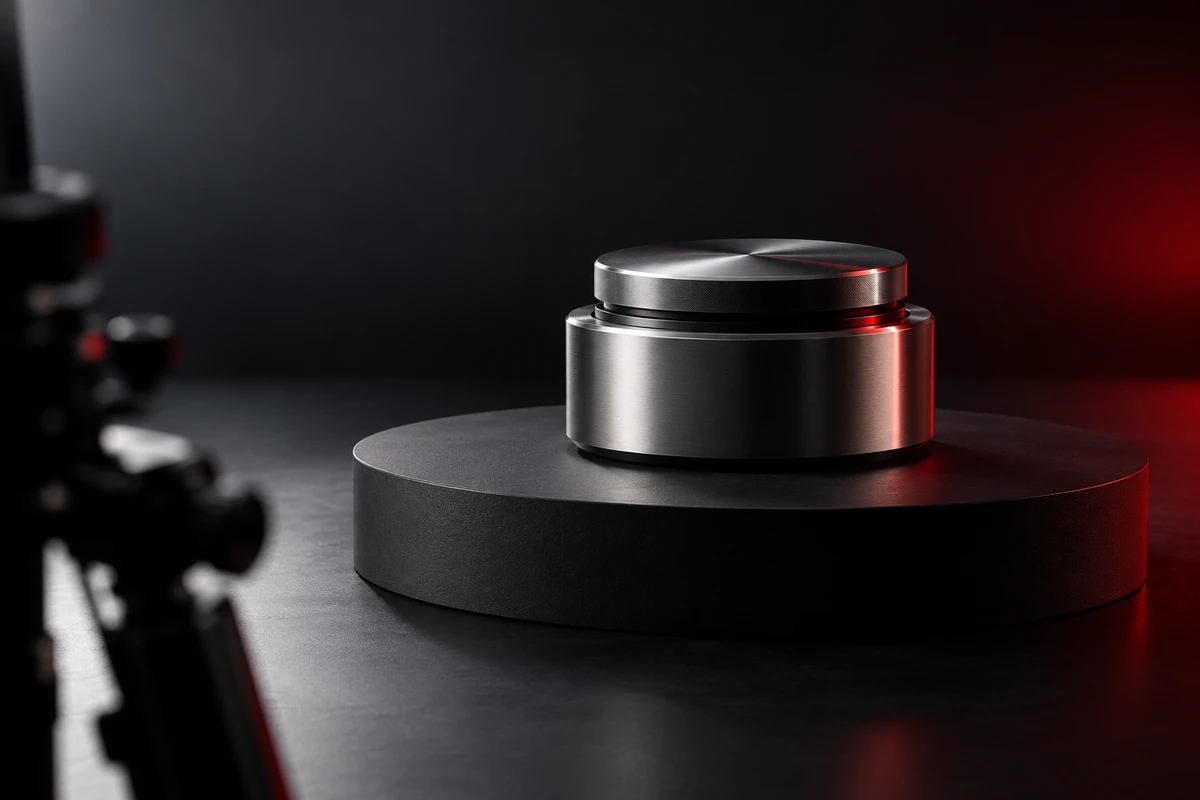
A low camera can create an instant hero shot. The product presses against the horizon, the foreground grows, and its edges rise like architecture. But the same shot may foreground the underside, hide the controls, or distort the very feature the audience needs to understand. In product advertising, camera height determines the viewer's relationship with the object before it determines style.
A powerful frame is not simply a lower frame. Camera height, silhouette, contact surface, functional axis, and focal length need to support the same idea: why should this product be looked up to, examined as an equal, or understood from above?
Camera height defines the relationship before the mood
A 1992 study in the Journal of Marketing Research compared product evaluations across upward, eye-level, and downward views. Under low processing motivation, looking up at a product produced the most favorable evaluations; under moderate motivation, eye level performed best; at high motivation, the angle effect was not significant. The experiments were conducted under specific conditions, so they do not establish a universal conversion rule. They do show that camera angle is not an isolated visual switch: its meaning changes with how closely an audience processes the message. The study abstract and publication record are available from SAGE.
A low view usually places the product above the viewer. It can suggest something immovable, hard to ignore, or ready to act. Eye level puts product and viewer on a shared line, making structure, interface, and operation easier to judge. A high angle hands the layout to the viewer and can make parts, sequences, or arrangements easier to understand.
Before choosing a height, ask what this shot wants the audience to do: submit to the object, approach it, or understand it. Without that relationship, a premium look can become a short-lived angle effect.
Eye level is not human eye height
For a desktop device, placing the camera at an adult's standing eye height is rarely useful. The relevant level may be the center of a display, the axis of a dial, a hinge, a lens module, or the line where two materials meet. When the camera approaches that functional axis, the viewer can see how the product works.
This is why some products look commanding from below but difficult to use. Buttons disappear along the top edge, ports fall into shadow, screens collect reflections, and the relationship between hand and object breaks. A restrained eye-level view may feel less theatrical, yet reveal thickness, opening path, and control surface in one frame.
Eye level is not neutral, either. Raise the camera by a few centimeters and the top structure appears; lower it and the front plane becomes more complete. Moving from “human height” to “the height where the function happens” is often more precise than choosing between three generic angle labels.
A low angle needs silhouette and contact to earn its power
When a low angle works, the frame usually has a clean silhouette and a believable weight-bearing relationship. Whether the outer edge separates from the background, how the base meets the surface, and whether the shadow explains weight all affect the sense of authority.
Lowering the camera without reorganizing the background can let shelves, window lines, or props cut through the product. Moving a wide lens too close can enlarge the front and shrink the rear until presence becomes distortion. Visual-science demonstrations make the distinction clearer: when subject size is held constant, changing camera position changes the perspective relationship among objects, while focal length and sensor size affect the field of view. The figures in Camera Focal Length and the Perception of Pictures compare these variables directly. An Edmund Optics guide further shows how focal length, sensor size, field of view, and working distance interact.
For product advertising, a safer low-angle process is to establish the key silhouette, decide whether the underside deserves attention, and only then choose how much front-to-back perspective the shot needs. If the product's value lives in a top control surface, opening mechanism, or overhead layout, the low angle may be answering the wrong question from the start.
A high angle gives the viewer control, not necessarily a smaller product
High angles are often treated as weakening the subject. Yet when value comes from arrangement, sequence, or coordination, a high view lets the audience understand the system before any single component. It suits modular equipment, kitchen tools, kits, and scenes that compare several states on one plane.
The trade-off is compression. A top view can erase thickness, suspended structure, and fine side seams. The solution is not always to abandon the high angle. Let it carry the relationship among parts, then restore volume and action with an eye-level or slightly lower close-up.
This differs from our earlier analysis of scale shifts in advertising. Scale-shift storytelling changes the ratio between product and world. Camera height changes the viewer's position within a world whose scale remains plausible.
A film needs an angle grammar, not a permanent low view
Power can be built across a sequence. An opening low angle creates presence. The next shot returns to the functional axis so viewers can read the structure. During use, the camera joins the shared height of hand and product. A slightly low hero frame can return at the end, now supported by evidence established earlier.
That progression is more persuasive than continuous upward viewing because authority emerges from function, material, and action instead of pose alone. Industrial products especially need a stable reference before motion can be read accurately. Our article on stable references and motion precision in industrial product video explores that problem in detail.
During a location or tabletop test, capture three brief options: eye level near the functional axis, a mildly low angle that avoids an irrelevant underside, and a gentle high angle that explains layout. Compare them as a sequence, not only as isolated hero frames. Ask whether the audience receives attitude, evidence, or use context first.
AIGC and CG require the angle to be decomposed
In a generative workflow, “cinematic product shot” is too vague. Camera angle, shot size, lens character, camera distance, and product orientation should be specified separately. A Runway camera-angle guide likewise separates camera angle from shot type and notes that tools may interpret angle terms differently. This is vendor workflow guidance, not proof that a generated product will preserve accurate geometry.
The largest risk is often not insufficient drama but identity drift. A low angle invents an underside; a wide view stretches a control; a top view relocates a port. AI can help explore angle sketches, but critical geometry still needs to be checked against product CAD, verified photography, and brand-approved references. The more extreme the angle, the more expensive that verification tends to become.
Three questions resolve the choice
Bring the decision back to three questions. Is the product's most important silhouette visible? Is the place where the function happens accurately explained? Does the viewer-product relationship support the value the film is claiming?
A low angle is powerful only when it answers all three. Otherwise, it has merely placed the camera closer to the floor.
If you are planning a product campaign for a new launch, industrial system, or consumer device, ONCE can connect camera tests, lighting and art direction with live action, CG, and AIGC production. Explore our advertising video creative and production services to turn “power” into product evidence an audience can see and understand.