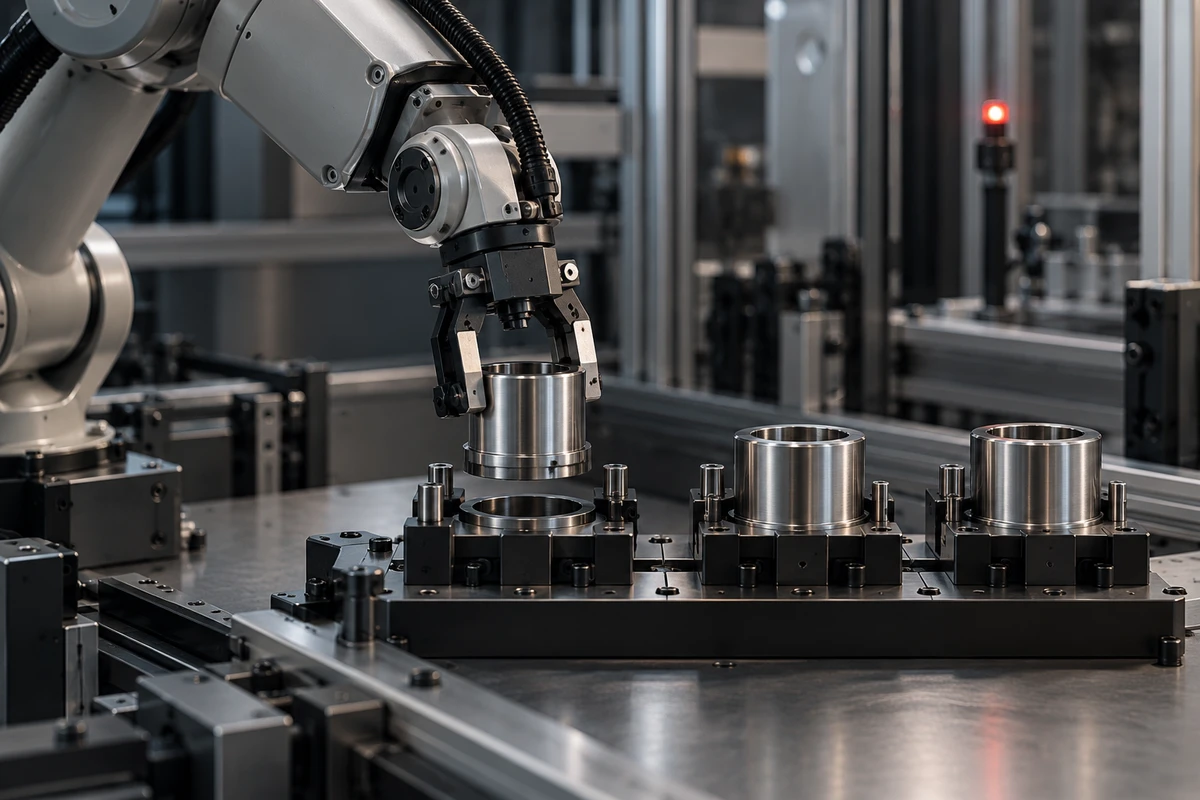
A robotic arm can pick, rotate and place a part, return to its starting point and do it again. On the factory floor, the stability may be obvious. In the finished film, however, the audience may see only a blur of movement: the camera pushes, the edit accelerates and the music keeps urging the machine forward. The very quality worth trusting, precision, disappears.
Industrial product videos often treat speed as power and complex camera moves as shorthand for technology. Buyers of robots, automation systems and precision hardware usually need something more specific. They need to understand how the product moves each time, where it stops and how it coordinates with the rest of the system. Sometimes the camera has to become quieter for that capability to remain visible.
Precision needs a reference point
Viewers cannot see an error value directly. They compare whether two motions follow the same path, whether the end effector returns to the same location and whether each part reaches the same destination. Without a reference, precision remains a line of narration.
The reference does not have to be a ruler. The edge of a fixture, a fixed mark on a conveyor, the gap between a component and its tray, or one static structural line in the frame can help the eye judge path and position. A locked camera is not visually unsophisticated here. It turns the space into a coordinate system that can be read more than once.
In its SCARA guidance, updated in August 2026, FANUC discusses speed, work envelope, payload and repeatability as separate considerations. That distinction is useful for filmmakers: fast does not mean repeatable, and reaching a position does not mean reaching it the same way every time. A film that keeps only the fastest take makes repeatability difficult to understand.
One beautiful move is weaker than three consistent moves
Advertising usually selects the most perfect take. Industrial imagery can benefit from keeping repetition. Show the same pick-and-place action two or three times in one composition and the viewer starts comparing automatically: Is the path consistent? Does the fixture vibrate? Does the machine settle cleanly? Do the surrounding components respond in sync?
Repetition does not mean duplicating a shot. The material, position or timing can change slightly while the core movement remains recognisable. This keeps the sequence visually alive while making stability observable. If the real machine cannot reproduce the behaviour consistently, editing should not manufacture that claim.
The moment of settling often says more than the speed
Industrial shots are frequently cut before the action finishes because the pause seems less energetic. Yet the end effector settling at its target, a gripper releasing a part without residual movement, or a status light appearing with the completed action can communicate control more clearly than the high-speed section.
Leave a few frames for arrival, deceleration, stillness and feedback. Without that ending, the audience sees motion. With it, they see control.
Every camera move should explain something
Tracking, orbiting and rapid pushes create immediacy. But when the product is already moving across several axes, moving the camera at the same time removes the reference the viewer needs. The result may feel energetic while explaining very little about what the machine completed.
Locked shots prove; moving shots immerse
Give the two shot types different jobs. Locked shots or tightly controlled short moves can show the complete path, repetition and stopping point. Moving shots can establish scale, spatial relationships and emotion. Let the audience understand first, then bring them closer.
When the camera must move in sync with the equipment, motion-control cinematography is valuable not only because the move looks polished, but because the camera path can be repeated. Different passes, lighting states or product conditions can retain the same spatial relationship in post-production. It is useful for precise composites and repeatable camera positions, but it is not a requirement for every industrial project.
Slow motion reveals detail but can rewrite the real rhythm
High-speed capture can unfold a grip, impact, vibration or material change that happens too quickly to inspect. Phantom describes high-speed imaging as a way to visualise and measure fast phenomena. Its creative value is the ability to reveal a process, not an automatic premium look.
Some industrial products, however, derive value from their real cycle time. Slowing every action can make an efficient system feel sluggish or make minor vibration appear structurally significant. A more honest sequence keeps one complete action at real speed, then uses slow motion to explain one important instant.
ARRI notes that motion blur is shaped by creative choices such as shutter angle. For industrial work, too much blur can erase paths and edges; too little can make movement feel like a sequence of jumps. The setting should follow what the viewer needs to read: continuous speed, a contact event or the accuracy of a stop.
Sound should share the same timeline as the machine
Precision is not purely visual. If motor start-up, gripper closure, material contact, valve release and completion feedback fall out of sync, even a beautiful shot feels assembled in post. Industrial sound does not have to preserve every piece of location audio, but the timing of key events should remain truthful.
Sound design can reduce continuous factory noise and emphasise one or two action points. It can also organise the collaboration between components into a readable rhythm. What it should not do is add an exaggerated impact to every movement and turn precision equipment into an action trailer. Power may be enhanced; causality should not be rewritten.
Test one complete action before choosing the style
Before debating a robotic camera or high-speed unit, record one complete action from an ordinary stable position. Let the machine begin at rest, complete the task and return to a state the viewer can judge. Review that clip with both the technical lead and the creative team.
Ask four questions. Are the start and end points visible? Can two repetitions be compared? Is the critical contact unobstructed? Are sound and system feedback synchronised? When all four answers are clear, the visual style has a reliable structure. If the basic action is still difficult to understand, more effects will only hide the problem.
This is the preparation that factory and corporate video production should complete with the technical team: decide which capability a customer must understand, then plan the real action, camera position and approved information around it. To turn an industrial product's motion into a hero film, exhibition cutdown or sales explanation, talk to ONCE about the product, audience and demonstrable conditions.