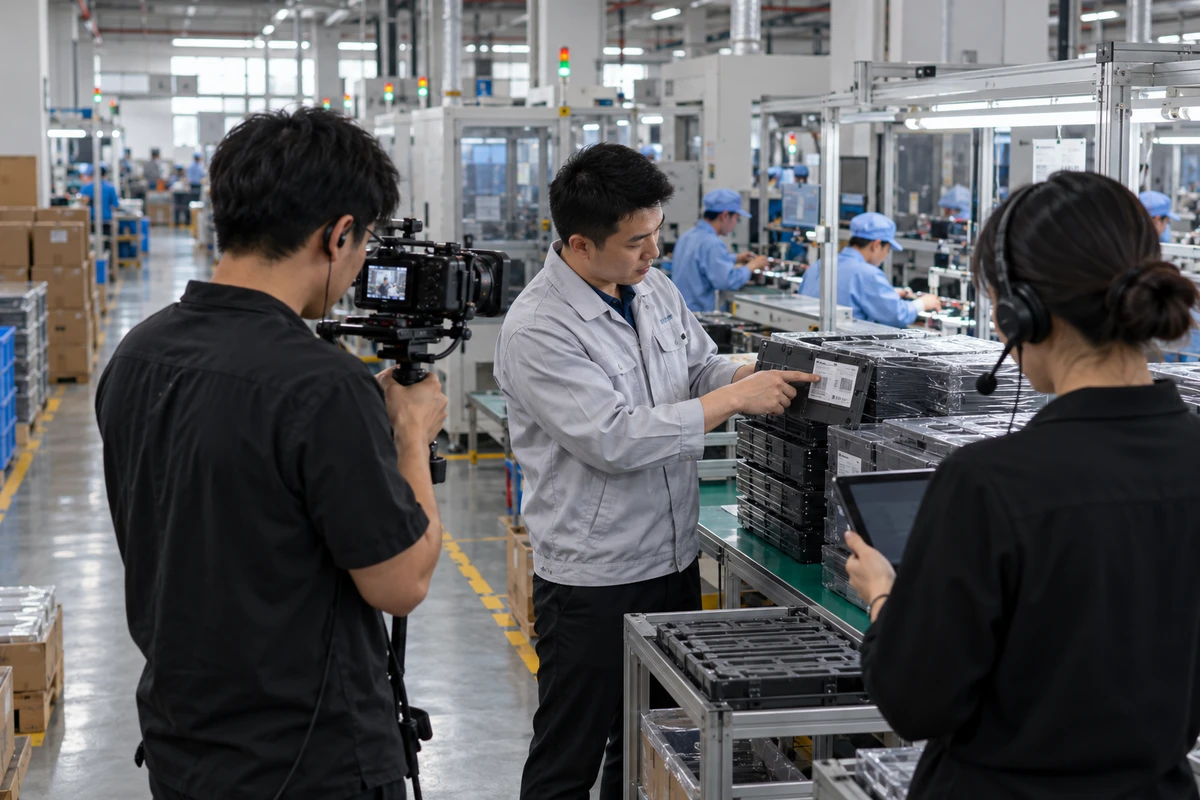
A supplier sends a polished factory walkthrough. Procurement's next question should be simple: can we choose the next aisle, ask the camera to go back, select a carton at random, and see what happens when something fails inspection?
If the answer is no, the film may still be useful—but it is orientation, not a buyer-controlled inspection. The format should follow the sourcing decision. Pre-recorded video explains the site consistently. Live video enables unscripted questions. A hybrid evidence session combines context with controlled spot checks. A formal audit remains a different engagement led by qualified auditors or inspectors.
The production team's role is to make the process visible, stable and reviewable. It should never be hired to manufacture the conclusion.
Four assignments that should not share one vague quote
| Format | Best use | What it adds | What it cannot establish alone |
|---|---|---|---|
| Pre-recorded factory video | Early supplier screening and process orientation | Stable picture, captions and reusable chapters | What happened outside the selected route or edit |
| Buyer-directed live walkthrough | Unscripted questions and selected visual checks | Buyer control over movement, return and close-up requests | Facts that require testing, sampling or records beyond the camera |
| Hybrid evidence session | Complex, cross-border reviews | Efficient context plus live challenge of selected risks | Certification, independent judgment or regulatory acceptance |
| Formal remote/on-site audit | A conclusion against defined criteria | Qualified method, responsibility and records | A production crew cannot issue the auditor's conclusion |
ISO/IEC TS 17012:2024, published in July 2024, says remote audit methods are not intended to replace on-site methods. They are tools for conducting an audit effectively and efficiently. IAF MD 4:2025, applicable from 30 January 2026, requires agreement on ICT use, security and confidentiality, infrastructure checks, documented risks, competent participants and reporting on the extent and effectiveness of ICT use. It also notes that manufacturing, warehousing and physical testing do not become “virtual sites” merely because they can be observed remotely.
Those documents govern conformity-assessment activity, not corporate-film production. Their practical lesson for a brand is narrower: a video connection can support evidence gathering, but the connection itself does not turn a factory tour into a formal audit.
The ONCE Two-Flow, Four-Anchor protocol
Start by deciding what the buyer must be able to review after the call. Then build two continuous flows.
Location flow
Establish the agreed site at the exterior, nameplate or entrance, then preserve the spatial relationship between reception, production, quality, warehouse and dispatch areas. The route does not need to reveal trade secrets. If recording must stop or move around a restricted zone, identify the break. Do not edit separate spaces into the appearance of one uninterrupted walk.
Process flow
Follow the relevant product from incoming material or component through production, in-process checks, final inspection, nonconforming-material handling, packing and dispatch. The item does not need to complete the whole process during one call. The camera, labels and records should make clear which product, batch, line or operation is being discussed.
Lock both flows with four anchors:
- Identity: facility, area, role, product line and participants;
- Time: date, local time, segment start and any interruption;
- Object: the sample, batch, carton, label, machine or record under review;
- Disposition: who quarantines, retests, releases or escalates an exception.
For the separate question of what a pre-recorded buyer evidence kit should contain, ONCE has a guide to building orientation films, question-led clips and an evidence index. The protocol here begins where that deliverable ends: it defines how a live session gives the buyer control and produces a reviewable record.
Choose the format from the decision, not the camera
Use pre-recorded video for orientation
This is appropriate when a buyer is still screening suppliers and mainly needs to understand the product category, site layout, process map and responsible teams. The process is stable, the footage is permitted for repeat use and no unscripted spot check is required. A successful video does not “prove the factory.” It helps the buyer form better questions and identify the next document, sample or meeting.
Add buyer-directed live video when control matters
Live becomes valuable when procurement or quality needs to choose the next area, return to a workstation, select an object, read a label or ask an operator to demonstrate a test. The benefit is not merely that the feed is real-time. It is that the buyer can change the route and challenge the prepared narrative.
Default to hybrid for complex cross-border reviews
For a large site, multiple departments or a narrow time-zone overlap, send a short pre-recorded route and site diagram first. The buyer marks risk points before the meeting. The live session is then reserved for identity checks, continuous transitions and selected challenges. On the same day, deliver the recording, time-coded stills, questions, exceptions and outstanding documents.
A WHO/UNFPA sector-specific guidance document for remote manufacturer inspections illustrates this logic. A pre-recorded factory tour can establish context, while inspectors retain the ability to request live views of specific areas. The document also calls for advance network testing across the facility, date/time/location labels, recording permissions and discussion of proprietary areas. It is not a universal factory-audit standard, but it is a useful operational example of why hybrid is more controlled than an improvised end-to-end call.
Escalate beyond video when the conclusion is not safely visible
Stop treating remote video as the answer when a decision depends on hidden construction, calibrated measurement, sampling integrity, laboratory conditions, safety exposure or a prescribed regulatory method. Escalate when the factory cannot show a critical area, confidentiality controls cannot be agreed, network quality breaks the evidence path, or the contract requires independent/on-site inspection. The buyer's appointed auditor, inspector or certification body should own that decision.
Run the live session as a controlled production
Before the session: questions, permissions and route
The buyer supplies its questions and mandatory challenge points. The factory classifies areas as recordable, mask-required, live-only or prohibited. The production team turns those constraints into a primary route, an alternate route and a connectivity map.
Agree in advance who may be recorded, which customer marks or documents need masking, whether the session may be stored, who may access it and when it will be deleted. Test every weak zone—not just the conference room. A primary factory connection should have an independent cellular or secondary-network fallback. Audio deserves equal attention: a sharp picture is of little use when machinery masks the question, interpretation or answer.
During the session: separate authority from execution
The buyer or auditor owns the questions, route changes and conclusions. The factory liaison explains the process and calls the relevant staff. The camera operator follows visual instructions accurately. A technical producer monitors the meeting, audio, recording and backup connection. An interpreter translates without becoming the technical decision-maker. A scribe logs timecodes, questions and open actions.
Open with the agreed identity, location, local time and scope. At a critical point, the buyer should be able to request a continuous move, pause, close-up, return or random selection. If the feed fails, log the interruption. On reconnection, re-establish the location and object, then repeat the critical segment. Never use an unmarked edit to make a broken path appear continuous.
After the session: deliver records that can be found
A two-hour recording by itself is often unusable. A better evidence pack includes:
- the original meeting or live-stream recording;
- continuous critical segments and permitted stills;
- a time-coded Two-Flow, Four-Anchor index;
- the question-and-answer log;
- interruptions, refused views and unresolved points;
- document owners, due dates, access rules and retention dates.
SGS describes QiiQ as a service in which an on-site SGS inspector works with a remote expert who directs steps, asks questions, checks documentation and records process, tests, product, packaging and markings. Intertek's Inview connects live smartphone video to qualified technical inspection experts and can provide inspection records on request. These pages establish how those two companies structure their own services; they do not prove that every remote inspection must use the same method. Their shared design principle is still useful: the expert owns the inspection judgment, while the video system enables and records the work.
Price the dependencies, not “two hours on Teams”
Two sessions of identical duration can have very different risk and workload. A practical cost model is:
Total cost = risk and route design + technical rehearsal and network redundancy + on-site capture/live duration + auditor, interpreter and support roles + evidence indexing and archive + contingency/reshoot
When comparing suppliers, check whether the quote includes:
- translation of buyer questions into route and camera instructions;
- connectivity testing along the whole route and an independent fallback;
- separate people for camera, meeting control, interpretation and logging where needed;
- the buyer's right to redirect the route and select objects;
- a log of outages, refused views, restarts and other exceptions;
- original records, a time-coded index, open actions and access controls.
A quote for “one camera operator plus a two-hour call” leaves the buyer to carry the process design, technical failure and evidence-management risks.
Let AI organize the record, never invent the missing view
AI can help transcribe the call, draft bilingual captions, index timecodes, group questions and prepare meeting notes. It should not reconstruct footage lost during an outage, generate a label that was never captured or turn an enhanced detail into purported original evidence. If denoising, stabilization or exposure correction is applied, preserve the original and record the transformation.
The scalable capability is not a more expensive camera kit. It is a repeatable protocol: who controls the route, which transitions must remain continuous, how outages are handled, what ships the same day and which conditions end the remote review. Use pre-recorded video for low-risk orientation, buyer-directed live video for unscripted visual checks, hybrid evidence for complex cross-border work, and independent or on-site inspection when the consequence or method exceeds what a camera can safely establish.