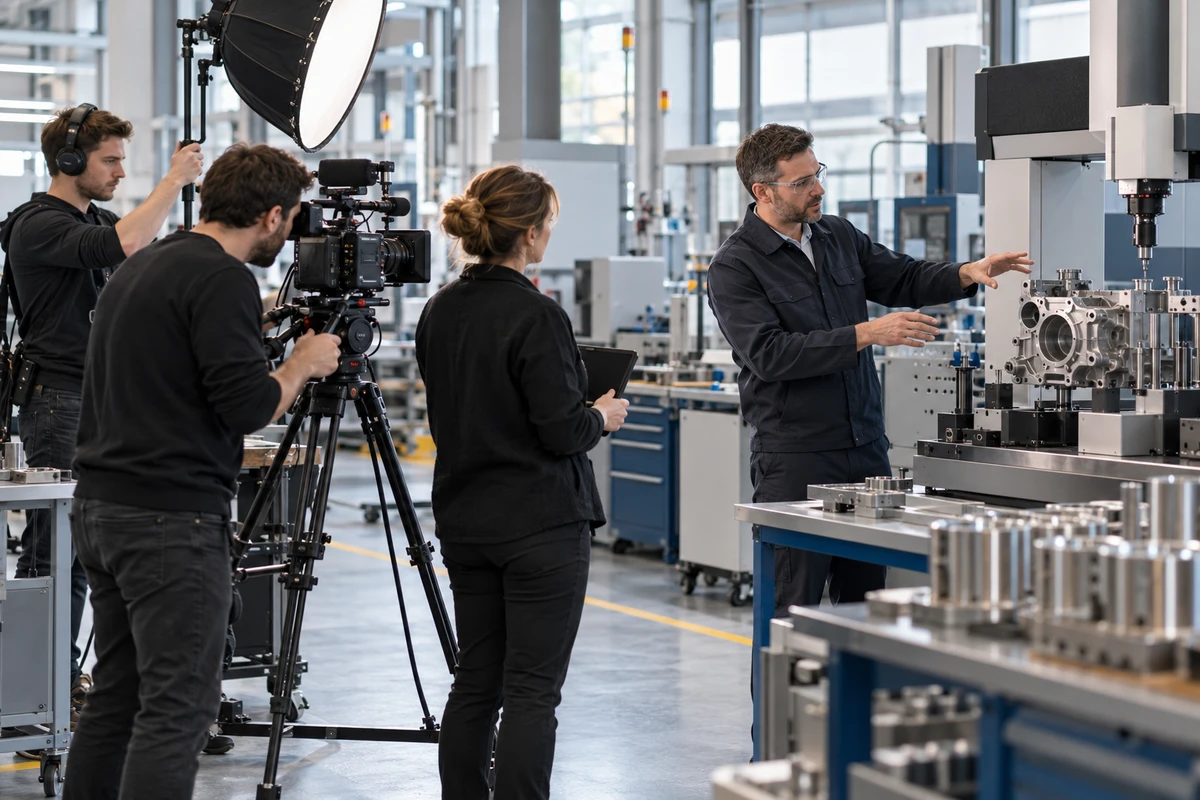
When an overseas customer cannot visit the factory, a three-minute corporate film can show the site, the team and the product. It cannot carry an entire supplier decision. Buyers rarely watch in the order a director intended: a salesperson sends one link, an engineer jumps to the test process, procurement wants to know who owns delivery, and an executive may watch only a minute before a call. Useful B2B trust video should therefore be delivered as a remote evidence kit that can be paused, located, forwarded and questioned—not only as one film that must be watched from beginning to end.
This does not mean cutting the same master into ten arbitrary clips. Each asset needs to answer one defined question and connect to an owner, a production date, a related document and a next conversation. The hero film gives orientation. Question-led clips give answers. An evidence index makes them traceable. A sales-use guide gets the right material to the right person.
First, place video correctly: it is not a factory audit
McKinsey's 2024 B2B Pulse survey gathered responses from nearly 4,000 decision-makers across 13 countries. Respondents used an average of ten interaction channels during the buying journey, with company websites, in-person sales and video conferences among the most frequently used touchpoints. The study does not prove that a corporate film will generate an order. It does show why remote buying is not a single-link journey. Video is most useful when it gives websites, email, calls and exhibitions a shared factual context.
IAF MD 4:2025, applicable from 30 January 2026, lists electronic meetings, remote document review, recordings and visual or audio access to remote locations as possible ICT methods in conformity assessment. It also requires controls for security, confidentiality, feasibility and agreement. The document governs conformity-assessment bodies; it is not a corporate-video standard. The useful lesson is narrower: seeing a process remotely is not the same as completing an audit. Marketing video can help a buyer understand and ask better questions, while certification, testing, samples, contracts and formal assessment still require their proper documents and procedures.
Layer one: a 90-second orientation film
The hero film does not need to contain the founding year, every product line, every certificate and every department. It has three jobs: state the business problem the company solves, map the critical stages between requirement and delivery, and show whom the buyer should approach for the next level of detail.
Consider a hypothetical machine-vision inspection system manufacturer. The film can follow one workpiece. An engineer confirms the part and inspection objective; the system identifies a condition; a quality specialist reviews an exception; and a project owner explains how the equipment enters a customer's production line. Factory wides and team imagery can establish context, but they serve that business path. The acceptance test is not whether the company looks large. It is whether a first-time viewer can sketch the basic workflow and knows which question to open next.
ONCE's factory and corporate video production service shows how R&D, manufacturing, people and delivery can be planned across website, exhibition, sales and multilingual uses. The kit described here starts after those facts have been selected: it determines how each fact can be found and reused.
Layer two: six question-led evidence clips
These clips are not mechanical cutdowns. Each runs roughly 20 to 60 seconds, answers one question that can be checked further, and preserves enough context to understand the action. For the hypothetical machine-vision product, the set might show:
- how sales receives an input and hands the requirement to engineering;
- how an engineer confirms the workpiece, inspection objective and current sample state;
- how a first-article trial begins and what is checked before operation;
- who evaluates, records and escalates an exception;
- which role performs a pre-shipment check and what may be shown publicly;
- what the customer must prepare for installation, training or maintenance.
Every clip needs an identifiable role, a complete action and a deliberately limited conclusion. Showing an instrument does not prove a performance claim. An engineer saying that the team reviews exceptions does not promise the same lead time for every order. Capacity, yield, certification, customer names and performance numbers must return to the relevant record, product scope, date and publication permission.
A public project such as ONCE's Jiyang Zhuyun corporate film can demonstrate how people, laboratory activity, documents and automated equipment appear in one visual path. The page describes only what is visible in the work; it does not infer production capacity or customer outcomes. That restraint is the model an evidence clip needs.
Layer three: an evidence index, not just attractive filenames
Remote material often fails a month after delivery. The image still looks polished, but nobody remembers what it supports, when it was filmed or which document should accompany it. Keep one internal index row for every clip:
- clip ID and question, such as Q03, “How is an exception detected and handed over?”;
- filming date, location and the role on screen, without exposing unnecessary personal data;
- the limited statement the image supports and the conclusions it does not support;
- related specification, test record or process note, plus the department that owns it;
- permission level: public website, exhibition, directed sales or meeting-only;
- approved Chinese source wording, approved English wording, units and version date.
The index does not need to be public. It is a shared fact-lock sheet for post-production, localisation, sales and technical owners. It prevents the website version from saying “defined process,” the sales cut from becoming “global standard,” and the exhibition subtitle from promising “zero defects.” Multilingual corporate-video production should not begin after picture lock. Terminology, units, role names and qualifications should be checked before the rough cut is approved by both the technical owner and a suitable language reviewer.
Layer four: a guide for when sales should use each asset
The viewing task changes by channel.
A website visitor needs the business map first, then the option to open R&D, manufacturing or quality clips. A first sales email should contain only one or two assets relevant to the current question, not a data-room dump. A video call can play a clip before handing the conversation to the person shown. An exhibition is often noisy, so the cut should rely less on narration and more on clear action, short captions and an obvious route to the next material.
This is why the landscape hero film, question-led clips, subtitle master and silent exhibition version should be defined before filming. The value is not the number of exported files. Each version needs a user, a buyer question and an owner for future updates. ONCE's Shenzhen video-production overview connects production planning with multi-version delivery across commercial uses.
AI can explain a future, but it must not counterfeit present evidence
AIGC or CGI can explain an internal structure, a proposed application or an abstract mechanism without revealing confidential details. It should not appear in the evidence layer as though it were a real factory, an operating machine or a delivered customer site. If synthetic material enters the hero film, mark it separately in the script, approvals and delivery record so that sales cannot later forward a concept visual as a site record.
C2PA's 2026 implementation material for Content Credentials describes machine-readable ways to indicate whether media was generated or modified by AI. Provenance can help teams manage an asset's history, but it cannot decide whether an image is fit to support a business claim. The safer production rule remains simple: store real evidence and conceptual visualisation as separate layers, then keep filenames, end notes and sales language aligned.
Run a find, explain and hand-off test before release
Do not approve the kit only by screening the hero film in a meeting room. Give a salesperson who did not join production three tasks: find the “exception handling” clip within 30 seconds; forward it to an English-speaking technical buyer without increasing the strength of the conclusion; and name the specification or record that must follow. If any task depends on a project insider explaining the archive, the kit is not finished.
Then check five points. Does every clip have a role and date? Do Chinese and English versions use the same fact-lock sheet? Are customer and process secrets masked in public edits? Are AI concepts separate from live-action evidence? Does sales know when to stop answering with video and hand the question to engineering, quality or compliance?
Remote trust does not come from making a factory look futuristic. It comes from helping a buyer find the question, see the action, identify responsibility and move naturally to the next verification step. If you are updating an international website, exhibition or sales package, share the target market, product, filmable processes, interview owners, publication limits, deadline and budget range through ONCE's corporate-video service to request an evidence-led production diagnosis.