Three treatments are on the table. One is emotionally rich, one makes the product look spectacular, and one tells the most complete story. Marketing prefers the first. The product team backs the second. A senior decision-maker says the third “feels more cinematic.” If the review stops at personal preference, the livelier the meeting becomes, the greater the risk of expensive reversals after production begins.
The real question is not which treatment looks best. It is this: which idea can make the brand proposition, the product facts and the practical production conditions work in the same film—and still remain clear in the hero edit, cutdowns and vertical versions?
To make that question concrete, this article uses a completely hypothetical smart-lock launch. The brand, product capabilities, characters and scenes are fictional. They do not represent an ONCE client or a real product.
Replace the taste vote with one communication task
Assume the launch proposition is not “advanced technology.” It is: “Coming home should involve less juggling.” The audience is an urban household in which someone may arrive carrying bags, holding a child or simply have both hands occupied. The intended uses are a launch-event hero film, a brand website and paid or organic social video.
That proposition creates the first test. Does the film make the change from disorder to ease visible? Does the product cause or support that change? If removing the lock leaves the story untouched, the idea may be a polished family film, but it is not yet a persuasive product commercial.
This is the difference between a coherent brand film production proposal and a collection of attractive references. People, product, setting and sound should not merely look good on their own; together, they should express a judgement that belongs to the brand.
Before reviewing treatments, the brand team should align on three sentences:
- what the audience should understand differently after watching;
- which real product action must occur for the story to change;
- which product statement requires sign-off from product, legal or the relevant market owner.
Without those sentences, more references often create more disagreement because every reviewer is quietly using a different standard.
Hypothetical review: why a beautiful rainy-night idea is not ready yet
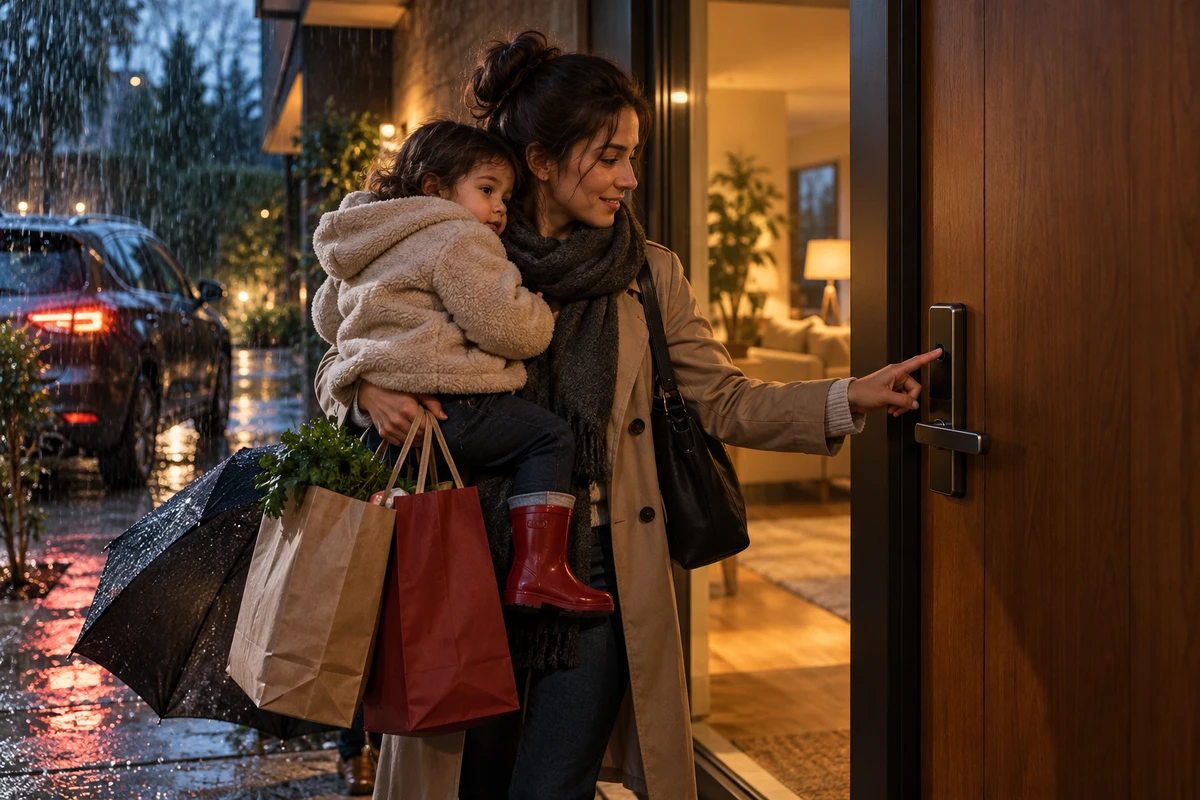
The treatment begins on a rainy evening. The protagonist approaches the door carrying a child in one arm and shopping bags in the other. The lock senses the arrival and opens. Warm interior light replaces the cold street light, while rain gives way to a restrained confirmation tone. The end line is: “Give coming home back to life.”
The direction has a clear emotional change and potentially memorable colour and sound. But “it feels right” is not an approval. At least four conflicts need to be surfaced.
Does the product action go beyond the confirmed feature?
If the current sample does not support passive automatic unlocking, the edit and performance must not imply that it does. The action could become a one-finger fingerprint unlock. Alternatively, the moment of juggling could happen before the door, while the feeling of ease appears in the uninterrupted sequence after entry. The idea may survive, but the product action must return to confirmed fact.
The product’s role also needs a precise description. It is not a hero that appears at the end. It completes the transition from identity confirmation to entry and then to a secure interior. The gesture, interface state, confirmation sound and performance response need to form one causal chain.
Is the memorable scene genuinely distinctive?
Rain, children and warm light are familiar advertising ingredients. Brand recognition may instead come from a sequence: the protagonist leans a wet umbrella against the wall, the lock emits a restrained tone, and the child relaxes against the shoulder as the door opens. The memory lives in the relationship between actions, not in one polished still.
During the review, hide the logo and ask what else distinguishes this film from another smart-home commercial. If the answer is only colour and lens quality, the treatment still needs a more specific product action, human relationship or sound signature.
Can the emotion actually be produced?
“From overwhelmed in the rain to calm at home” does not become real simply because it appears in a director’s statement. It depends on whether the location supports controlled rain, whether wet surfaces can be reset, the working arrangements for a child performer, whether the lock sample can repeat the action reliably, how exposure changes from exterior to interior, and whether sound is captured or rebuilt in post.
A treatment does not need to become a production manual, but it should reveal the conditions that could change the idea. Which elements must be filmed? Which can be achieved through art direction, compositing or sound? What is the lighter alternative if the preferred method fails? If controlled rain is impractical, wet clothing, an umbrella, shoe marks and distant rain sound may preserve the environment without making weather the central performance.
The AICP’s live-action production guidance describes a bid proposal as more than a cost allocation: it is a creative roadmap shaped by the contracting client’s specifications. That is a useful standard for a treatment too. The proposal should make its execution logic discussable before the award, not hide it until pre-production.
A landscape master is not automatically a vertical film
The hero film may use a wide frame to hold the person, the door and the interior in one spatial relationship. A centred 9:16 crop could separate the product from the person. The treatment should therefore identify which shots can be shared, which actions need dedicated vertical close-ups, where captions and interface elements may cover the image, and what makes the situation understandable in the opening seconds of a cutdown.
Current official YouTube guidance, for example, recommends vertical assets for Shorts, while its broader video specification page provides format-specific safe-zone guidance. Specifications can change, so the final export should always be checked against the actual media account and current platform documentation. The production principle is more stable: plan the composition and information hierarchy before shooting rather than treating every platform version as a late crop.
That is why TVC and commercial production version planning begins with distinct openings, actions and endings—not just a list of export sizes.
Six questions that turn a proposal into an executable decision
This review card is not designed to produce a false total score. It works better when marketing, product, creative, production and legal each state what is confirmed, what is missing and who owns the next approval.
| Review area | Answer to record |
|---|---|
| Brand proposition | What should the audience understand differently, and can this sentence guide visual choices? |
| Product role | What action does the product complete, what changes because of it, and could the image imply an unconfirmed feature? |
| Memorable scene | Without the logo, which relationship between person, product, space or sound remains recognisable? |
| Production conditions | Which dependency—sample, location, performance, art, specialist capture, compositing or sound—is most likely to change the idea? |
| Media versions | What opening, key action and end information does each hero, cutdown, landscape and vertical version require? |
| Approval owner | Who signs off brand expression, product facts, claims, visual direction and final deliverables? |
Avoid feedback such as “make it more premium,” “make it more social” or “show the product more.” Convert it into an executable note:
- retain the rainy-homecoming emotion, but replace passive entry with a fingerprint action the sample can demonstrate;
- keep the warm interior, while adding a readable close-up of the lock state that is not blocked by the performer;
- do not crop the wide master for vertical; film separate close-ups of the finger, handle and facial response;
- the product owner supplies final parameter copy; the creative team does not paraphrase it independently.
This does not reduce the director to an operator. It protects the questions that genuinely need directing: how to keep the performance unforced, how to let a product action carry emotion, and how sound completes the transition from exterior to interior.
Three situations in which the “creative direction” should remain conditional
The product state is still moving
If functionality, colour, interface language or the launch configuration may change, the team can approve the story proposition and visual character without marking a detailed feature action as final. Add a sample demonstration or product check before locking the storyboard.
Channel tasks are pulling in different directions
A launch film may need to establish emotion. A product page may need to explain a function quickly. Paid social needs an immediate reason to continue watching. They can share a brand world and selected footage without sharing the same opening. If the proposal supplies only one landscape master, the team has not yet approved the complete campaign system.
The idea depends on an irreversible or untested condition
If the central scene relies on special weather, a single-use build, children or animals, an untested effect, or an engineering sample that does not operate reliably, request one focused test and a fallback. The test is not a miniature finished film. It should validate the one dependency most capable of breaking the concept.
AI previsualisation can help examine framing, continuity or a proposed transition, but it should not quietly turn an unverified product state into an apparent fact. Approve what the preview is actually testing, and keep product accuracy, rights and final execution as separate decisions.
Acceptance should match the reason the idea was approved
If the treatment was approved for the change from disorder to ease, the rough cut should first be reviewed for whether that change is understandable. If the product was meant to cause the story turn, review the completeness of the action before debating the grade. If sound was part of the memorable device, the fine cut should be judged on the transition between rain, confirmation tone and interior ambience.
Brand imagery and feature explanation also need different acceptance criteria. Brand imagery is reviewed for character, human relationship and memorability. Feature explanation is reviewed for action order, product state, copy and audio accuracy. Mixing the two often produces a shot that is repeatedly asked to become more emotional while also carrying more information—and succeeds at neither.
Before final delivery, check the title and version number, aspect ratio, duration, caption language, product wording, music and asset usage rights, thumbnail or key frame, delivered files, and the named owner of each approval. Platform requirements can change; verify them at delivery instead of inheriting export presets from an older campaign.
A strong proposal makes the next step more specific
Creative review is not supposed to flatten surprise. It protects the part worth investing in while exposing product, production and version conflicts early enough to solve them without damaging the idea.
If a treatment can answer six questions—what understanding the brand wants to change, how the product participates, what scene is worth remembering, which condition determines whether it can be made, how each medium remains coherent, and who signs off the result—the team is no longer voting for a favourite image. It is deciding why this commercial deserves to be produced.
To turn an existing treatment into a shootable plan, use the ONCE project enquiry page to share the brand background, confirmed product functions, audience, channels, references, sample status, timing and budget range. ONCE can then discuss the creative, production and delivery versions against the same brief.