Two weeks before a product launch, the biggest risk is rarely one missing video. It is three teams working from three different versions of the product: the event film presents the most ambitious experience, the press folder still carries an old specification, and the sales demo treats an engineering sample as the shipping product.
For a technology product launch, the first item to lock should therefore be a fact master—not the final edit. The fact master connects every public claim to a product version, a repeatable action, its conditions, an approver and every asset that uses it.
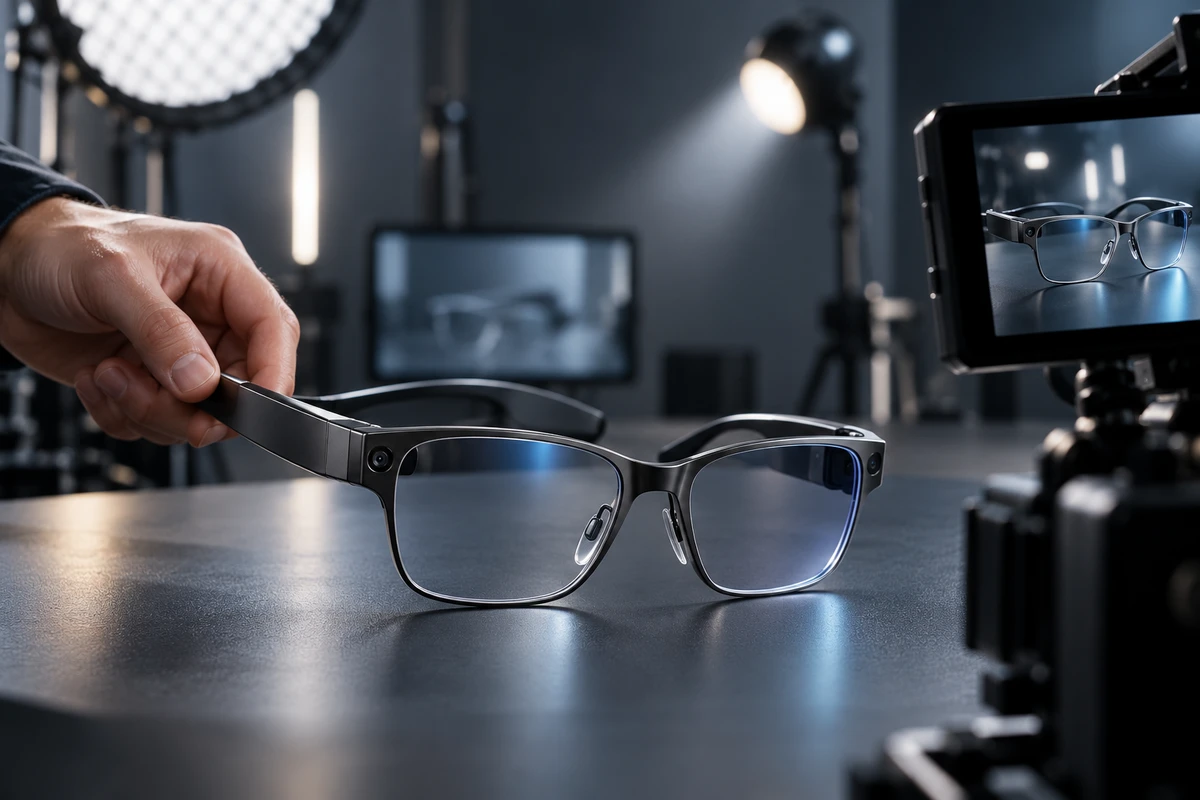
This article uses a hypothetical pair of AI glasses. It is not an ONCE client project and does not describe a real brand. The industrial design is frozen. Live translation, prompting and camera controls can be demonstrated reliably. The battery-life wording is still under review, and production packaging will arrive one week later. One production needs to support a launch-event hero film, a media asset kit and modular sales demonstrations.
Those outputs can share the real sample, material shots and approved product actions. They should not share one narrative, and they must not rewrite the product facts independently.
Diagnose the change before calling it a creative revision
Late revisions are often grouped under “creative feedback,” but they usually come from four different causes: the product state changed, a claim lacks support, the channel task changed, or approval ownership was unclear.
- A new temple colour is a product-version change that affects every exterior shot.
- “All-day battery” without final supporting evidence is a claim-status change. It needs to be removed or qualified, not polished into a better line.
- A request for clean B-roll is a channel-use change that can be solved from well-planned source footage.
- Marketing approved the copy, but product never confirmed the operating conditions. That is an approval gap.
File names cannot manage these differences. A stronger system gives each claim one row containing its version, visible proof, conditions, approval state and affected assets. The US Federal Trade Commission’s current advertising substantiation policy says advertisers should have a reasonable basis for objective claims before dissemination. This is not legal advice for every market, but it is a useful production principle: copy, performance and images can create an implied claim together.
A fact master is not another product manual
The fact master should contain only information that can change the script, shoot, edit or public description. It does not need to repeat a long specification sheet. It needs to let directors, editors, PR and sales find the same answer quickly.
| Field | Hypothetical AI-glasses entry | Production purpose |
|---|---|---|
| Product version | EVT-3 black sample, 8 October firmware | Checks whether a shot still represents the launch product |
| Public claim | Demonstrates bilingual captions under the specified network condition | Sets the safe limit for voiceover and supers |
| Visible support | Continuous wake, speech and caption sequence | Defines the action that must be captured intact |
| Conditions | English and Chinese only in this demo; connection required | Stops the image from implying a broader capability |
| Status | Approved, pending or prohibited | Controls whether the claim can enter a public cut |
| Approver and time | Product lead, 10 October, 15:00 | Records who approved which version |
| Affected assets | Hero 02:10, media B03, sales S05 | Makes change propagation practical |
| Reshoot trigger | UI layout or operating path changes | Separates an edit fix from a genuine reshoot |
Ownership matters more than the exact template. Product confirms what is true. Marketing confirms how it is expressed. Legal or compliance confirms whether it can be public. Production confirms how it can be filmed. A pending feature can remain in the master, but it should not become “approved” simply because the event edit already depends on it.
One fact, three different viewing jobs
ONCE’s current ecommerce product-video service plans hero films, product-page demonstrations, ad cutdowns and language versions as a connected set. For a technology launch, the same principle applies: the useful unit of reuse is the verified product fact and its source footage, not one edit exported at several sizes.
The event hero film makes the product change memorable
An event audience gives the brand one concentrated moment of attention. The hero film should not reproduce every setting. It should establish the most important change the product introduces.
If the proposition is “keep information in your line of sight during a conversation,” the film might begin with a missed phrase, move through one continuous activation-and-caption action, and return to the conversation. The product fact is bilingual captions under specified conditions. The brand meaning is one less reason to look down and one more reason to stay present.
Review the hero film by asking whether the change is clear without a specification table, whether the product action is continuous and real, and whether the combination of performance, music and text expands a narrow approved feature into a wider promise.
The media kit lets another editor see, cut and verify
A media kit is not a second copy of the hero film. CES currently provides high-quality photos, press releases and B-roll as separate media resources. That does not prescribe a launch kit for every brand, but it demonstrates a practical truth: editorial teams need materials they can identify and use independently.
For the hypothetical glasses, the media kit could include clean front, side and rear product views; the fit on a person; a complete activation-and-caption sequence; ports and packaging; B-roll without music or supers; approved feature descriptions; and a shot index. Leave handles around actions, preserve the beginning and result, and avoid providing only half-second fragments from the hero edit.
The acceptance question is simple: without watching the hero film, can another editor identify the product, understand the action and avoid presenting a concept visual as a shipping feature?
The sales demo moves from an objection to its conditions
Sales audiences are no longer deciding whether to pay attention. They have specific questions: What does caption latency look like? How is the feature activated? Which language pair is supported now? What comes in the box?
Sales demonstrations work better as 20- to 45-second modules, each preserving the full action, interface state, relevant condition and update date. They need to be pausable, explainable and replaceable. If a firmware update changes only the interface artwork, a screen segment may be replaceable. If the operating path changes, the original action is no longer accurate and should be filmed again.
Separate shared source footage from purpose-built shots
| Product fact | Shared source footage | Event hero | Media kit | Sales demo |
|---|---|---|---|---|
| Form and fit | Turntable view, temple detail, person wearing product | Establish recognition and brand character | Supply clean B-roll and stills | Support fit and placement questions |
| Bilingual captions | Full wake-speak-caption action | Compress into a narrative turn | Deliver an uninterrupted clean take | Preserve conditions, steps and interface state |
| Camera control | Button, point-of-view feedback and review | Use only if central to the proposition | Provide a separate feature clip | Answer operation and limitation questions |
| Battery life | No complete approved proof yet | Do not use a definitive duration | Do not attach a numeric super | Mark the data as pending; make no promise |
| Packaging | Film after production packaging arrives | Optional to the main story | Replace engineering packaging footage | Update the unboxing and accessory module |
This table prevents two false efficiencies. The first is calling three aspect ratios three different ideas. The second is letting three teams film the same action separately. Facts and source takes should be shared. The viewing question, information order, caption density, ending and acceptance criteria should remain purpose-built.
Work backwards through the final fourteen days
D-14 to D-11: lock the master and the sample state
List every claim that may enter the picture. Only approved and explicitly pending claims continue. Record engineering interfaces, old packaging and non-production accessories that must not appear. Turn each claim into an action that can be repeated on set. If the action cannot be reproduced reliably, the script cannot make it true.
D-10 to D-8: run one small visual and functional test
Do not test the entire hero film. Capture three short pieces with the intended sample: material and fit, the complete core action, and one emotional beat from the hero concept. Product reviews factual accuracy. Creative reviews the brand language. Post-production checks reflections, interface treatment and caption legibility. When the test fails, change the failing variable instead of restarting the whole concept.
D-7 to D-5: capture the shared source before version-specific shots
Start with complete product views, details, full actions, the product-person relationship, isolated operating sounds and clean plates. Then film the hero performances and transitions, spacious media B-roll, and slower sales steps with condition close-ups. When time forces a choice, protect the only continuous take that proves the core action before adding another decorative transition.
D-4 to D-2: run three review lines in parallel
Brand and event owners review the hero narrative. PR reviews the media naming, descriptions and editability. Product and sales review question coverage and limitations. There is only one fact master, but each deliverable has its own definition of done. When a claim changes, update the master first, then use the affected-assets field to locate every version.
D-1: freeze the public release and downgrade uncertainty
If the battery figure is still unapproved, do not hide it in fine print. Replace the duration claim with a non-numeric use scene, remove the affected shot or delay the module. A release freeze does not mean every uncertainty disappeared. It means the team knows exactly what can be public and what must wait.
When a feature changes late, choose one of four responses
- The fact is unchanged; only wording changes. Update copy, voiceover and descriptions while preserving the version record.
- The interface changes; the operating logic does not. Assess a screen-layer replacement. If it would misrepresent the real interaction, reshoot.
- The feature scope narrows or gains a condition. Downgrade the hero, media description and sales module together.
- The product behaviour changes. The old action is invalid; reshoot the affected sequence.
If generative tools extend a non-functional environment, create a concept transition or clean a background, record what was generated or altered. The current C2PA specifications provide a technical framework for recording media provenance and edit history. Provenance does not prove a product claim. Critical evidence about appearance, interface, function and human interaction still needs to return to the actual sample, approved version and repeatable action.
Final review should not ask only whether it feels cinematic
Ask instead:
- Do the product name, appearance, feature scope and operating conditions in all three outputs come from the same master?
- Can every definitive claim be traced to a source shot and approval record?
- Can media use the kit accurately without relying on the hero film?
- Can sales find a complete demonstration by customer question?
- Was pending information downgraded clearly rather than hidden by editing?
- If the product state changes, can the team locate every affected asset in ten minutes?
This method does not replace product testing, legal review, launch strategy or sales training. It cannot promise coverage or commercial performance. It solves a more basic production problem: in the final fourteen days, different teams can work from the same real product facts while telling different audiences what they actually need to know.
If you are planning a technology-product launch, send ONCE the launch date, sample version, approved claims, three intended use cases and an indicative budget range through our project brief. We can first build the fact master and version map, then scope the script, production and quote.