If you are choosing a long-term production partner from several candidates, the most revealing question is rarely, “How many SKUs can you film in a day?” Ask this instead: Can you turn the same product range into a delivery manifest that an ecommerce operator can actually take over?
A portfolio shows what a team has made before. It does not necessarily show whether the team can manage product variants, platform-specific edits, languages and later product changes. Rather than asking for unpaid concepts or a free test shoot, run a 45-minute desktop stress test. Give every candidate the same hypothetical assignment and ask them to explain the relationship between shots, versions and final files. They do not need to make a script, treatment or film.
This method suits brands with frequent launches, multiple SKUs and content for marketplaces, DTC stores and paid social. It is different from a paid single-SKU pilot: the pilot tests execution, while the delivery-manifest exercise tests whether the proposed workflow understands the complexity before production begins.
Start with three products and three destinations
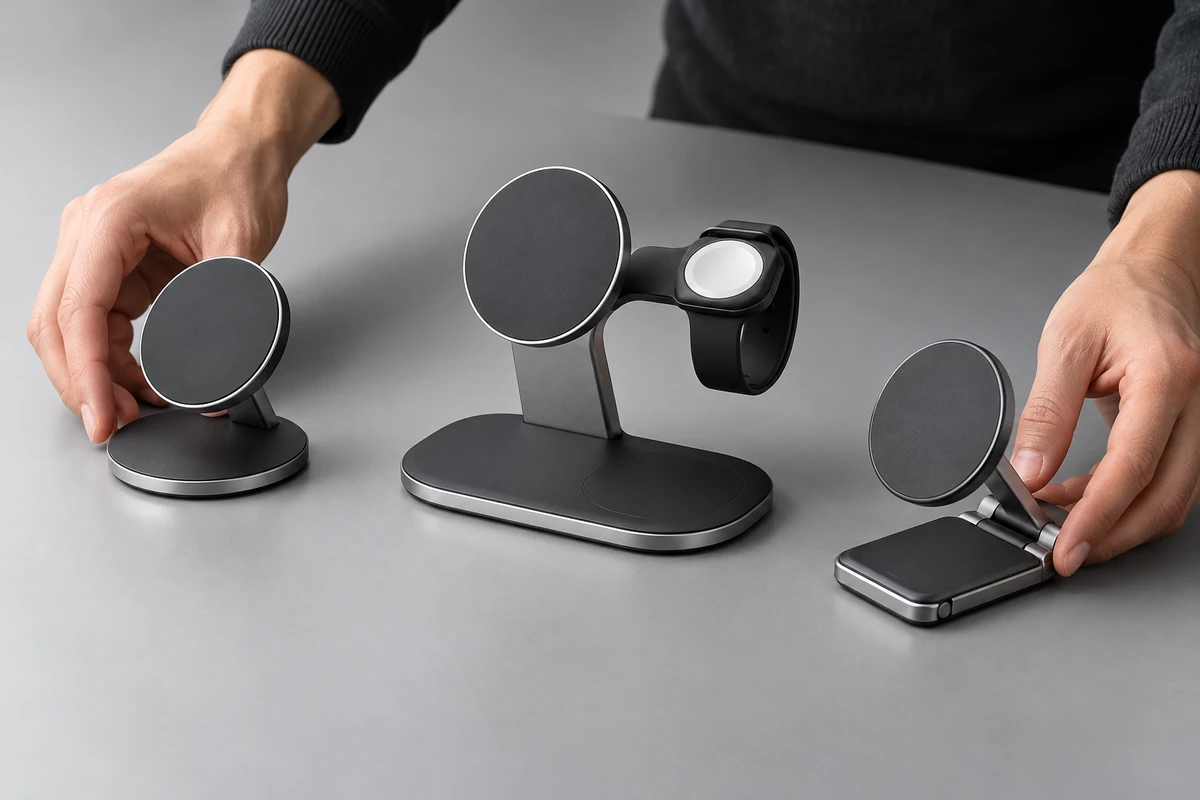
Imagine a brand launching three wireless charging stands. Mini charges one device. Pro adds a watch-charging module. Travel folds for packing. The planned destinations are an Amazon product page, a Shopify product page and a vertical TikTok ad. This is a hypothetical exercise, not an ONCE client project.
Every candidate should receive the same inputs:
- product images, dimensions, ports, accessories and approved compatibility wording for all three SKUs;
- the real sample status—what works, what is appearance-only and what is still awaiting confirmation;
- the exact placement on each channel, not a vague label such as “ecommerce”;
- target market, language, subtitle needs and prohibited claims or third-party brand elements;
- launch date, available sample quantity, brand approver and the operator who will receive the files.
The candidate is not being asked to invent a beautiful campaign in the room. The test is whether it can identify the action difference between Mini, Pro and Travel, then decide what can share production and what needs a specific treatment.
Do nine cells really require nine finished videos?
Three SKUs across three destinations create nine apparent delivery cells. A weak proposal prices nine videos immediately or mechanically crops one landscape edit into nine files. A stronger team first asks what job each cell performs.
Ask the candidate to classify each cell in one of four ways:
- shared fact footage for stable product truths such as appearance, port location or the start and end of a fold;
- a channel-specific edit when the same action remains useful but the opening, pace, captions and ending must change;
- a dedicated shoot for a SKU- or placement-specific action, composition or human interaction;
- do not make it yet when a version has no defined publishing use.
Travel’s folding action might support a complete Shopify explanation and a fast TikTok opening. An Amazon placement may instead need package contents and operation steps. Pro’s watch module cannot be represented by Mini’s turntable shot. A team that can explain why one requested output should be removed can be more useful than one that promises every file without questioning its purpose.
Current Amazon Seller guidance separates shoppable videos into uses such as product overview, unboxing, operation, setup, troubleshooting and brand story; it also connects uploads to ASINs and languages. Shopify product-media guidance supports direct video files as well as YouTube or Vimeo embeds, with its own file and theme conditions. TikTok’s current creative guidance emphasizes vertical framing, UI-safe zones and an early content proposition. These requirements can change and should be checked again before locking a plan. Their main effect is not merely export dimensions—they change what the viewer needs to understand.
Batch capacity should appear as constants and variables
The point of batch production is not to make every product look identical. It is to know what must stay consistent and what must change.
Constants might include product scale in frame, background and lighting references, colour checks, shot IDs, folder structure, caption style and approval status. Variables include SKU dimensions, reflective surfaces, unique operations, accessories, hand interaction, framing safe areas and sounds that need fresh recording.
In this hypothetical assignment, Mini and Pro may share an initial test for the same surface finish. Pro’s extra watch module changes the visual balance, so it cannot simply be dropped onto Mini’s floor mark. Travel’s hinge needs an uninterrupted action and reset time, so it should not be treated as a colour swap. A candidate should be able to turn those differences into a shoot order before the crew reaches the set.
If scope and price are still being compared, ONCE’s article on choosing a cross-border product-video company gives the broader brief, portfolio and delivery questions. This exercise goes narrower: it tests whether each proposed reuse decision is operationally sound.
Can someone who missed the shoot use the delivery package?
Neat filenames are not the same as a usable handoff. Ask each candidate to draft one delivery record containing at least:
- asset ID and SKU ID;
- the product-fact or claim version it represents;
- channel, market, language, aspect ratio and duration;
- whether captions are burned in, supplied separately or absent from a clean master;
- usage conditions for music, fonts, talent and third-party assets;
- approval status, change history and approver;
- its relationship to a master, cutdown or source clip;
- which files need a text change, re-edit or reshoot if a product fact changes.
That record is more valuable than a file called final_final_v3.mp4. An operator who never attended the shoot should still be able to tell which file can be uploaded, which is for internal review and which has become obsolete.
The material scope also needs to be explicit. Camera originals, project files, audio stems, textless masters and subtitle files are not automatically included in every agreement. The brand should define what it needs for future use, how long material must be retained, who handles later edits and what usage rights apply. The stress test evaluates whether a candidate raises these questions; it does not assume unlimited delivery or perpetual rights.
Change one product fact and watch where the team looks
Give the candidate one more change: shortly before the shoot, the approved compatibility wording for Pro is narrowed and a planned headline can no longer be used.
A good answer goes beyond “we will change the caption.” The team should locate every appearance of that claim: spoken line, packaging, phone screen, subtitle, voiceover, thumbnail and implied demonstration. It should determine whether only Pro is affected or whether a shared opening also needs revision; whether a textless master can be recut; and whether the physical action itself now implies an unsupported function and therefore needs replacement or reshooting.
This step exposes whether the version relationships are real. If the workflow depends on one editor remembering every clip, it will become fragile as the catalogue grows. If SKU, product fact, shot and final edit can be traced through the manifest, later packaging changes, localisation and new placements become easier to scope.
Score five capabilities separately
After the stress test, assess five independent capabilities:
- Product understanding: Did the team identify operational differences, not just different appearances?
- Batch logic: Are constants, variables, shared work and dedicated work clearly separated?
- Platform adaptation: Does every edit have a viewing task, rather than a different aspect ratio alone?
- Handoff usability: Can an operator find the correct file, status and usage condition from the manifest?
- Change response: Can the team locate the exact text changes, re-edits, downgrades or reshoots caused by a changed product fact?
The scores do not need to pretend that supplier selection is perfectly objective. Their value is that the brand can explain why one team is a better fit—product understanding, platform experience, or an operational handoff that can survive frequent launches. Visual taste still matters, but it should not conceal an inaccurate demonstration or an unusable delivery folder.
When this test is the wrong tool
For a one-off brand film whose value depends on directorial expression, performance and a complete narrative, a creative treatment and production proposal are more revealing. If the product is still changing rapidly, the brand should first stabilise the facts it can publish; a production company cannot replace product, legal or marketplace approval.
If you are ready to test physical execution with a real product, a multi-spec sample plan can help prepare the next step. The two methods are complementary: the delivery-manifest exercise filters out proposals that have not resolved SKU and channel relationships, while a pilot tests the remaining team in practice.
ONCE’s ecommerce product video production service plans hero content, product-page demonstrations, advertising cutdowns and multilingual versions as one connected scope, with final deliverables agreed for each project. If you are evaluating a long-term partner, send your SKU list, channels, languages, sample status, launch date and budget range to ONCE VISUAL, and request an ecommerce video production checklist that you can use to compare proposals.