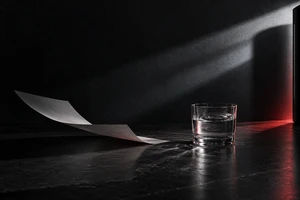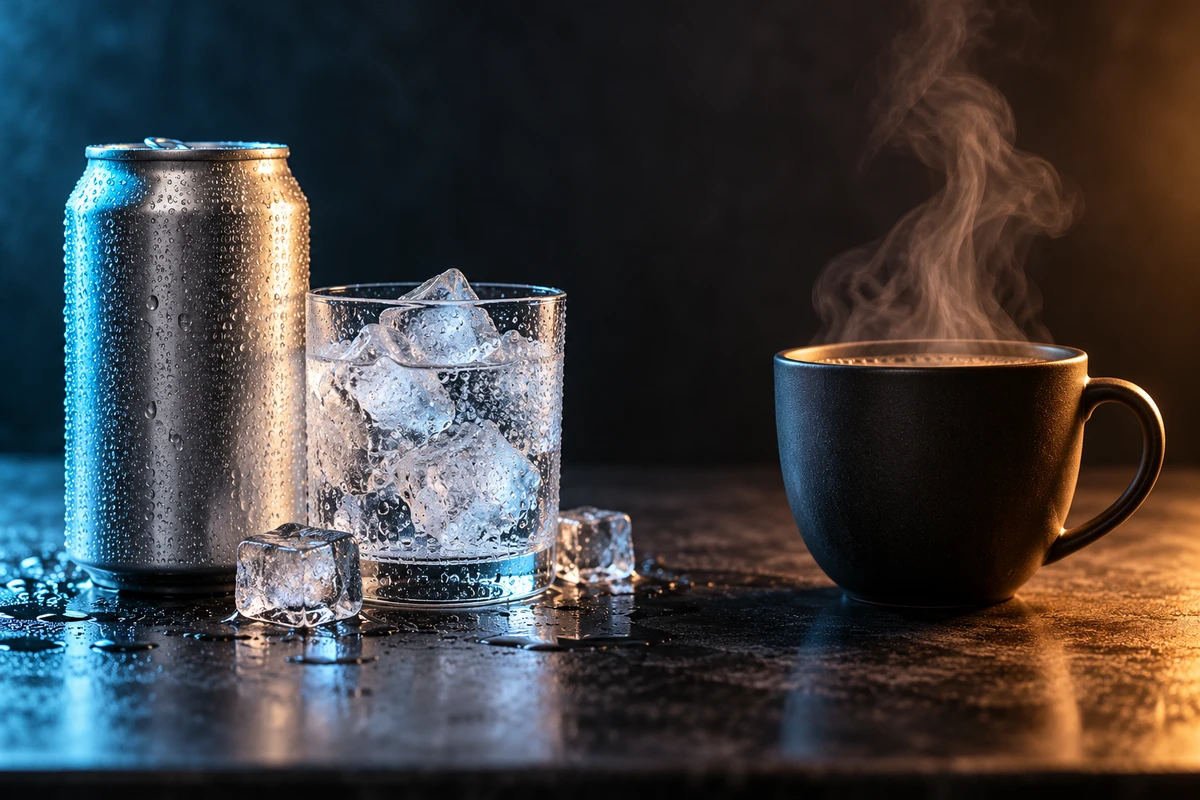
Imagine two shots of the same canned drink. One can sits against a blue background, perfectly dry, as if it has just come out of its packaging. The other sits in neutral light while fine droplets form along the shoulder, merge into a thin stream, and move down the curve. Ice shifts in the glass, and a small cloud appears only after the can opens. Which one feels colder? Usually, it is not the bluer image.
Temperature is invisible. Viewers can only see what temperature changes. Product advertising therefore needs more than a cool or warm palette. It needs a visible change caused by heat or cold. Colour, sound and performance can reinforce that change, but they cannot replace it.
First decide which kind of temperature the film must express
The direction to “make it feel warmer” often combines three different ideas.
The first is ambient temperature: a winter street, a kitchen, a sauna or harsh summer sun. The second is the temperature of a product surface or its contents: a chilled can, freshly poured coffee or a heated panel. The third is human experience: hesitation before touching something hot, relaxation after the first sip, or the body loosening after moving from cold air into a warm room.
All three can appear in one film, but they cannot stand in for one another. Amber light can make a room feel warm, but it does not prove that a device is heating consistently. A performer drawing in their shoulders can communicate cold, but it does not prove that a jacket performs at a stated temperature. Mist over a cup does not automatically prove that the drink has just boiled.
Before writing the shot list, write one plain sentence: should the viewer believe that the space is cold, the product surface is cold, or the user feels refreshed? That choice determines whether the camera should prioritise air, surface or bodily response.
Blue and orange are cues, not conclusions
The association between red and warmth, and between blue and cold, is measurable. A 2014 PLOS ONE study on colour-temperature correspondences found that colour affected how participants processed thermal information. A separate 2020 study of illumination and perceived temperature found that lighting hue could alter participants’ subjective sense of coolness or warmth.
That helps explain why commercials often use cyan-blue for refreshment and amber for hot food or domestic warmth. But those studies support the idea that colour can trigger an association. They do not show that a grade can make any object genuinely appear to be at a particular temperature. If a can remains dry, the ice never changes, and the user’s behaviour stays the same, blue works mainly as a genre label. If every material around a hot drink stays motionless, orange light remains attractive set dressing.
A stronger approach is to film one primary cue that actually changes, then use colour to confirm it. Blue light can separate fine droplets from a reflective surface. Warm backlight can reveal a thin plume. The convincing part is still that the droplets grow, the plume disperses and the performer adjusts their action.
Temperature needs time: appearance, change and result
Condensation is more than droplets placed on a surface
The persuasive part of condensation is not simply that a surface looks wet. It is where the droplets begin and how they develop. NOAA explains that water vapour condenses into tiny liquid droplets when it meets a cooler surface, with dew point marking the condition at which that transition occurs.
Commercial production may use tested stand-in droplets to control shape, or combine real condensation with a local effects pass. That can be entirely appropriate for appearance. But if the shot carries a factual claim such as “fresh from refrigeration” or a serving-temperature promise, the brand should retain separate records of the real sample state, relevant measurements or functional footage. Styling may support desire. It should not act as a substitute for performance evidence.
Steam needs a source and a way to disappear
Steam can quickly fill a frame, and it can just as quickly suggest the wrong product. A thin plume over a hot drink, a short burst from a garment steamer, or the instant after a pot lid lifts each has a defined source and duration. Fog rolling continuously around sealed electronics can instead suggest overheating, leakage or failure.
Give vapour background contrast, side or backlight, and room to move. Then record output level, airflow, dissipation time and camera speed for each take. If one shot is dense and the next is faint, the cut makes temperature appear to jump. Vapour is first a continuity problem and only then an atmosphere effect.
Melting and frost need before and after states
Ice, frost and melting droplets naturally contain time. They are effective when a film needs to show that something has just happened or is changing now. They are weaker when treated as frozen decoration.
If the ice never melts, or the frost pattern changes between every angle, viewers sense that the sequence has been assembled from incompatible moments. A reliable production defines a start state for every shot: the number and position of ice pieces, liquid level, frost coverage, wait time and reset method. For temperature storytelling, continuity across shots matters more than the prettiest isolated frame.
Performance, sound and editing bring temperature into the body
A product surface tells viewers that heat or cold is present. Performance explains what that temperature does to a person.
Cold does not require exaggerated shivering. A finger touching first and then closing around a can, a small contraction through the neck and shoulders, or a change in breathing after stepping into cold air can be more specific than a generic “so cold” expression. Heat is not limited to wiping sweat. Switching hands while holding a cup, slowing down before approaching a hot surface, or pausing after the first sip can place temperature inside the rhythm of the action.
Sound confirms the location and material of the event. Ice hitting glass, the short release after a can opens, or liquid meeting a hot vessel can direct attention back to the physical action. These sounds do not need to magnify every detail. If the sound is more extreme than the image, the product can seem to be made from a different material.
Editing must also leave enough time for the change to register. Cut away as a droplet first appears and the viewer sees only a highlight. Leave vapour before it establishes direction and the viewer sees only a white patch. A temperature shot does not have to be slow, but its beginning and result should both remain legible.
Divide the work among live action, effects and AIGC
A temperature image can be separated into three production layers.
The first is product fact: real packaging, control states, vents, heating surfaces, liquids and the way a person makes contact. If a detail affects function, safe use or purchase decisions, it should normally come from live action or brand-approved 3D product data.
The second is the controllable thermal cue: condensation, vapour, frost, reflections, heat shimmer and environmental particles. Practical effects or compositing can adjust these elements, but they still need to match light direction, gravity, surface curvature and shot speed.
The third is emotional space: an exaggerated crystal landscape, abstract heat flow or a scale-shifted microscopic world. CG or AIGC can be effective here because the image expresses sensation rather than measurement. ONCE’s guide to motion-ready product sources makes the adjacent point that generation can fill in motion, but it should not be asked to invent product structure or physical state.
This division is not about avoiding new tools. OpenAI’s technical report on video generation models as world simulators openly documented failures in basic interactions and changes of object state. The 2026 WACV paper Do Generative Video Models Understand Physical Principles? evaluates physical consistency against real video and discusses how familiar perceptual metrics can miss implausible motion. Generated video is becoming more realistic, but looking plausible is still different from proving that a product behaves that way. Use AIGC to extend atmosphere; use live action or controlled 3D to protect product fact.
Write one temperature shot as a three-part change
Before listing props, write the core shot in three beats:
Start: What state is the product in, and what initial condition does the environment provide?
Change: Which cue appears first, and how does it grow, move, dissipate or melt?
Result: What readable change occurs in the product, the person or the space?
For a chilled beverage, the start might be a dry can entering warmer air. Fine droplets appear, merge and move down the curved surface. The result is a clear contact mark when the performer lifts the can. For a heated beauty device, the main cue should not be smoke. It should be an approved combination of device state, contact, performance rhythm and brand-verified functional information.
Let one cue lead each shot. The others should confirm it, not compete with it. When ice, fog, droplets, blue light, amplified sound and an exaggerated reaction all arrive together, the result is usually a poster that says “cold,” not a believable process of temperature change.
The viewer believes causality, not colour alone
Temperature in product advertising is not ultimately a choice between a bluer or more orange grade. It is a directing question: what changed because of temperature, and did the camera show that change from its beginning to its result?
Colour points the viewer in the right direction. Condensation, vapour and melting make change visible. Performance and sound connect that change to bodily memory. When all three layers describe the same event, heat or cold feels real. When they contradict one another, even expensive effects remain surface atmosphere.
If you are developing an ad for beverages, appliances, beauty devices, outdoor products or another category where temperature matters, bring the approved product claims, sample state, target market and required versions to ONCE brand film production. We can begin with one temperature-change line and decide which images require live action, which benefit from controlled effects and which can be extended with AIGC.
Source note
This article reviewed Ho et al., “Colour-Temperature Correspondences: When Reactions to Thermal Stimuli Are Influenced by Colour” (PLOS ONE, 2014); “Effect of illumination on perceived temperature” (PLOS ONE, 2020); NOAA NESDIS, “What Is Humidity?” (August 28, 2025); OpenAI, “Video generation models as world simulators”; and the WACV 2026 paper “Do Generative Video Models Understand Physical Principles?” The three-layer temperature model and the start-change-result writing method are ONCE’s creative analysis, not advertising-effect conclusions supplied by those sources.