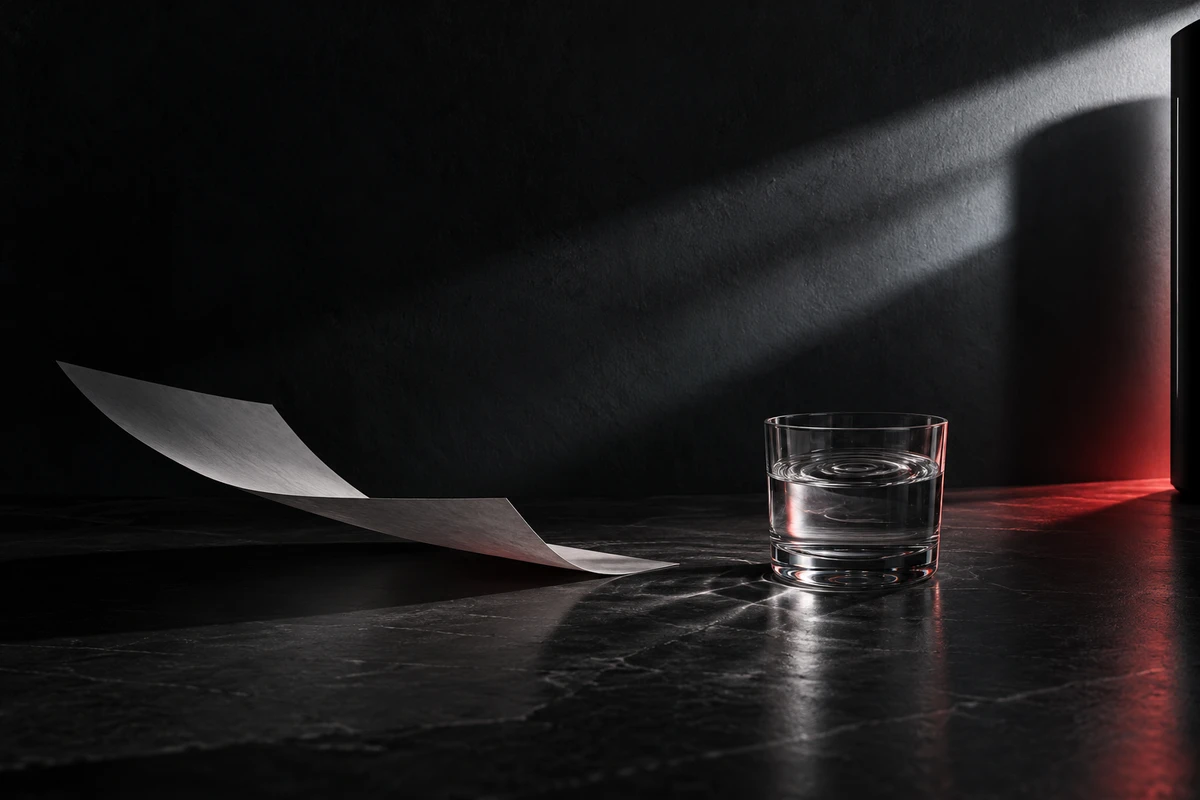
Imagine an opening with no clean product shot. A sheet of paper lifts toward the left. A cool band of light travels across the wall. A person stops what they are doing and looks beyond the right edge of the frame. Two seconds later, a projector moves into view.
If those first two seconds show only an empty room, the late reveal feels evasive. If every cue points to the same offscreen source, the audience can sense the product's direction, force, and effect before seeing it. The point of offscreen space is not to hide the product. It is to let the product participate through its influence.
Offscreen Does Not Mean Absent
Product advertising often treats visibility as a race to place the pack or device in the center of the frame. Yet some values are easier to understand through their effects. A speaker first changes the sound field of a room. A lamp changes the shadows on nearby objects. A fan moves hair and fabric. A cleaning device changes the path of dust.
Keeping the product outside the frame for a moment can change the viewing order from "What is this?" to "What is it changing?" The audience reads the effect first and then attributes that effect to the product. When the product enters, it arrives as the cause of an event, not as an isolated beauty shot.
Offscreen space is not the same as a delayed reveal. A reveal withholds information in the hope of a final surprise. Offscreen space keeps providing information while withholding only the complete subject. The questions are not merely "What is it?" but "Where is it, what is it doing, and when will it enter?"
Four Relationships Create a Convincing Offscreen Presence
Source: every change should feel caused by the same thing
Sound, reflected light, shadow, and a performer's reaction can all appear in one passage, but they cannot contradict one another. If a startup sound comes from the right, the light sweeps in from the rear left, and the performer looks straight ahead, the audience receives three unrelated prompts rather than one rich event.
Before shooting, mark the offscreen product's position, orientation, and path on the floor plan. Then decide how each cue travels from that point into the frame. Lighting, art direction, performance, sound design, and editing are now describing the same source.
Direction: the audience should be able to map the product
Direction is not limited to a multichannel mix. Even on a phone speaker, changes in level, perceived distance, reverberation, eyelines, and moving shadows can suggest "approaching from the right," "starting behind us," or "passing below the table."
Dolby's explanation of spatial audio describes placing different sounds in different locations. Adobe's guide to J-cuts and L-cuts shows how audio and picture can change at different times. In an ad, a product sound can arrive first and direct attention toward an empty edge of the frame; the image then confirms that expectation. The goal is not an elaborate mix. It is a directional relationship that survives ordinary playback.
Effect: the frame needs a result that can be attributed
Hearing a product is not enough. It should leave a specific effect inside the frame: a controlled highlight appears along a glass edge, ripples form in a cup, a sleeve moves in one direction, debris disappears from a surface, or an object changes from idle to responsive.
Those results must remain faithful to the product. A dramatic shot should not turn a modest airflow into an impact strong enough to throw objects. A generated reflection should not imply brightness, speed, or coverage that the product cannot deliver. Offscreen cues can intensify an experience, but they should not invent capability.
Entry: the reveal must fulfill the earlier cues
When the product finally appears, its direction of entry, lighting state, and motion should agree with the setup. If the previous shot establishes a low sound source to the right, introducing the product from the upper left breaks spatial continuity.
The entry does not have to be a full hero shot. An edge, port, air outlet, or beam source can appear first, followed by the complete form. Each step should answer a question created by the preceding shot instead of using a handsome transition to erase the relationship.
Sound, Light, Reaction, and Motion Should Not Work Equally Hard
Each cue is best at answering a different question. Sound establishes that an event has started and suggests direction. Light and reflection describe energy, material, and environmental contact. A human reaction conveys meaning. Motion traces the connection between an offscreen action and an onscreen result.
If every cue performs at maximum intensity, the sequence feels like a demonstration exercise. Choose one lead cue and let the others confirm it. For a speaker, sound might establish position, ripples in a glass confirm low-frequency energy, and an eyeline quietly reinforces direction. The curtains, lighting, and camera do not all need to move as well.
This is why a product sequence should be previsualized with sound design, not decorated with sound after the edit. Sound may be the audience's first encounter with the product; it simply has no picture frame.
Offscreen Cues Still Have to Obey Product Facts
With transparent, metallic, or glossy products, a reflection can enter before the object itself. But the width, color, and speed of that reflection also define the material. The same applies to CG or AI-generated backgrounds. If environmental light sweeps in from the right while the product highlight remains static, the offscreen world never truly touches the product.
A hybrid-production review should therefore check more than whether the product looks correct. Light direction, contact shadow, reflection speed, and spatial sound should belong to the same event. For a related discussion, see our article on credible AI product-ad backgrounds.
Functional products need an additional limit. Airflow, brightness, noise reduction, cleaning, and protection can all be interpreted as performance claims. Without supporting tests, the image should express an experience rather than imply a precise comparison or exaggerated result.
When the Product Should Enter Sooner
Offscreen space is not a default opening or a shortcut to a premium tone. Confirm the product sooner when the category is unfamiliar, the value depends on form or interface, brand recognition must happen immediately, the asset is a short action-oriented ad, or muted playback would remove the key cue.
Google's ABCD guidance for YouTube creative emphasizes attracting attention, integrating the brand naturally, connecting with the audience, and directing action. It is guidance for particular platforms and advertising jobs, not a universal rhythm for every film. It does, however, make one principle clear: offscreen presence must serve the communication task. Keep a two-second delay if it makes the product easier to understand. Remove it if it merely postpones recognition.
A useful test is to mute the sequence and extract still frames from the first and third seconds. Ask someone outside the project to describe what is offscreen, where it is, and what it changes. If all three answers are unclear, the cues have not formed a relationship. The best repair is often to bring the product in earlier, not to add more atmosphere.
Put Offscreen Space in the Storyboard
Add four columns to the shot list: the offscreen source position, the cue that enters the frame, the object or person affected, and the moment the product fulfills the cue. Every shot does not need all four, but the sequence needs a continuous path from source to entry.
The director can then judge spatial relations, the cinematographer and gaffer can preserve direction, art direction can select objects that visibly respond, sound can plan its lead into picture, and post-production can identify which generated or composited elements must remain continuous.
Keeping a product out of frame does not primarily enlarge mystery. It enlarges the relationship between the product and its world. The audience first senses that something is happening, then discovers what is making it happen. The reveal arrives with meaning already attached.
If you are developing a product campaign, ONCE can turn offscreen sources, light reactions, sound direction, and product entry into a shootable concept that also adapts cleanly across versions. Explore our video creative and production services.