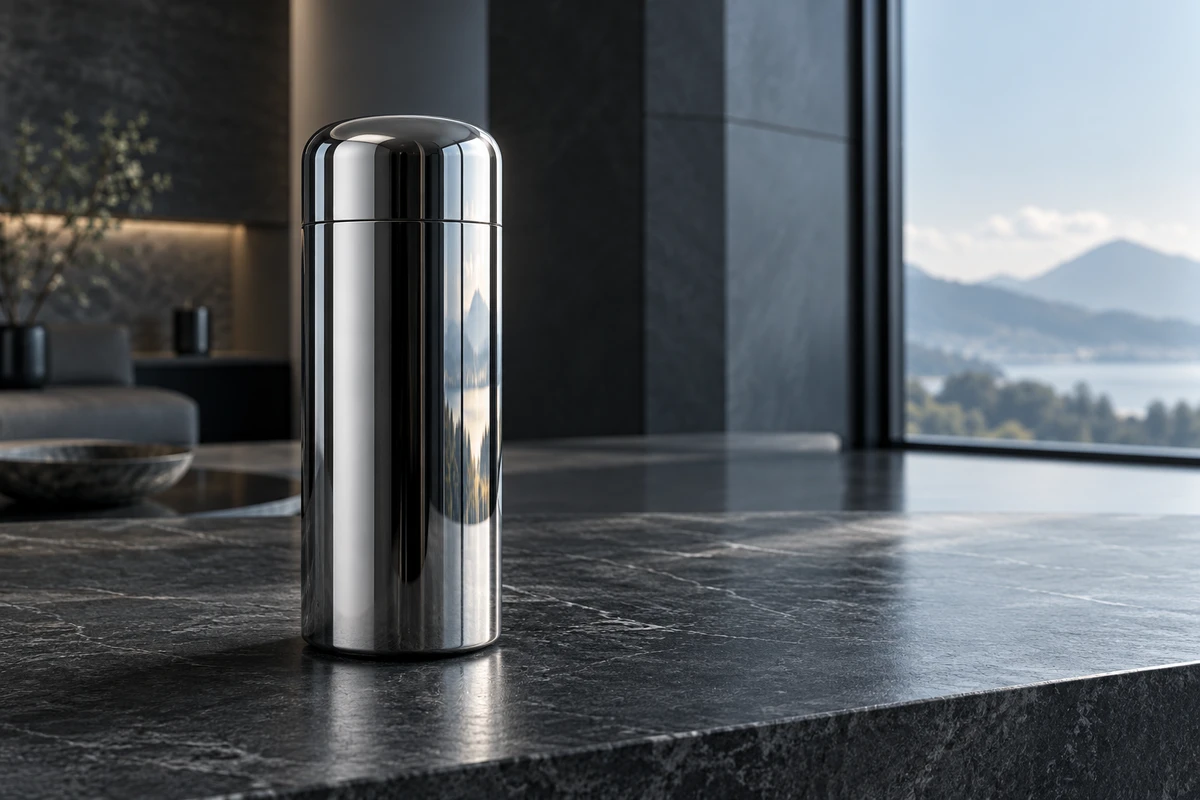
Imagine a real stainless steel coffee machine placed inside an AI-generated morning kitchen. The counter is clean, the window is beautiful, and the air carries a perfectly judged haze. Nothing is obviously wrong, yet the machine still looks like a cut-out. The problem is usually not that the background is insufficiently realistic. The product simply does not participate in what is happening in the room.
The easiest mistake in AI product ad background production is to treat realism as a matter of background detail. Viewers are reading a different set of relationships: whether the camera occupies one position, whether the window light reaches the product, whether the metal reflects that window, whether the machine appears to press against the counter, and whether those relationships change together when the camera moves. A background and a product look as though they were captured together only when they share the same spatial and optical rules.
Realism is a set of relationships that support one another
Five relationships reveal whether a product belongs in a scene.
Perspective determines whether the product stands in the same space. A background may have a low vanishing point while the product was photographed from above. The room may feel wide-angle while the product edges retain long-lens compression. Viewers may not name the conflict, but they notice the cut-out effect.
Light direction determines whether the environment reaches the product. A hard window light may come from frame left while the product keeps a studio rim light on its right edge. An overcast environment may be diffuse while the package carries a sharp strip-box highlight. Either treatment can be attractive, but they cannot both describe the same location.
Reflection is the environmental evidence held by glossy materials. Metal, glass, and polished plastic do not display only their own color; they record the space around them. If the generated room contains a large warm timber wall while the product still reflects a white studio, the frame contains two worlds that have never met.
Contact explains where weight lands. A broad contact shadow makes the product float; an excessively dark one makes it look pasted down with a dirty outline. A reflective counter without corresponding bounce at the product base is equally suspicious. When a soft object presses against a surface without any deformation, the missing consequence matters more than imperfections in the distant background.
Temporal continuity decides whether a video survives its second second. A shadow that works in a still may fail to change perspective during a push-in. A window reflection may slide with the bottle rather than with the room. As a hand approaches a package, occlusion, shadow, and surface reflection may fail to respond together. Once a product moves, realism is no longer the quality of one frame; it is the continuity of relationships.
Our earlier guide to unifying lighting direction and shadows in AI-composited product videos covers light capture and compositing controls in detail. The broader point here is different: light is only one form of evidence. A brand also needs to decide whether the product leaves visible consequences in the space.
First decide whether the product must affect the environment
Not every shot needs the same degree of physical realism. It helps to divide shots into three groups.
The first group is atmosphere shots. The product does not need to prove a precise function or interact heavily with a person or surface. A pack may remain fixed in the center while the background supplies season, color, or world-building. If silhouette, scale, and basic light are stable, a generated environment can carry much of the frame.
The second group is identity shots. The viewer needs to confirm packaging text, color, material, ports, or included accessories. The environment may be generated, but the product should usually come from an approved live-action plate, an approved 3D asset, or a tightly controlled source image. An attractive background cannot excuse a changed bottle shape, logo, or finish.
The third group is evidence shots. A hand opens a lid, liquid passes through a transparent vessel, polished metal reflects an approaching person, or a device screen responds to an action. The environment changes the product, and the product changes the environment. Here, placing a real product cut-out over a generated background is rarely the cheapest shortcut because every interaction has to be reinvented in post.
A useful test is this: if the background disappears, does the product action remain complete? If the product disappears, is there any event the background must answer? When either side needs to change the other, establish a shared camera, light field, or 3D space early.
Which products expose generated backgrounds most quickly
The more a surface records its surroundings, the less suitable it is for a workflow in which a beautiful product plate is shot first and the world is changed later without constraint.
Mirror metal records the shape of lights and the bright-dark pattern of a room. Transparent glass refracts background lines. Jewellery and faceted surfaces turn small angular errors into jumping highlights. Translucent materials need backlight to participate. Soft packs and fabrics answer contact through dents and folds. For these products, the background is not decoration behind the object; it is part of the object's appearance.
Matte products with stable geometry and clean edges are easier to separate from their environments. Even then, camera height, focal length, scale, and placement need to agree. A generator can supply an environment, but it does not automatically know what the brand has promised about the product's true proportions.
Adobe describes its Firefly Object Composites feature as blending product shots into generated scenes through complementary tones, colors, lighting, shadows, and textures. That description shows what the tool is designed to address; it does not prove that any automatic result preserves a particular product's approved facts. Treat an automatic composite as a candidate frame, not an exempt-from-review final.
Three hybrid methods solve different problems
Keep the real product and capture a physical reference
When product appearance must remain exact, the most dependable starting point is still the real object. Alongside a clean plate, retain camera height, focal length, product placement, color references, and material that describes the dominant reflective environment. The purpose is not to overwhelm post-production with files. It is to give the generated environment a real photographic condition to meet.
This method suits shots in which packaging, color, and material cannot drift while the surroundings may change. It protects product facts; it does not automatically solve complex interaction.
Use an approved 3D product for perspective and reflection
When the camera moves substantially, scenes change repeatedly, or the product has well-defined geometry, an approved digital product can protect perspective better than a single cut-out. As the camera moves, silhouette, occlusion, shadow, and environmental reflection can be calculated together.
The trade-off is that the asset cannot be approximate. Dimensions, materials, labels, small structures, and moving parts need approval. Otherwise, a so-called digital twin is only a more expensive approximation. 3D provides computable relationships; it does not decide which version of the product is correct.
Let an LED stage bring the environment into the shoot
For shots that need real reflections, performance interaction, or a more complex camera move, LED virtual production can let the virtual environment provide light and reflections on set. Epic's In-Camera VFX overview describes LED lighting, camera tracking, and real-time rendering as a combined basis for integrating foreground subjects with virtual backgrounds. It also explains how content outside the camera view can act as a dynamic light and reflection source for the physical set.
An LED wall is not simply a larger background. Camera tracking, panel calibration, pixel pitch, color management, moire, supplemental fixtures, and exposure all affect the result. Its particular value is that the real product receives part of the virtual world's light during capture instead of leaving every relationship for post-production to guess.
Platform requirements change what a shot is allowed to promise
An image suitable as a campaign mood visual is not automatically suitable as a marketplace main image.
As checked on October 22, 2026, Google Merchant Center's AI-generated content guidance requires images created with generative AI to retain the relevant IPTC DigitalSourceType metadata; images containing synthetic composite elements use the CompositeSynthetic type. Amazon Seller Central's product image guide requires product images to represent the product accurately, and its main-image rules call for a realistic, professional-quality image that accurately represents scale, quantity, and color. Platform rules change, so brands should verify the applicable market, category, and placement before submission.
The practical question is therefore not only, "Does this look real?" It is also, "What promise does this asset make in this placement?" A concept poster can exaggerate space. A lifestyle image can propose a context. A main product image or functional demonstration must protect product facts much more strictly. Disclosure and provenance metadata should remain attached during asset handling, not be improvised at the final export.
Look for consequences, not just flaws
When reviewing an AI background, ignore the distant texture for a moment and watch the small area around the product. Does the base carry weight? Do the edges pick up environmental color? Does a glossy surface contain the scene? When a hand approaches, do occlusion and reflection change? After the camera moves, does the perspective still belong to one space?
When those relationships agree, a simple background can feel credible. When they contradict one another, a detailed world still leaves the product looking pasted on. AI is strong at expanding the world. Live action and 3D are strong at protecting the product. The real production decision is to let each medium carry only what it can prove.
If you are planning shots that combine a real product with a generated environment, explore ONCE's AIGC commercial production service. Bring the product, target setting, and critical shot list; we can first identify which relationships need to be established on set and which can be handled through generation and compositing.