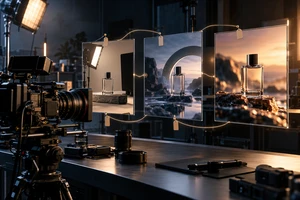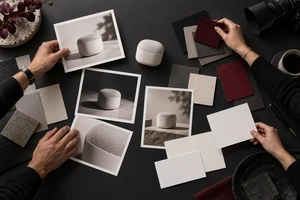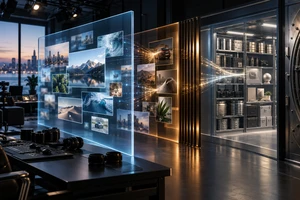
The most obvious failures in generative brand video are familiar: a character changes face, a product gains a button, or a signature colour drifts between shots. There is another failure that receives less attention. To prevent drift, the team locks every shot to the same composition, lens feeling, lighting pattern and camera move. The person stays recognisable and the product stays intact, yet the film feels like one concept frame animated six times.
Brand consistency in AI video should not make every image identical. It should make variation feel as if it belongs to the same world. A brand needs a stable visual language; each shot can then use that language to say something different.
Consistency is not sameness
Imagine a film for a wearable device. Six shots use the same three-quarter angle, shallow focus, cool blue environment and slow push-in. Each clip looks polished on its own. In the edit, however, there is no meaningful difference between establishing the world, discovering the device, using it and remembering it.
The system has achieved surface consistency while removing narrative hierarchy.
Consistency should protect what the audience must continue to believe: the same person, the same product, the same material logic and the same fundamental way the brand sees the world. Composition, movement, shot size, lighting intensity and rhythm should be free to change when the job of the shot changes. Otherwise, a brand system becomes a photocopier.
This is a different problem from basic identity control. If you are still solving facial drift, packaging errors, misplaced ports or colour changes, start with this guide to maintaining character and product consistency in generative brand visuals. The question here begins after those assets are stable: how can a sequence still have drama?
Define a brand language before writing individual prompts
A brand language is not a list of adjectives such as premium, cinematic and futuristic. It is a small set of visual relationships that can govern choices.
One brand might define material contrast as soft environments surrounding precise hard edges. Its movement rule might be that the environment moves first and the product completes the action. Its colour rule might reserve one high-chroma signal inside otherwise muted spaces. These rules do not dictate what every frame must look like. They explain why different frames belong to one film.
A useful brand language contains three kinds of information:
- facts that cannot change;
- expressive choices that may change;
- memory cues that should return.
Product geometry, markings and character identity are facts. Camera position, shot size, environment and action intensity are expressive choices. A recurring edge light, directional move, shape or sound beat can become a memory cue. The review question then changes from “Does this look like the previous image?” to “Does this difference still speak the same language?”
Give each shot family a different freedom to change
Instead of using one increasingly long prompt for the entire film, group shots by narrative purpose. Families may differ from one another; shots within a family should retain a visible relationship.
World-building shots can vary space
These shots establish the scale, climate and behaviour of the brand world. They may move between locations, weather conditions or times of day, while retaining two or three anchors such as material contrast, light direction or movement rhythm. A wide environment and a close texture do not need to match literally. They need to offer the same answer to the question: how does this world behave?
Product shots should vary facts less
The product family may change angle, distance and reflection, but it should not rewrite geometry, labels, ports or functional relationships. Variation should come from the reveal: one shot begins with the silhouette, another lets a highlight travel across the material, and another uses a hand-product relationship to explain use.
When the audience must read text, understand structure or trust a functional result, live-action close-ups, a controlled 3D asset or layered compositing are often more dependable than another generative pass. This is not a rejection of AI. It is a decision about which layer should carry product truth.
Action shots can vary speed
The action family carries transitions, turns and energy. Camera speed, subject direction, foreground relationships and edit length can change, but action causality must survive the cut. If one shot lifts the product, the next cannot suddenly switch hands, reverse screen direction or add a component.
Variation creates momentum. A continuous start and finish make that momentum believable.
Memory shots should vary brand signals less
The closing shot does not need to repeat every visual element in the film. It only needs to return one or two established signals to their clearest form: the same edge light, the same direction of movement, the same geometric shape or the same sound landing.
What the audience recognises is not a copied frame. It is a relationship that the film introduced earlier and has now completed.
This idea of a variation budget is an editorial heuristic, not a fixed score. A shot can change composition boldly while preserving product facts and light logic. It can change environment and speed while preserving identity and screen direction. When identity, space, lighting, action and rhythm all change at once, the audience usually does not see a new shot. It sees a different film.
References, keyframes and composition controls solve different problems
Official product documentation available in October 2026 shows that major generative tools now offer several distinct layers of reference control.
Runway’s Gen-4 References is designed to keep a subject recognisable across different lighting conditions, locations and treatments. Google’s official introduction to Veo 3.1 reference images says creators can provide up to three images of a character, object or scene to guide a video. Adobe Firefly separates first and last keyframes, composition references, motion references and camera settings; its documentation also notes that some controls become unavailable when keyframes are used. Midjourney’s official Seeds documentation warns that seeds have the least effect on consistency and should not be treated as a reliable way to preserve a character or style.
These capabilities point to a practical conclusion: more references are not automatically better. A reference should correspond to the task of the shot.
An identity reference answers who or what appears. A style reference answers how the world is seen. A composition reference answers where elements sit in the frame. First and last keyframes answer where motion begins and ends. These inputs reduce what the model has to invent, but they do not decide why the shot exists.
When every reference is pushed into one generation, control does not necessarily increase. More often, each intention is only half executed.
Build echoes across shots instead of copying frames
A unified film often comes from echoes between shots.
The first image may contain a red reflection moving from left to right. In the second, a character enters in the same direction. In the third, the product interface lights up along that path. Content, scale and action are different, but colour and direction make the shots related.
The same principle can use shape. An arch in an establishing shot, a curve on the product edge and a closing graphic may carry spatial, material and brand information respectively while sharing one geometric rhythm.
This produces stronger memory than repeating one camera position, and it adapts more naturally across formats. A landscape version can retain direction, a vertical version can retain the colour landing, and a short cut can retain the sound beat. The brand signal changes container without changing grammar.
Know when to stop generating
If revisions are concentrated around product text, the number of ports, a face shape or a critical hand-product contact point, the problem is usually no longer an imprecise prompt. Generation is carrying a task for which it is poorly suited. Returning to an approved product image, character keyframe, live-action element or 3D asset is often closer to a finished film than a tenth reroll.
Another stop signal is more subtle. Every shot passes a frame-by-frame review, but the edit has no rise, contrast or release. The answer is not more consistency. It is to ask whether the shot families are actually doing different jobs. The sequence may need a true establishing view, a decisive action or one clean memory echo—not another reference image.
Generative brand video requires two opposing abilities: protecting facts that should not change, and changing expressions that should. The first earns trust in the product and the brand. The second gives people a reason to keep watching.
If you are planning a brand film that combines live action, generated imagery and compositing, share the storyboard, product materials and approved references with ONCE. We can map the shot families and non-negotiable facts first, then decide which images belong in an AIGC commercial production workflow.