Can a clean product image become a publishable product video? Ad platforms are increasingly able to generate the motion. The harder question is whether the result still tells the truth about the product.
On October 6, 2026, Meta said advertisers and agencies could generate video from existing static assets in Advantage+ creative, and that eligible catalog advertisers in beta could turn product images into product videos at scale. Amazon Ads had already described Responsive eCommerce Creative animating static product images and generating product-in-use scenes. Google’s October 1 guidance recommended starting with existing social assets and using Asset Studio to turn photos and URLs into previewable YouTube videos.
These are product announcements from three companies, not proof that every account has the same access or that generated video outperforms live action. They do reveal a procurement shift: product photography is becoming source material for automated video creation, not only a finished visual deliverable.
Motion is cheap; product truth is not
A conventional product photograph optimizes one frozen moment. Video generation has to infer everything outside that moment: what sits behind the visible surface, how a hinge travels, where a hand should grip, how fabric reacts to force, and which part responds when a button is pressed.
Give a model one front view and it may invent the hidden side, internal geometry, reflections or motion path. The result can look polished while changing a port, opening direction, scale or material. That may be a cosmetic error for décor. It can become a false demonstration for appliances, tools, wearables or safety-sensitive products.
The durable production decision is therefore not “AI video or a shoot.” It is whether the shoot should also produce verified inputs that downstream tools can animate without guessing the product.
The ONCE Motion-Ready Source Pack
1. Geometry truth
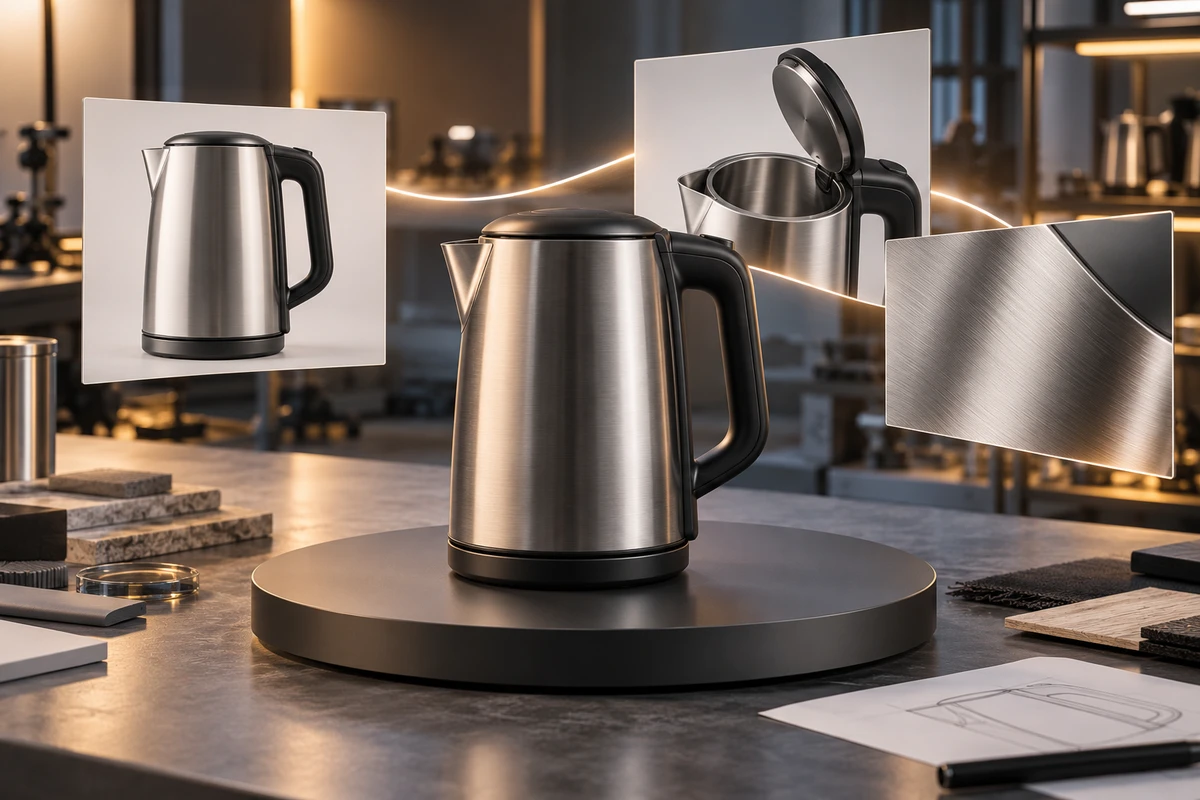
Capture front, side, back, top, bottom and critical three-quarter views with consistent optics or documented lens changes. Add clear records of ports, seams, controls, displays, textures and removable parts. For visually similar SKUs, identify the features that cannot be swapped.
This is not a 360-degree spin for its own sake. It defines which contours a model may interpolate and which structures must stay locked.
2. Action states
Break each meaningful action into verifiable states. A folding chair may need closed, half-open, locked and loaded states. A kettle needs fill, lid-close, power and pour states—not merely a hero image with attractive steam.
Generation can create intermediate motion. The brand still has to supply the correct start, finish and prohibited movements.
3. Material and physics references
Record short close-ups for metal, glass, fabric, liquid, steam and illuminated components. Amazon’s official example describes adding rising steam to a coffee-cup image. That visual cue may suit a beverage; applied carelessly to a sealed electronic device, it could imply heat or failure.
The point of material references is to make creative motion obey product physics, rather than letting generic “advertising motion” replace reality.
4. Composition latitude
Many marketplace hero images are cropped too tightly for vertical, horizontal or moving-camera formats. Source capture should include safe margins, clean backgrounds, text-free versions, separable shadows and useful plates. When hands or people will be introduced, record matching light direction, scale and grip references.
You do not need infinite whitespace. You need a declared plan for crops, pushes, pans and scene expansion.
5. Claims and permissions
Attach a compact control sheet to each source group: exact SKU, market, allowed claims, prohibited inferences, talent and music rights, permission for generative modification, approved platforms, expiry date and final approver.
Platforms may infer creative combinations from images, product pages and campaign history. They cannot decide whether “water resistant” permits an underwater demonstration, whether a model’s likeness may be regenerated, or whether last year’s packaging remains valid in a new market.
Together, these five layers form a Motion-Ready Source Pack. It does not force every brand into a reshoot. It makes the choice between reusing, topping up and rebuilding measurable.
Measure qualified versions, not generated files
As the cost of an individual generation falls, selection and correction become easier to hide. Use this denominator instead:
Cost per qualified video version = (source capture and preparation + generation and platform fees + human review + factual correction + required reshoots) ÷ versions that pass brand, product and market checks
The denominator is not the number of exports. If 40 outputs from legacy images produce only two versions without geometry drift, false actions or rights problems, the procurement unit should not be “40 AI videos.”
Three routes are usually enough:
- Reuse existing images when the product has simple geometry, needs no functional demonstration, and the archive already provides enough views and composition latitude for low-risk tests.
- Top up motion-ready sources when the product is stable but the archive lacks rear views, action states, material behaviour or use references. A focused capture can support several markets and platforms.
- Use live action or controlled 3D production when the promise depends on precise mechanics, human operation, safety, regulated claims or premium storytelling.
Timing belongs in the equation. A Chinese factory, engineering sample and product specialist may be available together for only one production day. Discovering a missing connector angle after the sample has shipped overseas can cost more than adding ten minutes to the original shoot.
Add one page to the next China production brief
Start with one structurally simple, lower-risk SKU. Add a single page to the brief: six geometry views, four action states, three material references, two composition-safe layouts, and one claims-and-permissions sheet.
After capture, hand the pack to someone who was not on set. Ask them to mark what may move, what must stay locked and what is still unknown. If the answer depends on the photographer explaining the product from memory, the handoff is not yet reusable.
Our earlier guide to a three-frame product evidence pack for visual ads focused on what a customer must see to explore, verify and choose. Motion-ready sources solve a different problem: how a platform may animate those facts without rewriting the product.
Keep these scenes under direct production control
Use live action, controlled 3D or frame-by-frame human approval for medical and safety demonstrations, load and durability tests, precise mechanical sequences, performance led by a real person, and claims that affect purchase eligibility, warranty or compliance.
AI video is useful for extending facts that have already been captured accurately. It is a poor substitute for facts the brand never recorded. The scalable move is not to gamble on more motion from one image; it is to finish the source record before the product leaves the studio or factory.
Sources
- Meta, “Advertising Week New York 2026: New AI capabilities to guide campaigns and reach customers,” October 6, 2026.
- Google, “Turn your existing social assets into high-impact YouTube ads,” October 1, 2026.
- Amazon Ads, “The new creative advantage: Tools that easily scale, optimize, and drive creative performance,” June 22, 2026.
- TikTok for Business, “TikTok Symphony levels up with Dreamina Seedance 2.5,” August 3, 2026.
Platform scope follows each company’s announcement. The five-layer source pack and cost model are ONCE methods.