An office, a factory, a lab, and a showroom can all look impressive, yet the finished corporate brand film may still feel like a location reel. The problem is not a shortage of places. It is that every transition changes the setting without carrying forward a decision.
A stronger spatial narrative follows one decision, sample, document, or unresolved question as different people take responsibility for it. The office makes a choice. The factory turns that choice into action. An approved customer-facing outcome explains why the action matters. The audience follows a working relationship, not a tour of buildings.
Start with a business verb, not a location list
Do not begin with four headings called office, workshop, meeting room, and customer site. Begin with a verb: approve, revise, test, hand off, verify, or respond. The verb gives the film a reason to leave one space and enter another.
Imagine a film about product reliability. In the office, people are not pretending to have a meeting. They are approving a structural change. The next scene does not cut to a generic factory wide shot. A marked drawing, sample, or physical cue reaches a test station. The third scene shows the tested state moving toward packaging, delivery, or another result that the company is actually allowed to show. This is a hypothetical script exercise, not an ONCE client case, but it reveals the four parts of a spatial handoff:
- Decision: what changed in the previous space.
- Carrier: which object, action, or sound takes that decision forward.
- Receiver: who must respond in the next space.
- State change: what becomes visibly different after the handoff.
If only the locations and people remain, the scenes are interchangeable. A marked drawing, a sample carrying a test trace, or an unfinished alert tone can make the transition carry an active task.
This is different from communicating factory scale. Scale needs people, process, and route as references. A spatial handoff asks how the same piece of work moves from one role to another. For the first problem, see ONCE's video production insights.
A transition should transfer meaning, not merely look smooth
Match cuts are often treated as attractive tricks: a circle cuts to another circle, a raised hand continues across a cut, or a machine tone becomes a door chime. The useful question is whether the cut makes the audience understand that both scenes are working on the same issue.
Adobe's guide to graphic, action, and audio match cuts offers a practical vocabulary. In a corporate film, these methods can carry responsibility across spaces.
Complete an action in the next space
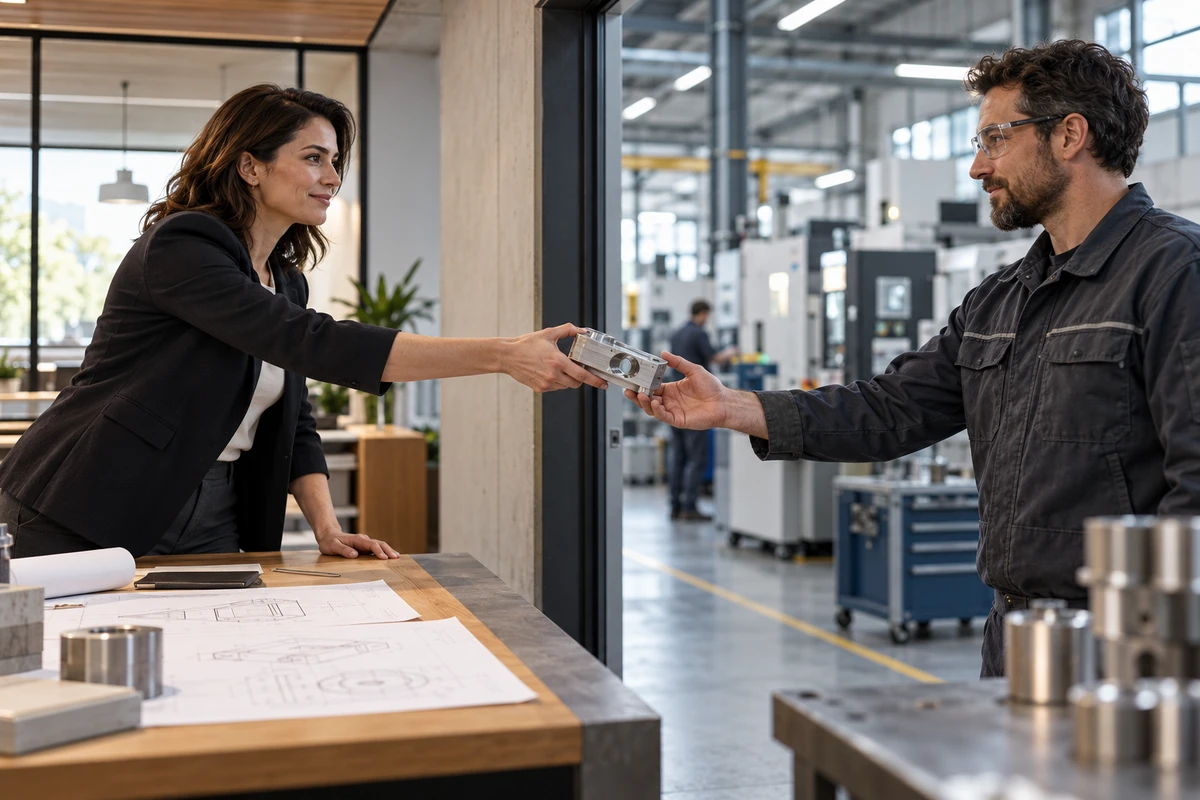
A hand pushes a sample to the right edge of the office frame. In the next shot, a factory operator receives it from the same direction. The edit does not need to pretend that both moments happened at the same time. Consistent direction, speed, and screen position are enough to place the two people on one workflow.
Change the state of the object
Do more than match a shape. If the outgoing shot shows a component awaiting approval, the incoming shot should reveal a processed, tested, or marked state. The shape remains recognizable while its meaning moves forward. The transition creates both visual memory and business information.
Let sound arrive before the picture
A test alert can enter before the office scene ends, then lead the image into the lab. A sealing sound can continue into a loading-bay door opening. A sound bridge should announce the next task, not hide an unclear edit.
Not every handoff needs a showy transition. A hard cut can be more precise: approval ends, execution begins. Before choosing the technique, decide whether the cut carries shape, action, sound, or responsibility.
Keep the spaces different while preserving the handoff rule
In pursuit of a uniform premium look, some films give the office, factory, and showroom the same color temperature and the same slow-motion rhythm. The result removes the working character of each place.
The office may be about choice and discussion, so the camera watches eyelines, documents, and pauses. The factory is about execution and feedback, so hands, equipment, materials, and tempo matter. A customer-facing result is about consequence, so the image should reveal the real task the product enters. The spaces do not need one filter. They need one issue that keeps being handled.
Production design can evolve the carrier. A colored mark on a drawing becomes a sample label, then a verification sticker on the package. Wardrobe, light, and architecture can change as long as the audience recognizes the state change.
If the customer site is unavailable, do not invent one
B2B films often face legitimate restrictions. A customer name may be confidential, a delivery site may be inaccessible, or a real interface may contain protected data. The weakest solution is to stage a handshake in a generic office and let the voiceover present it as a customer result.
When the site is absent, the final handoff can become a public, verifiable consequence:
- Film the real finished state of the product instead of pretending it is running at a named customer site.
- Use approved anonymous documents, packaging, test records, or operating steps while removing sensitive identities and data.
- Demonstrate a general action in a neutral environment and label it as a functional demonstration, not a client case.
- Let sales, engineering, or service staff explain how they handle a problem without speaking on behalf of the customer.
Absence does not break the story. It requires the film to separate what the company did from what a customer achieved. The first can be shown through a real process. The second needs permission and support.
Divide live action, CG, and AIGC by continuity responsibility
CG can explain an internal product change. AIGC can help with previs, abstract transitions, or a concept sketch for a scene that cannot yet be filmed. But generated imagery should not impersonate a real office, production line, or customer environment when the image is being used as proof.
In 2026, Google Research described coherent long-form video generation as a problem of explicit world-state tracking and continuity planning. CVPR 2026 work on long-range multi-scene generation likewise treats consistency as a dedicated technical challenge.
The practical lesson is simple: do not ask a model to guess wardrobe, sample state, movement direction, and spatial relationships. Lock the input and output of every handoff with real location references and storyboards first. Then decide what to shoot, model, or generate.
Review the rough cut with a location-blind test
Ignore how modern the office looks and how large the factory feels. Ask four questions:
- Does every outgoing scene leave an unfinished question?
- Does a person, action, object, or sound receive it in the next space?
- After the handoff, is there a visible new state?
- If the customer site cannot appear, does the film honestly explain where the consequence comes from?
If the answers are clear, space is carrying the narrative. If not, more drone shots, corridors, and meeting rooms will only make the company address look more complete.
ONCE develops corporate and brand films around business logic, people, real environments, and future versions. If your next film needs to move across offices, factories, and customer conversations, visit ONCE VISUAL and bring the workflow, available locations, and confidentiality limits to the first creative discussion.