The short answer is to design the change in the person first, then decide how the product makes that change happen. Slow motion, warm light, steam, and close-ups can enlarge a moment. They cannot create meaning for a sequence that has none.
A convincing product ritual usually has a stable order, an unmistakable start, a perceptible result, and a closing beat that lets the new state settle. The viewer is not merely shown an elegant cup. They understand that picking it up turns a scattered morning into one that feels manageable. The product is not decoration inside an ideal life; it is the hinge between two states.
The difference between use and ritual is a change of state
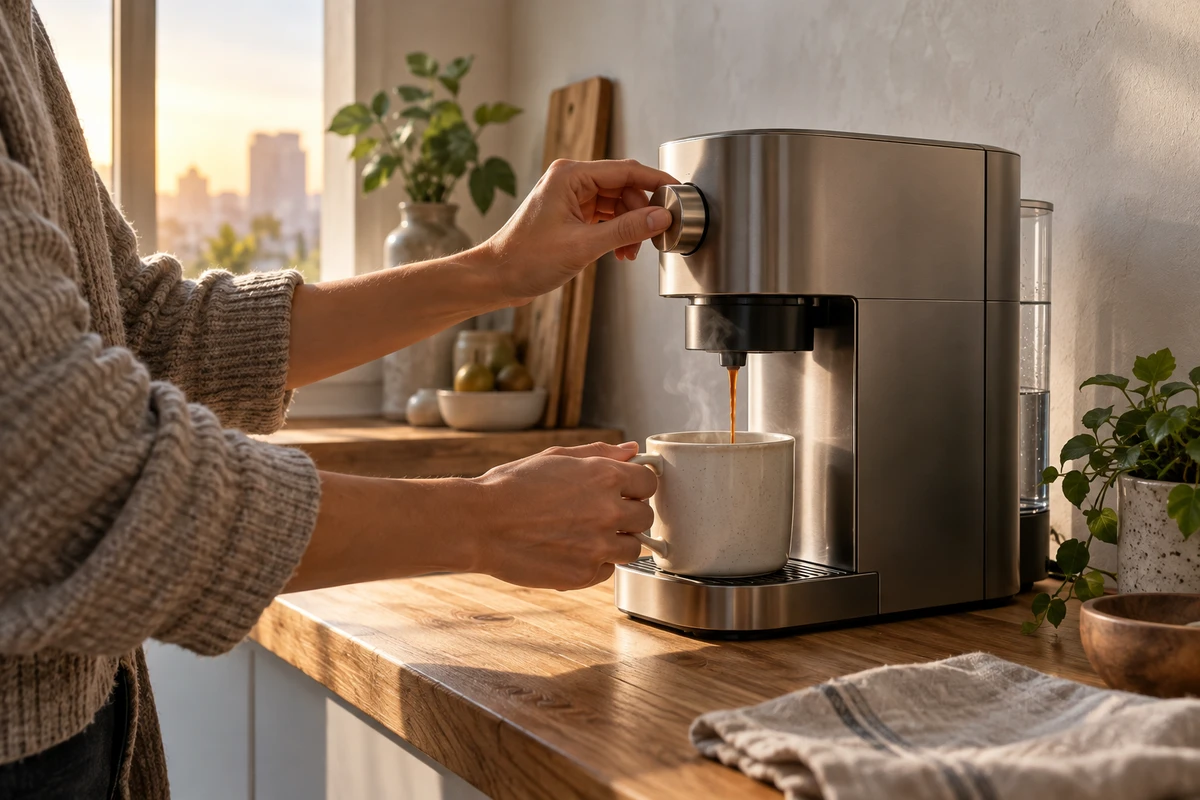
Putting a capsule into a coffee machine, pressing a button, and collecting a drink can be a demonstration. If the person first puts away their phone, opens the curtains, sets the cup in its place, presses the start control, hears the machine come alive, and finally sits down for the first sip, the sequence may mark a transition: distraction is over, the day has begun.
Consumer-ritual research offers a useful but limited clue. In four experiments involving chocolate, lemonade, and carrots, Kathleen D. Vohs and colleagues found that performing ordered ritualized actions increased involvement and subsequent enjoyment compared with random gestures or merely watching another person perform them. The authors did not study advertising performance, and the product and laboratory conditions matter. Their result should not be turned into a promise that ritual imagery increases sales. It does, however, support the distinction between a meaningful sequence and a collection of pretty movements. The original 2013 paper reports the experimental scope.
A 2022 study in Frontiers in Psychology similarly describes ritualistic consumption as a multi-step behavior with a fixed sequence, formality, repetition, and meaning. Its three studies examined emotional mechanisms and perceived control, not the effectiveness of a particular commercial. The open-access article is useful here as a definition, not as a creative formula.
Start with the threshold the person must cross
Lifestyle product ads often begin with props: timber, linen, morning light, plants, and ceramic vessels. That can produce an attractive room without producing a life that belongs to the product.
A better question is: what changes in the person before and after use?
- Waking distraction becomes readiness to work.
- Commuting noise becomes a private listening space.
- Post-workout tension becomes recovery.
- End-of-day disorder becomes permission to rest.
The change need not be dramatic. Specificity makes it filmable. A headphone does not have to promise abstract immersion. It can mark the moment after a train door closes when the wearer presses one control, the external sound field recedes, and their attention returns to them. A home fragrance does not need to signify generic luxury. Lighting it can turn a room that still feels like a workplace back into a private space.
If the product can be removed and the person reaches the same state through exactly the same actions, the product is probably set dressing. If the product's form, sound, weight, or feedback determines how the transition happens, the ritual can begin to belong to it.
A filmable product ritual has four action phases
Preparation makes room for the moment
Preparation is not purposeless prop styling. It might mean clearing the table, rolling up a sleeve, taking off a coat, loading a consumable, dimming the room, or bringing the product from storage into a usable state.
Its job is to create anticipation. The film does not need to document every step. Choose the action that shows the person actively entering this moment. A wide shot can establish the lived environment, a medium shot can preserve body rhythm, and a close-up should appear when the hand and product form an important relationship.
The threshold gives the ritual a clear beginning
The threshold is often the most memorable beat: a lid locks, a dial reaches its detent, an indicator wakes, a stylus drops, a flame catches, or headphones settle into place. It separates not-yet-started from underway.
Picture, sound, and product feedback should meet here. High-speed capture is not automatically helpful. Many start actions feel more decisive near real time. The return of a button, the engagement of a mechanism, or a display changing state can make the product's role more credible than indiscriminate slow motion.
Use shows a consequence, not just an operation
The common mistake is to repeat the same feature from several angles. What matters is causality: after the product starts, what happens to temperature, sound, posture, light, or distance between people?
A finger pressing a control without a result feels like a fragment of an instruction video. A smiling performer without product feedback feels generic. Place both in the same cause-and-effect chain and the viewer can understand why this moment matters.
Closure lets the meaning land
A ritual cannot remain forever in preparation. Sitting down, releasing a breath, placing the cup within reach, returning a device to its position, or sharing the first taste can close the sequence.
Closure is not an end-card slogan. It is evidence of the changed state. A brief reaction, the return of room sound, or objects settling into order can all tell us that the sequence has completed.
Slow motion, close-ups, and sound should magnify selected beats
Slow motion is most useful when it reveals a physical process that would otherwise pass too quickly, or gives a very short threshold action enough viewing time. If the whole routine is slowed down, preparation, threshold, use, and closure lose their hierarchy. The performer may also appear to be acting out refinement. For a deeper treatment of frame rate, shutter, and playback rhythm, see Slow Motion Is Not Just Stretched Time.
Close-ups must also answer a question. Why does the hand pause here? Where does the product respond? How does its material or structure affect the action? When every rim, fingertip, and wisp of steam receives equal emphasis, the viewer can no longer find the start.
Production sound turns action into confirmation. A seal peeling, a dial engaging, liquid reaching a cup, fabric moving, or a noise-cancelling sound field changing gives the sequence weight and order. Music can support emotion, but it should not erase every real product response.
Some products should not be given more ritual
Ritual is not a universal shorthand for premium. If the core promise is speed, fewer steps, emergency response, or freedom from attention, adding preparation can contradict the value.
A cleaning tool that promises a ten-second result does not need an elaborate arrangement of accessories. An instant translation device should not make every start feel ceremonial. A safety product must never have its real sequence rewritten for atmosphere. In such cases, the stronger creative idea is to show the product removing an old routine rather than adding a new one.
Professional equipment can contain ritual, but it should come from actual procedure. Calibration, confirmation, reset, and handover carry force because they protect accuracy or safety, not because they look slow. The real operator should verify the sequence before it is staged for camera.
Three deletion tests reveal whether the ritual is real
Before approving the storyboard, make three deletions.
First, remove slow motion. If the change of state remains clear, the ritual has a structure. If only a polished montage remains, the idea depended on a speed effect.
Second, remove the product. If the person reaches the same result through the same actions, the product is a prop. If the causal chain breaks, it has entered the story.
Third, scramble the order. If the phases can swap places without consequence, they are atmosphere shots. If anticipation, start, result, and closure lose their meaning, order is doing narrative work.
Lifestyle advertising still needs controlled environments, performance, and visual taste. ONCE's guide to commercial-quality lifestyle scenes covers how those elements coexist. Product ritual asks a narrower question: why does this life begin now, and why is it different because of this product?
A memorable ritual does not have to be slow or complicated. It only has to make four things legible: the person prepares, crosses a threshold, experiences a product-caused result, and settles into a new state.
If you are developing such a use sequence for a launch or brand film, ONCE can test the causal chain from concept and action storyboard through production and horizontal and vertical versions. Start with our brand-film production approach.
Sources and scope
The research basis includes Vohs, Wang, Gino, and Norton, “Rituals Enhance Consumption” (2013); Huang et al., “How Positive and Negative Emotions Promote Ritualistic Consumption Through Different Mechanisms” (2022); and Ratcliffe et al., “The Role of Ritual Communication in Consumption: A Consumer Coffee Experience” (published online in 2023, journal issue 2024). These studies help explain sequence, participation, and meaning. They do not establish a sales effect for any proposed advertisement.