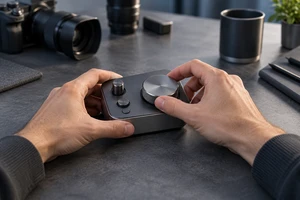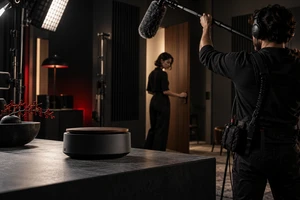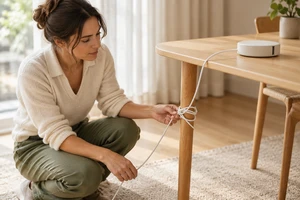
A product commercial for an overseas market can feature international talent, a pale sofa and a wide window, yet still feel like a local studio pretending to be somewhere else. The problem is rarely the price of the furniture or the absence of a lawn outside. It is usually that the people do not form a believable relationship with the space: Who has just come home? Who lives here? Who can pick up the device on the table without asking? Who crosses the living room, and who needs a corner where they will not be disturbed?
A home setting is not an interior design rendering. It is a social order shaped by everyday use. For a brand entering another market, localization should address relationships, zones, paths and traces of life, not just decor.
Begin with who lives together
Many productions search for a room with a vaguely Western look, then place actors inside it. A more reliable order is the reverse: define the household first, then decide how the room would be used.
The same dining table might double as a desk for someone who lives alone. In a shared apartment it may be a negotiated common area. In a family home it may move between breakfast, homework and storage. Change the relationship and you change object ownership, sightlines, seating distance and performance rhythm. When those relationships are missing from the scene, performers can only demonstrate the product, and the room feels temporarily rented.
IKEA published its Life at Home Report 2024 in March 2025. It draws on a survey of more than 38,000 adults across 39 countries, together with home ethnographies and digital immersions. The report considers life at home through activities such as feeling good, having fun, building atmosphere and making connections, while distinguishing between living alone, with a partner, children, relatives, friends or housemates. It cannot define a target audience for a brand, but it is a useful reminder that home is not a single visual style. It is something people continuously negotiate through their relationships and routines.
Before writing the shot list, define the residents in one sentence. For example: “Two remote-working housemates share the kitchen and living room but keep separate work zones.” That sentence gives the director, art department and cast more useful direction than “a modern Scandinavian living room.”
Shared and private zones shape camera distance
Living rooms, kitchens and entrances appear public, while bedrooms, desks and cupboards appear private. In real life, the distinction is not made by walls alone. Headphones left on a sofa arm may be treated as a household object. A charger that always stays on one desk probably belongs to one person. A smart lock, camera or speaker also raises questions about who controls it, who is recorded and who is merely visiting.
A 2024 study of security and privacy in shared homes found that device relationships in non-family households can be more complex than in traditional family settings. Ownership, access and landlord-resident relationships all affect how devices are understood and used. The paper is about smart-home security rather than advertising effectiveness, but it offers a useful scene-design reminder: where a product sits in a home communicates power and intimacy.
That changes cinematography. If a product belongs to a common area, two people can enter from different directions and pass its use naturally between them. If it belongs to a private zone, the camera does not need to reveal the entire room like a property listing. It can move closer to touch, pause and storage. A premium feeling does not always come from a wider shot. Sometimes it comes from knowing where the camera should stop.
Draw the paths before placing the product
A believable home commercial often passes a simple test: remove the product for a moment and the person still knows why they are moving through the room.
Start with three lines on the floor plan: entry, pause and exit. When someone comes in, do they put down keys before taking off a coat? Do they pass the product because it sits awkwardly in the route, or turn toward it because a need has arisen? After use, does the product remain in a shared area, move into a private zone or return to a fixed storage position?
These questions determine product composition. A robot vacuum should not wait in the center of a room simply to show its branding. An air purifier that appears only in a hero shot, without any relationship to windows, pets or human activity, rarely feels as if it belongs there. When placement follows the path, product value can emerge through behavior: reach conveys convenience, a pause conveys attention, and storage suggests frequency of use.
Localize traces of life, not national symbols
The least convincing props are often the ones placed solely to prove location: a conspicuous flag, excessive holiday decor, identical drinks in every hand, or a famous skyline pasted beyond the window. They tell viewers where the production wants to be, but not how the characters live.
More useful references show how life leaves traces. Does the entrance hold bags, shoes and mail temporarily? Does the kitchen counter preserve evidence of breakfast in progress? Which person sits closest to the sockets, charging cables and remote controls? How do pet supplies, children's objects or exercise equipment change the route through the room? Not every detail needs to appear on camera, but the spatial logic should support itself.
When researching a target market, gather multiple real homes, local floor plans, home-retail content and resident interviews. Then ask someone familiar with local life to review the script and art direction. A single influencer's apartment represents one taste, not a country. TikTok for Business makes a similar point in its official Home and Lifestyle creative guide: there is no single formula, while distinctive and authentic work feels native to the platform. Localization is therefore not the copying of one fashionable room. It is the search for a believable connection between the product and a specific group of people.
Give live action, sets and AIGC different jobs
Live action preserves physical continuity between doors, tables, sockets, bodies and products. When a claim depends on size, installation, touch, opening, load, cleaning or storage, the real product and a real action remain the most reliable foundation. A real home, however, can restrict sound, light, camera position, permissions and shooting hours. A studio set can make wall distance, window direction, paths and removable structures easier to control.
ONCE's Pearl River Delta location studios help solve camera access and multi-format production. Yet a beautiful living room is not automatically a believable household. Relationships and paths still need to be defined before the set is built, or the extra polish will only make the room feel more like a showroom.
AIGC is better suited to early exploration and non-critical environment extension. It can compare layouts, times of day, materials and palettes quickly, or extend distant scenery beyond a window. It should not replace validation of product structure and human contact. The 2023 paper Structure and Content-Guided Video Synthesis with Diffusion Models explicitly discusses conflicts between content edits and structural preservation, and treats temporal consistency as something requiring additional control. Tools continue to improve, but the underlying tension remains relevant: when a selling point depends on dimensions, hand contact or a continuous route, an attractive still frame is not enough evidence that the shot works.
A practical hybrid is to use AIGC to expand scene directions, art previs to check paths, a set or real home to capture crucial human-product relationships, and post-production to extend the environment. This increases visual choice without allowing the background to erase product facts.
Run a resident test before approval
During review, temporarily cover the brand and product, then ask three questions. Can you tell who lives here? Can you distinguish shared zones from personal ones? Do the character's entry, pause and exit have a reason?
If the answer is no, another set of more “foreign” furniture will not rescue the film. The team needs to return to the relationships and rewrite the actions and space. If those answers are already clear, the product can enter as a choice within real life rather than a sales object temporarily placed in a living room.
A believable overseas home does not have to represent an entire country. It only needs to represent a specific group of people, honestly, for one day with the product.
If you are planning a home, appliance, consumer-tech or lifestyle campaign for international markets, send ONCE your target market, audience, core product value and channel versions. We can develop the household relationships, spatial paths and product actions together through our cross-border product video production service, then choose the right combination of locations, sets and AIGC.