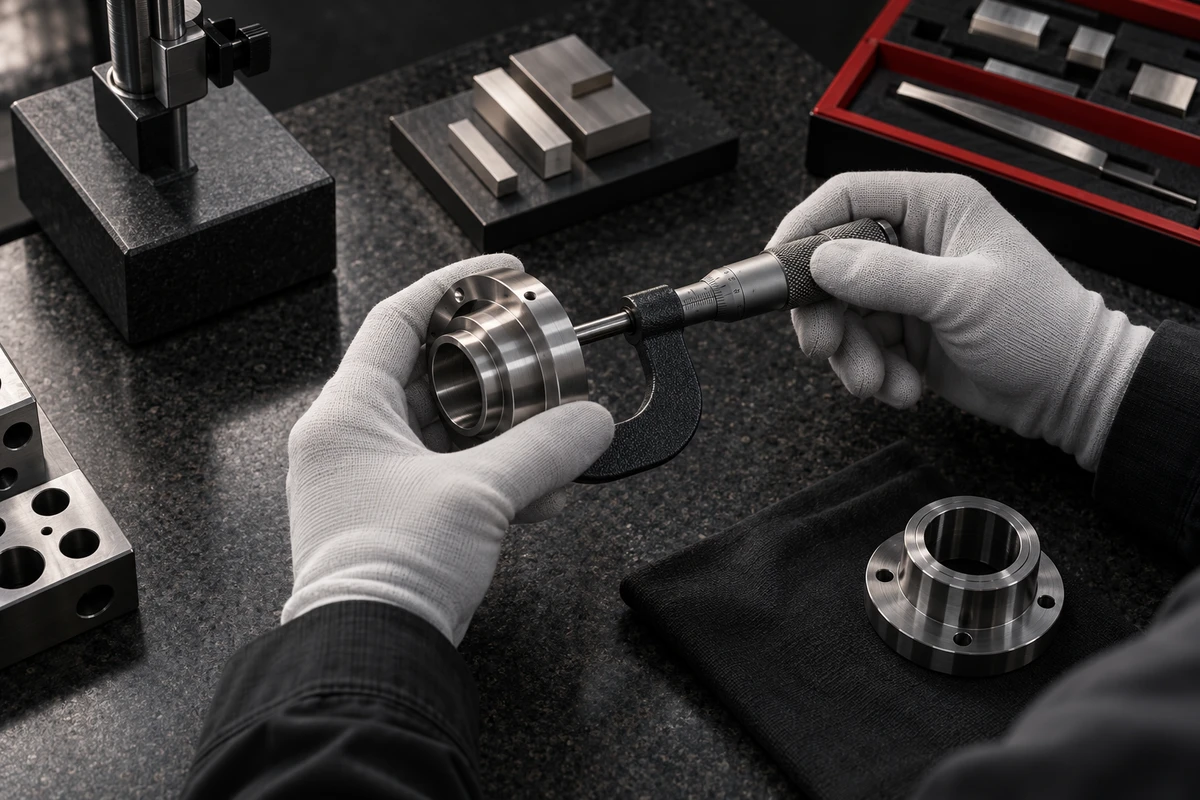
A camera moves close to an instrument display. The reading settles four places past the decimal point. Cold light travels across metal while a robotic arm advances with controlled precision. The image looks technical, yet the viewer still does not know what is being measured, what it is compared with, who noticed a deviation, or what the result changes.
To make precision visible in a corporate film, enlarge the relationship rather than the number. A working object meets a reference. An operator identifies a difference, responds to it, and carries the result into the next operation. Precision then stops being an adjective in the voice-over and becomes an action the audience can follow.
Precision Is a Relationship, Not a Decimal Place
China's State Administration for Market Regulation describes calibration as an activity performed under specified conditions to establish the relationship between an instrument's indication and the value reproduced by a measurement standard. The National Institute of Metrology of China likewise describes measurement standards as intermediate links in the country's dissemination and traceability system.
That definition offers a useful creative principle: the isolated instrument is not the real subject of calibration. The subject is a relationship to a reference. When a film shows only gauges, probes, and numbers, it shows equipment. When the reference, working object, operator, and downstream decision appear in the same sequence, the film begins to show how an organization treats precision.
Write Calibration as Four Visible Actions
Bring the reference into the frame
Do not begin with the reading. Establish the object and its reference first: a standard is removed from a protective case, a reference thermometer and the instrument under calibration enter the same apparatus, a gauge block is placed on a cleaned surface, or a calibration target is fixed in front of an imaging system. The reference may be visually modest, but it gives the sequence a logical starting point.
If it is physically small, start wider. Show who handles it and where it goes before moving into macro detail. Otherwise, the reference can look like an unexplained piece of technical set dressing.
Give the deviation a chance to be seen
A deviation does not need theatrical exaggeration. A pointer that does not return to its expected position, two readings held within one line of sight, an operator pausing to reseat a sample, or a curve separating briefly from a reference line can all create a clear story beat. Position the camera where the working object and the reference can be understood together instead of fragmenting them into unrelated close-ups.
The claim must remain modest. A shot can show that a difference requires judgment. It cannot establish a specific error value unless the underlying record supports that statement.
Film the operator's movement as judgment
Calibration often consists of small actions: returning a system to zero, adjusting a control, repositioning a probe, recording environmental conditions, or repeating a measurement. The hand close-up is not meaningful by itself. Its weight comes from cause and effect: why the operator stopped, which value was checked first, and why the measurement was repeated after an intervention.
Preserve the person's actual working rhythm. A shift of attention, a confirmation, and a written record usually communicate more professional intent than a staged gesture toward a screen.
Show where the result goes
The sequence should not end on a beautiful number. It becomes useful when the audience sees the instrument status recorded, the part move into a subsequent operation, a batch continue through measurement, or a team decide to repeat a check. The result needs a destination before the viewer can connect precision to manufacturing, research, or service.
Moving forward is not the same as proving conformance. That conclusion may depend on verification, inspection, a report, or a quality procedure. A corporate film should represent only the process it genuinely recorded and was authorized to show.
Use Cinematography to Clarify the Relationship
Precision equipment is often photographed as a bright contour against a dark background. This can create visual quality, but it can also hide the operating logic. A more legible sequence usually works across three distances:
- An establishing shot locates the instrument, working object, and operator relative to one another.
- A relationship shot holds the reference and measured object together, or connects them through the operator's eye line.
- A detail shot then reveals the scale, contact point, control, curve, or record that answers the question raised by the previous image.
Macro photography particularly needs scale cues. A polished metal surface can be beautiful without explaining its size or function. Let an edge of a glove, a fixture, a gauge block, or an interface remain in the composition long enough for viewers to understand the relationship between physical scale and measurement.
Displays need a camera test before the shoot. Refresh rate, shutter settings, exposure, and polarization can introduce banding, rolling artifacts, or clipped readings. Any interface replaced in post should be reviewed by the company for technical accuracy and permission to disclose. A more futuristic screen is not worth inventing a result that never existed.
Let Editing and Sound Give Small Changes Enough Time
Changes associated with precision can be too small to survive rapid cutting. The reference enters, the reading stabilizes, the operator makes a judgment, and the measurement is repeated. At least one complete cycle should remain visible. Other shots can be compressed, but the causal path cannot disappear.
Sound can add tactility without turning the process into science fiction. The click of a protective case, probe contact, a control settling into position, a keyboard confirmation, and restrained room tone can help the audience distinguish the actions. The purpose of sound is to reveal, not to inflate.
If the main film cannot accommodate the full process, give calibration one focused ten-to-fifteen-second passage, then build a more detailed cut for the website, an exhibition, or a sales conversation. The corporate film creates understanding; technical documentation supports further verification. They do not need to compete for the same minute.
A Calibration Shot Is Not a Certificate
The International Vocabulary of Metrology distinguishes calibration from adjustment and verification. The NIST policy and guidance on metrological traceability also stresses that traceability is a property of a measurement result, supported by a documented, unbroken chain of calibrations. Merely showing a calibrated instrument does not support every possible claim about results produced with it.
On-screen language should therefore describe the action being shown: establishing a relationship to a measurement standard, recording environmental conditions, or repeating a measurement. Unsupported statements such as “zero error,” “the world's highest precision,” or “globally certified” turn a careful scene into an unreliable promise. Certificates, reports, and standard numbers should enter the frame only after the company confirms their validity, scope, and permission to disclose.
If a brand wants to communicate rigor, it does not have to turn every instrument into an authority symbol. Showing how people respond to differences, preserve records, and decide what happens next is closer to rigor itself.
When Calibration Deserves a Place in the Main Film
Calibration can carry a central story beat when a company's value depends on measurement consistency, process stability, or comparable decisions across batches. Precision manufacturing, sensing, medical devices, laboratory services, imaging measurement, and quality infrastructure may all fit that condition. If calibration is only one routine backstage activity among many, it may work better in a focused technical film than in the main brand narrative.
A useful test is simple: if this passage is removed, can the audience still understand how the company knows its work is right? If not, calibration is not decorative B-roll. It is the reference point of the story.
ONCE VISUAL develops corporate content from real, authorized actions, people, and materials, then decides what belongs in a main film and what needs a dedicated technical cut. If you are planning content around manufacturing, research, or quality, map the crucial measurement scenes, references that may be shown, and the disclosure limits of supporting reports, then submit a project brief through our corporate video and B2B content solutions.