Establish Visual Anchors During Project Initiation
At the start of a TVC project, brands often treat video scripts and print posters as separate deliverables. This fragmented thinking leads to conflicting visual styles or misaligned core messages later on. True visual unity begins with setting a single visual anchor during initiation. The team must identify which frame will serve as the core symbol for dissemination. This frame must not only drive narrative turns or emotional peaks in the video but also possess compositional integrity as a standalone image.
Brands must prepare a detailed creative brief at this stage, including core selling points, target audience profiles, and reference visual styles. The production team should provide initial concept art or dynamic storyboards based on the brief to confirm the lighting logic, color tone, and character state of the "anchor frame." Failure to reach consensus here poses significant rework risks during shooting. The criterion is whether the frame clearly conveys the brand proposition without sound or context. If it cannot stand alone, the script structure or visual focus must be adjusted.
Asset Consistency Assessment During Pre-Production
During pre-production, the art director and director of photography must jointly develop a detailed shooting plan. The key is ensuring that sets, props, and lighting schemes for video are fully compatible with the static requirements of poster shoots. Many projects fail because video uses dynamic lighting while posters require extreme static detail, creating fundamental differences in light ratios and depth of field.
The production team should organize joint location scouts to confirm if the space supports both dynamic camera movement and high-resolution static shooting. Actor makeup and styling must undergo dual testing to ensure natural flow in video frame rates while withstanding close scrutiny in large-format poster prints. Brands must verify version consistency for all on-screen products to avoid errors like using old packaging in video and new designs in posters. A key risk is scheduling conflict; if video and posters are shot separately, sufficient transition and reset time must be reserved to prevent rushed work from compromising visual quality.
Dual-Track Recording During Shooting Execution
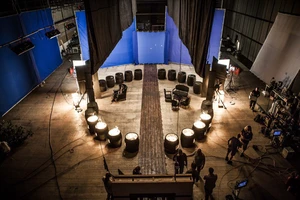
The set is where visual consistency is realized. While shooting main video angles, the cinematographer must dedicate time to capturing high-precision static frames for posters. This involves an independent shooting process with adjusted camera settings, aperture values, and focus positions. For high-speed motion shots, high-resolution cameras or dedicated still cameras may be needed for synchronous recording.
The director must compare dynamic footage and static compositions in real-time on set monitors. Key checks include whether micro-expressions remain compelling when frozen and whether background elements create distracting visual noise in stills. If a perfect dynamic moment appears cluttered statically, adjust blocking or clear the background immediately. Actions include using gray and color cards for scene-by-scene color calibration to ensure accurate baseline data for grading. An exception applies when creative intent requires strong motion blur; static posters may need clarity reconstructed in post-production, requiring early notification to the post team and retention of sufficient RAW footage.
Color and Composition Tweaks in Post-Production
Post-production is the final safeguard for converting dynamic imagery into static visual assets. After picture lock, the editor must provide exact timecodes for the first frame or key frames to the colorist. The colorist’s job is not just to unify the film’s tone but to perform secondary color optimization specifically for the selected poster frame. Video may sacrifice some shadow detail for fluidity, but posters must retain rich layers for print or large-screen display.
The compositing team must retouch selected frames as needed, such as removing visible wires, fixing blinking eyes, or optimizing product reflections. This process must strictly follow pre-established visual guidelines to avoid noticeable quality gaps between the poster and the final video due to over-retouching. The criterion is whether viewers feel a familiar visual continuity when seeing the poster after watching the video. If the poster is overly polished while the video appears rough, it triggers consumer trust issues. Therefore, a "dynamic-static comparison review" should be included in the post workflow to ensure high consistency in grain, contrast, and saturation.
Dimensional Restructuring for Multi-Platform Adaptation
Modern marketing requires TVC first frames and posters to adapt to various aspect ratios and display scenarios. From traditional horizontal TV screens to vertical mobile devices and outdoor billboards, a single composition rarely meets all needs. The production team must provide cropped versions in different ratios during post-production, ensuring core visual elements remain within safe areas across all sizes.
Brands must provide the latest technical specifications for each distribution platform, including resolution, file size, and color space requirements. Designers must adjust layout and information hierarchy for different ratios to ensure brand logos and core copy remain legible at any size. A key risk is subject loss due to automatic cropping, so sufficient off-screen space must be reserved during shooting. Neglecting this step can lead to stretched images or obscured key information by interface elements on specific platforms, severely impacting communication efficiency.
Acceptance Checklist and Delivery Standards
In the project closing phase, a rigorous acceptance process is the final quality gate. Acceptance should not only focus on playback smoothness but also verify the match between static assets and dynamic content. We recommend a checklist including: color deviation values between the first frame and poster key visual, font licensing scope, product detail consistency, and completeness of different ratio versions.
Brands must sign acceptance confirmations for the video master, poster source files, and project files separately. Pay special attention to defining copyright scope, including usage duration and geographic restrictions. If third-party music or fonts are involved, confirm whether their licenses cover static image usage. Deliverables should include uncompressed high-quality image formats and editable layered files for future brand adjustments. Any additional modification requests not confirmed earlier should be treated as new scope, requiring separate negotiation of fees and timelines.
Applicable Boundaries and Non-Applicable Scenarios
While visual consistency enhances brand recognition, strict first-frame-poster integration is not suitable for all TVC projects. For strong narrative or long-form brand micro-films, the core appeal lies in plot progression, and a single frame cannot summarize the essence. Forced consistency may spoil or mislead viewers. Such projects are better suited for extracting series stills or creating motion posters.
Additionally, with extremely limited budgets or tight deadlines, pursuing perfect dynamic-static unity mayfen san resources and affect overall completion. In such cases, prioritize core narrative quality in the video, and use abstract graphics or text-only designs for posters. Brands must make rational trade-offs based on communication goals and resources. When creative core relies on temporal changes or interactive experiences, static visual unity should yield to dynamic performance integrity. Understanding these boundaries helps teams make optimal decisions under resource constraints, avoiding formalistic traps.
If your team is planning next quarter’s TVC projects, we recommend introducing visual consistency discussions during the brief stage. Clarifying the coordination strategy between the first frame and poster can effectively reduce later communication costs and enhance the quality of overall marketing assets. For more details on TVC, brand promo, or product video production processes and standards, refer to the service scope and business introduction on the ONCE official website for detailed production guidelines.
If you are preparing a TVC project, start by organizing your brief, reference images, product or corporate materials, delivery platforms, and copyright scope, then view theTVC Commercial Service Pageto translate abstract preferences into executable production boundaries.