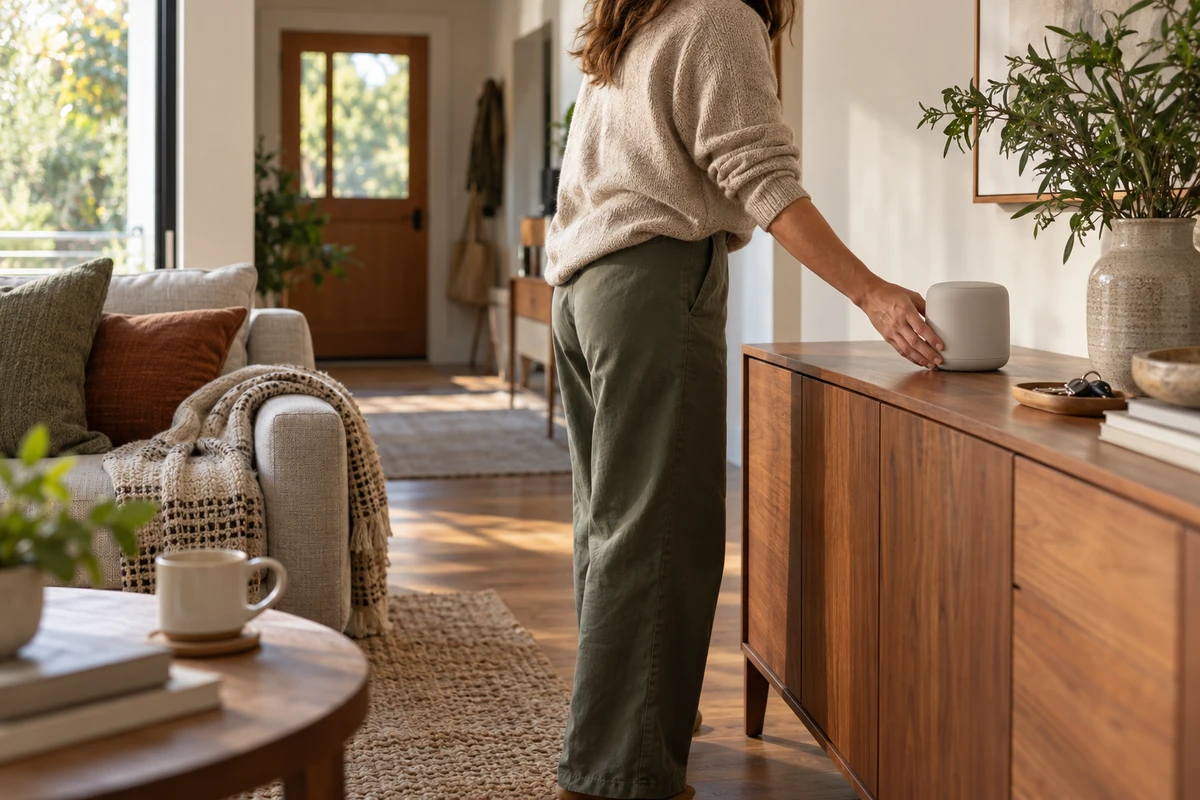
A living room built for a global product ad can get every visible detail “right”: a beige sofa, pale wood cabinetry, controlled greenery, and no loose cable in sight. The talent, product, and lighting are polished. Yet an overseas reviewer may still give the same note: it looks like a show home, not a place where somebody lives.
The problem may not be taste. The set has completed a decorative style without completing a way of life. Localizing a home for a global product ad is more than replacing Chinese books with English ones or chopsticks with cutlery. It means understanding how people enter, store things, charge devices, cook, rest, care for children or pets, and make room for the product inside those actions.
Polish is not credibility; familiarity comes from cause and effect
Viewers rarely audit every furniture brand before deciding whether a home feels real. They first read the relationship between people and space: where a coat goes, where keys and bags land, whether an outlet sits where a device could actually be used, and whether a kitchen counter leaves enough room to complete the action. A room can be beautiful, but if every object faces the camera, life appears to have been cleared away just before the take.
Google’s official guide to localizing ad campaigns places cultural relevance beyond translated voice and copy. It recommends reflecting local customs, cultural moments, and local advocates. A separate guide to authentic cultural representation argues that mistakes often live in concrete details: casting may look inclusive while the home, object, or ability shown does not belong to the character’s life.
Set localization therefore should not paste a national label onto the frame. It should build an understandable chain of cause and effect. Why does the person enter from this direction? Why is the product stored here? Why can the next action happen naturally? When space and action explain each other, a home can feel specific without displaying a flag. When that logic breaks, more “local” props only add decoration.
Write the household verbs before choosing the sofa
Set design often begins with a mood board: modern, warm, Nordic, minimal. For a global ad, a more useful starting point is a sequence of actions. What happens before the product appears, who needs to pass during use, and where does the product go afterward? Those verbs should shape the space rather than force the space to accommodate a finished shot list.
For a robot vacuum, the question is not only whether the living room is large enough. Floor transitions, chair spacing, and the charging dock must support believable movement. For a kitchen appliance, the counter must connect preparation, washing, heating, serving, and storage within a human stride. For home security, the entrance, doorbell sightline, parcel position, and indoor response need to belong to one residential logic.
IKEA’s official Life at Home Report 2024 surveyed 38,630 adults across 39 countries and included visits to homes. Its subject is not a universal global decor style. It looks at enjoyment, connection, private time, and everyday rituals. For a production team, the useful point is that the credibility of a home grows from activity and relationships; a fashionable furniture package cannot substitute for them.
Infrastructure performs in the scene too
The entrance defines how the day begins
Door swing, entry width, coat and shoe habits, and the temporary landing place for a parcel determine whether a return-home action can flow. Without a credible entrance, the performer can only walk in from offscreen toward a living room that has already been prepared. The product loses its path into daily life.
Power, water, and heat are not only crew concerns
Consumer electronics, kitchen appliances, cleaning devices, and smart-home products all depend on infrastructure. A cable that vanishes, a device operating far from any outlet, a water appliance with no supply or drain relationship, or a heating unit that conflicts with the window can produce an undefined sense of falseness. Viewers may not name the error, but the product feels placed inside a box built only for photography.
Scale decides whether a person can live there
A wide lens can make a studio set feel generous while exaggerating problems between furniture and the body. An island that is too high, a sofa that is too deep, or a passage that works for the camera but not for a turning person will reveal itself in motion. Letting the performer walk the complete route during a lens test exposes more than an empty beauty frame.
Lived-in detail is more than making the table messy
To escape the show-home look, a crew may add a cup, blanket, books, and toys at the last minute. The room stays artificial because none of those things has an owner or a before-and-after state. Useful traces of life answer three questions: who used this, what just happened, and what happens next?
A partly coiled charging cable can show that a device was just used. A correctly sized lead by the door can connect a pet product to the act of going outside. Open ingredients and a dish waiting to be washed can explain why an appliance is running now. Random books, spotless cups, and permanently fluffed textiles only make the styling more visible.
Lived-in detail must also serve the proposition. A fast-cleaning product can inhabit recognizable but solvable disorder. A product about quiet rest may need visual restraint. A fuller set is not automatically a truer one. Every visible trace should support the character, the product, or the event.
The character, space, and product need one shared life
Global advertising can treat casting as the main evidence of localization. A performer who appears to match the target market does not make the set credible by themselves. Age, occupation, physical ability, household structure, and routines change furniture scale, storage height, lighting needs, and product placement.
A two-handed product placed in the center of a passage prevents anyone else from moving through the home. A room written for an older character contradicts itself if every frequently used object sits in a high cabinet. A pet appearing in a house with no relevant trace on the floor, entrance, or textiles looks borrowed for the shot.
This is more specific than adding a “diverse” cast. Google’s representation guide focuses on the mismatch between people and lived details. Before the shoot, art direction, casting, wardrobe, and performance should answer the same questions: why does this person live here, why is the product here, and how have they already coexisted for some time?
One hero film can preserve a replaceable market layer
Multiple markets do not always require rebuilding an entire home for every country. A practical production system separates a stable layer from a market layer. The stable layer contains the surface needed for product use, the key light direction, major camera positions, and performer routes. The market layer contains outlets and interfaces, entrance behavior, everyday packaging, textiles, wall information, and household relationships.
During storyboarding, mark which shots need the whole room and which need only hands, product, and a local environment. Wide spatial shots carry household relationships and regional credibility. Partial shots carry function and material and are easier to reuse. This does not reduce localization to swapping props. It concentrates the cultural information that must be re-proven in the shots where viewers can actually see it.
Capture clean plates, environmental cutaways at several scales, and action versions without dialogue so subtitles, dubbing, and market changes have room to work. Our article on assigning roles across a launch hero film explains how one lead asset can leave work for supporting content. The guide to localizing humor in global ads shows why translating dialogue alone does not transport the social rule.
AI backgrounds can extend space, but they cannot hide broken life logic
AI and CG can quickly change the city beyond a window, wall finishes, room depth, and styling combinations. Their weakness is often the place where people and products make contact. Pressure on a countertop, the path of a moving chair, the relationship between a device and its outlet, mirror reflections, and contact shadows need to remain coherent through continuous action.
A robust hybrid approach anchors the interactive foreground in a real or reliable physical set. The performer, product, support surface, key props, and practical light work on camera first; AI or CG then extends distant and non-contact areas. If the generated room dictates the action while the stage lacks matching scale and obstruction, postproduction keeps repairing hands, feet, gaze, and shadows.
Generated space can be more ambitious in a one-second atmosphere shot. A functional demonstration, continuous walk, or shot that proves product size needs a stronger physical anchor. Choose the method by the job of the shot rather than declaring the whole film “all live action” or “all AI.”
Do not ask whether it looks American; ask whether life can continue
“Does it look like this country?” easily pushes a review toward stereotypes. A better question begins where the shot ends. Where does the performer put the product next? Where does the cable run? Who needs to pass through this route? What happens to the objects on the table ten minutes later? If every answer relies on unseen space or an edit, the set may support one frame without supporting life.
Invite real users in the target market, a local creative, or a team familiar with that market to review mood boards and lens tests early. They do not need to direct the aesthetic. They need to identify relationships that cannot work in local life and details that the production has mistaken for universal experience.
Localization has limits too. Homes vary within one market by city, income, age, community, and personal habit. One round of research cannot define a country. First decide whose story the ad tells, then build a home that this specific character could inhabit. The goal is not an “overseas living room” everybody recognizes and nobody actually lives in.
If you are planning an overseas campaign for an appliance, consumer device, pet, security, or lifestyle product, send ONCE the target markets, product sample, core handling actions, and version requirements. During art direction and lens testing, we can test scale, performer routes, practical foreground interaction, and replaceable market layers so the product enters a credible life before it enters the frame.
Sources reviewed on November 2, 2026: Google’s official guidance on campaign localization and authentic cultural representation, and IKEA’s Life at Home Report 2024. These sources guide the research method; they do not imply that one household style represents an entire country. The set situations in this article are production examples, not client results.