You bring international creators into a workshop with a China-based product team. They identify a frustrating control, suggest a different storage arrangement and supply useful stories from daily life. The session produces lively footage. A month later, nobody knows which suggestions were accepted or who owes the participants an answer.
Creator product co-creation needs a decision process as well as a production plan. The useful output is not necessarily a redesigned product. It is a clear account of what the brand will do with the input.
Broader collaboration needs a more specific scope
Laura Mercier’s Collective announcement describes co-creation and pre-launch color and formula review alongside storytelling. Its page is dated October 28, 2026, but the text specifies a May 21 launch. It is used here as an existing collaboration example, not October launch news or evidence of members’ final decision authority.
Snap’s October 20 announcement gave Robert Downey Jr. an honorary Chief Customer Experience Officer role at SPECS, with work spanning original content, Lens experiences, hardware and in-person experiences. It does not disclose a transferable internal approval process.
These are particular company arrangements, not proof that an industry has changed or that co-creation improves sales. ONCE’s inference concerns procurement: once collaboration reaches product decisions, the scope needs to say more than how many posts will be delivered.
Open a real decision before opening the workshop
“Give us ideas for the new product” leaves participants guessing about what can change. A more useful invitation identifies a live question and its constraints.
For a hypothetical portable lamp, the battery and certification plan might be fixed while storage and switch instructions remain open. Ask participants to identify obstacles in the intended use context. Do not imply that a locked production structure is available for redesign merely to make the workshop feel collaborative.
The product owner should distinguish adjustable choices, fixed commitments and matters requiring technical verification. If only instructions can change this round, call it an instruction-design exercise. Clarity does not diminish participation; it gives the contribution a realistic destination.
Participants can identify problems and propose solutions without becoming responsible for engineering, safety, cost or market-access approval. An expert in the room does not make an untested idea a finished capability.
ONCE’s suggestion disposition sheet
This proposed working record retains the original input, its use context, the brand’s current assessment, the next action and the person responsible for a reply. It is a method, not a deployed ONCE software product or a reported client outcome.
Separate the observation from the proposed fix
“I cannot find the switch at night, so make the button bigger” contains two contributions. One is an observation; the other is a solution. The team can take the first seriously while comparing location, tactile cues or instructions rather than immediately accepting a larger button.
Record the relevant sample, setup and context. Agreement among a few participants can justify further investigation without representing the entire export market. Preserve dissent instead of editing a discussion into apparent unanimity.
Assign a destination to the suggestion
A team might adopt, test, defer or decline an input. State exactly what that means. Adopting a task to investigate nighttime operation is not the same as approving a new component. A test needs a defined comparison and owner. Deferral needs a dependency. Declining an idea needs a reason relevant to the project.
These are management options, not a universal scoring system. Some questions need an engineering prototype, some another observation and some only clearer instructions. Avoid promising a product change for every contribution simply to demonstrate participation.
Report back
Agree when participants will hear what happened and who will answer if the question remains unresolved. Explain which part of a suggestion was used, what still needs validation or why a proposal was not adopted.
This does not give every participant a vote. Distinguishing input, validation and final approval makes the actual role more understandable.
Keep decision records separate from public storytelling
Workshop documentation serves the product decision. A campaign film serves public communication. Willingness to discuss a sample is not blanket agreement to publish every remark as advertising. Explain recording, internal audiences, intended public material and the relevant confirmation process before the session.
If an observation undermines the planned script, pause that expression and ask the product owner to investigate. Do not direct a more enthusiastic repeat to conceal the disagreement. A public account of co-creation can explain what was found, how it was checked and what changed, provided those statements are accurate. A proposed improvement should not appear as something customers can already buy.
ONCE’s article on creator script review (Chinese) addresses factual control and expression after product claims are established. This article addresses an earlier question: how input is handled while the product decision is still open.
Commission outputs that can be accepted
Scope question definition, participant preparation, facilitation, recording, synthesis, product review, follow-up and any optional public production separately. Decide who supplies samples, approves changes and performs validation before the workshop rather than leaving those jobs with the camera crew afterwards.
Estimate the actual tasks. Multiplying a creator count by a video count does not describe an internal decision exercise. An internal workshop need not include engineering tests or finished ads; if both are required, assign their separate work and approvals.
Acceptance can check whether the agreed question was explored, observations were distinguished from solutions, significant inputs received a disposition and unresolved questions have an owner. It should not require a redesign or unanimous praise. Concluding that the original design is appropriate can be useful if the reasoning is traceable.
Build a learning relationship rather than repeat events
For brands working with Chinese supply chains, retain the link between overseas use contexts, product decisions and the next content brief. A deferred idea may become relevant when the next generation changes its constraints. A resolved decision can help a new production team understand why the demonstration is designed that way.
For ONCE’s brand content planning, this is a direction for a repeatable service, not an existing platform, margin claim or guarantee of results. Continued work is worthwhile only when the brand has a genuine open question and a team able to process and answer the input.
Before inviting creators to co-create, establish what can change, who can approve it and who will communicate the next step. Useful participation needs somewhere for the contribution to go.
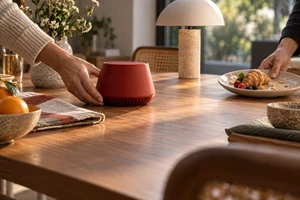
Sources checked October 29, 2026: the Laura Mercier page and Snap announcement linked above, with their date distinctions stated in the text. Method and lamp scenario are ONCE editorial analysis. The original AI cover is a sample-discussion concept, not a depiction of either company or an ONCE client.