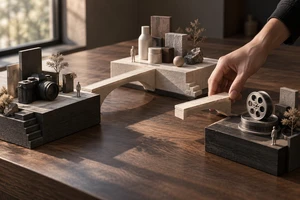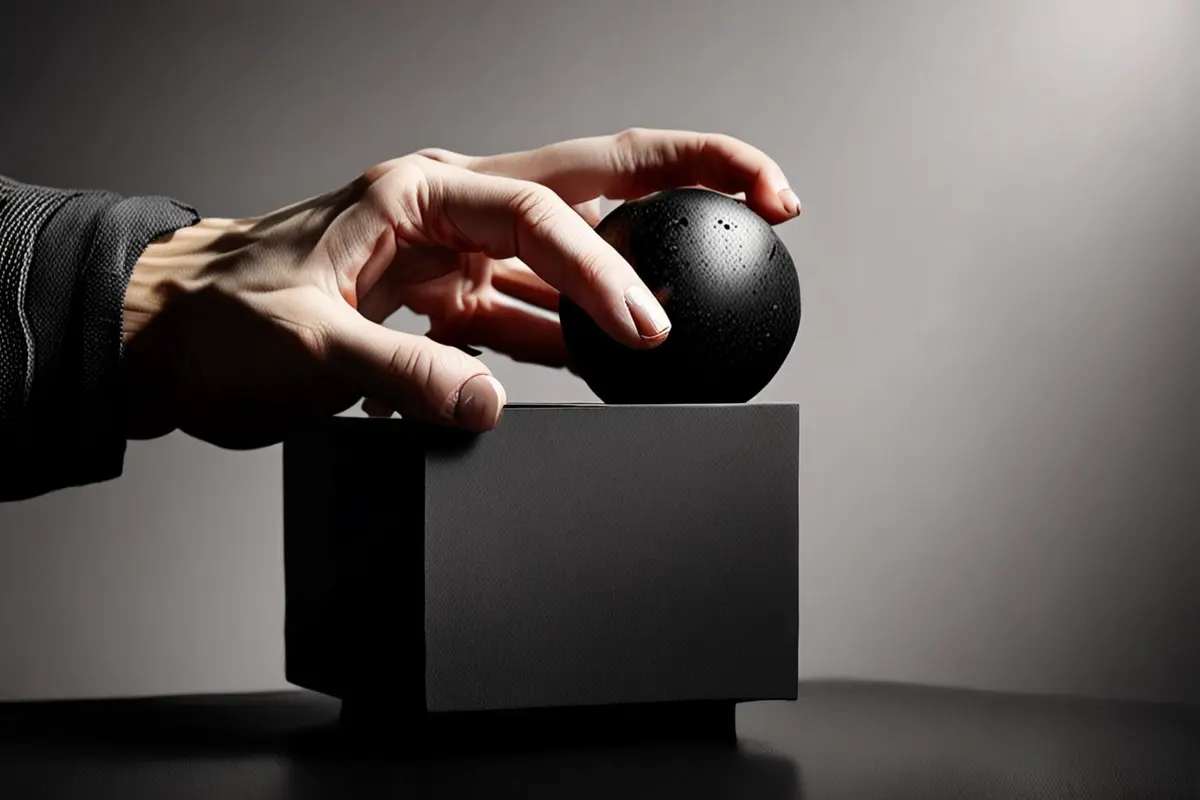
Repetition in a brand film tends to fail in one of two ways. Viewers recognize that they have seen the shot before but cannot say why it belongs to this brand. Or the creative team changes the language of every new film so thoroughly that even beautiful work accumulates no shared memory.
A useful visual motif is not a handsome action pasted into every piece of content. It is a stable relationship: what prompts the character, how the character touches the product, and what feedback the product returns. The setting, cast, framing and emotion can change. When the relationship returns, however, the audience should be able to re-enter the same brand world.
Consider an explicitly hypothetical scene, not a client case. A person places a small device on a table, traces a finger along its edge, and only then does a hidden light come alive. One film takes place at dawn, another in a hotel room, and a third has a family member passing the device to someone else. Reusing the same close-up would soon feel like a template. Preserving the three beats—place, touch, response—while changing the character's purpose and the consequence gives the motif room to grow.
A motif is not a shot. It is a relationship you can retell
Temporarily remove the camera language and write the motif with verbs. Do not write, “An overhead shot of a hand opening the box.” Write, “The character locates the opening, meets a small amount of resistance, and receives a clear confirmation from the product.” The first version mistakes a camera position for a brand asset. The second gives performance, cinematography and editing room to create a new execution.
An action motif usually contains at least three beats:
- Trigger: what makes the character begin;
- Action: the contact between person and product that cannot be replaced;
- Feedback: how the product, environment or character state changes.
Every version does not need to show all three at equal length. A six-second cut may retain only the action and feedback, while a hero film lets the trigger carry a relationship. But if the product can be removed and any prop can complete the same three beats, the motif remains a generic performance gesture.
Find it in a real use ritual, not in an advertising pose
Durable actions often already exist in the use experience: checking a scale before turning a dial, moving hair aside before putting on a device, or pressing a thumb against a closure to confirm that it has locked. They may not be dramatic, but they contain function, touch and habit at the same time.
In “Rituals Enhance Consumption”, published in Psychological Science in 2013, four experiments studied ritual behavior before consumption. Performing the ritual oneself produced more involvement and enjoyment than merely watching it, while random gestures did not produce the same result. The research concerned foods and drinks rather than brand-film performance, so it does not show that adding a ritual will increase conversion. Its useful creative boundary is narrower: an action gains meaning through an ordered, purposeful experience, not through tidy repetition alone.
Observe actual product use before deciding what to heighten. Ask where the user must make a choice, where the structure can be felt, and where the result is confirmed. A motif should sit on one of those moments. If the product has no reliable tactile or visible feedback, do not invent a premium sensation with exaggerated acting, foley or effects.
Keep the action skeleton and let the situation change
Repetition does not require every film to look alike. Usually only a few structural features must remain stable: direction of movement, the key contact point, the order in which the result appears, and the moment at which the brand becomes attributable. Character, location, light, pace, obstacle, emotion and camera can vary.
Variation should add meaning. A character completing the action alone can show familiarity. Two people sharing it can reveal a relationship. The same action under time pressure can reveal efficiency. The relationship remains recognizable, yet each appearance answers a different question. Merely changing wardrobe, city and background creates asset variants, not narrative development.
Memory research also warns against treating variation as an automatic benefit. A 2005 Journal of Consumer Research study on spacing and encoding variability ran four experiments and found that changing ad format and content could become counterproductive at longer intervals because it reduced retrieval of the earlier presentation. The study used print advertising and laboratory memory tasks; it is not a direct rule for a video media plan. The safer creative implication is that variation needs a retrievable core. Every execution should not begin again from zero.
Repetition must return attention to the product
An action can easily be overshadowed by the performer, setting or camera technique. In a 2018 Frontiers in Psychology study, repeated composite advertising images containing a model and a cosmetic product did not automatically create the same mere-exposure effect for the product component. The product result appeared when participants were explicitly encouraged to attend to it. The samples, still images and laboratory task limit what can be inferred about film or sales. Even so, the experiment usefully challenges a common assumption: repeating a whole image does not prove that product memory is accumulating.
Each appearance of the motif should therefore end with an attention check. Does the character's gaze lead us to the contact point? Does product feedback occur when the action is most legible? Are light, sound and editing clarifying the cause, or merely making the performer more attractive?
Try a no-brand review. Hide the end card and captions, then watch only the action. The viewer does not need to identify the company by name, but they should be able to say which product changed what. If they remember only a beautiful hand, an unusual transition or a celebrity, the motif has not yet completed its brand attribution.
Preserve the same cause across hero films, cutdowns and portrait edits
One benefit of a motif is that it gives a content system a shared skeleton without forcing every deliverable to reuse the same crop. A hero film can show trigger, hesitation, action and outcome. A fifteen-second version may keep the trigger and the key contact. A six-second version may retain half a beat before the action, the contact point and the feedback.
The protected element is not every frame. It is the shortest path the viewer needs to understand the cause. If a cutdown leaves only the product lighting up, the response has lost its source. If a portrait crop removes the hand-product contact and keeps only the expression, the emotion has lost its evidence.
Localization requires more than replacing talent and captions. Everyday handling, gesture etiquette, who touches first, and where a product sits in domestic or public space can all change the meaning of an action. What remains stable is the relationship the brand wants to express, not necessarily the external shape filmed in one market.
Let live action protect tactility and use AIGC to extend the world
An action motif asks more of generative video than a single atmospheric frame because it depends on order and transition. TC-Bench, published in ACL Findings in July 2025, evaluated conditional video generation using initial states, final states and compositional changes. The paper reported that the tested contemporary generators completed fewer than 20 percent of the specified compositional changes and continued to struggle with temporal instructions and combining elements across time. The benchmark does not cover every model or shot, and it cannot predict the outcome of a particular production. It does establish a practical warning: attractive first and last frames do not guarantee a reliable causal action between them.
When product contact, resistance, closure, liquid behavior or mechanical response carries the claim, use the real object, a weight-matched sample or a verified 3D animation as the action reference. AIGC is better suited to extending environments, exploring atmosphere and creating transitions that do not alter the product mechanism. If an action must be generated, do not rebuild its three beats as unrelated prompts. Lock the direction of the hand, contact position, product-state change and finishing pose before varying the world around them.
Live action is not automatically continuous either. If coverage changes movement direction, force phase or product state, the edit turns one action into three different actions. Capture a complete performance as the causal reference before adding contact and result inserts. Sound can make material and feedback legible, but it should not invent a capability the image and product cannot support.
Build a one-page action motif card during scripting
A motif does not need a heavy brand manual. One page is enough if it records decisions rather than adjectives.
Invariants
Define the trigger, key contact, feedback order and product state that must remain visible. Add one sentence explaining why this product is necessary. If the answer is only “it feels premium,” the causal idea is not yet specific enough.
Variables
List the characters, settings, pace, obstacles, outcomes and camera positions that may change. Each change should add information rather than merely increase the asset count.
Prohibitions
Record choices that would break product truth or brand attribution: turning a light touch into a heavy impact, using impossible deformation for visual pleasure, allowing performance to hide the response, or reversing the action order between versions.
Compression test
Retell the motif as a hero film, a fifteen-second cut, a six-second cut and a sound-off portrait edit. Every version should preserve the shortest causal path while letting rhythm and composition respond to the channel. If compression leaves only a logo, the motif is not yet a content asset.
Make viewers anticipate the next variation, not the next copy
The goal of a brand-film visual motif is not to make people say, “I have seen this shot.” It is to create a familiar expectation as the action begins: how will the same relationship alter this character, product and situation now?
Stability gives memory an entrance. Variation gives the content a reason to continue. A sustainable motif can keep saying something new without betraying the real structure of the product.
If you are planning a hero film, a series of shorts or multi-market versions, ONCE can help move from product-use observation and concept development through scripting, storyboards, live action and hybrid AIGC production. See our brand film production approach, and bring the product, its real use sequence and the one action you most want people to remember.
Sources checked on October 24, 2026. This article draws on Vohs et al., “Rituals Enhance Consumption”; Inoue et al., “The Contribution of Attention to the Mere Exposure Effect for Parts of Advertising Images”; Appleton-Knapp et al. on advertising spacing and encoding variability; and the ACL 2025 TC-Bench paper. The production method is an editorial synthesis within the limits of those studies, not a performance guarantee or a real client case.