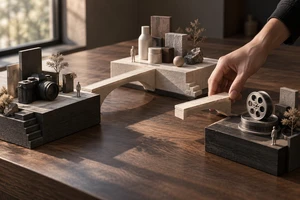
An overseas brand commissioning content from a China-based studio may ask for exclusive creative. But what should not appear in a competitor's next campaign: the finished edit, a bespoke character, a narrative device, or every generated background?
Those requests have different production consequences. ONCE recommends naming the objects that matter before paying a premium. More generation attempts do not establish stronger exclusivity, and a commercial-use statement does not answer every ownership question.
The official distinction behind the buying decision
The U.S. Copyright Office's January 29, 2025 announcement makes human control of sufficient expressive elements central to copyrightability. Prompts alone are insufficient; creative arrangements or modifications can matter, and AI assistance does not automatically prevent protection.
This is a U.S.-specific official explanation, not a global rule or a determination about your advertisement. We rechecked it on October 24, 2026 for this evergreen analysis. We have not conducted a legal review of the full report or a particular work. Actual protection, ownership and contractual commitments require qualified assessment of the work and relevant jurisdiction.
For commissioning purposes, keep three questions separate: what tool terms permit, what expression may attract legal protection, and what reuse the supplier agrees not to undertake. None can be answered simply by increasing the render budget.
ONCE's two-layer creative brief
Ask whether removing an element would remove the brand-specific meaning. This is a budget-prioritization question, not a legal test.
| Layer | Production priority |
|---|---|
| Recognition core | Deliberate bespoke expression, iterations and records, with any proposed dedicated-use arrangements separately reviewed |
| Presentation layer | Appropriate use conditions, product accuracy, replaceability and delivery quality; no automatic exclusivity premium |
The core might be an original story sequence, a character's distinctive behavior or a recurring product action. The outer layer might be atmospheric scenery or temporary promotional decoration. These are not fixed asset categories: a setting can be central to a brand, while a presenter can be entirely incidental.
Do not label all human involvement as copyrightable authorship. Writing, design, filming and editing may produce expression that needs assessment; a resize, filter or saved project file is not a legal conclusion. Describe real work accurately rather than reconstructing a fictional authorship trail after delivery.
Replace “exclusive video” with an object list
Imagine a hypothetical portable-speaker campaign. The brand wants to retain a sequence in which everyday objects build a rhythm that the speaker completes. The setting may change for different markets.
List the actual items under discussion: approved script, action sequence, bespoke character design, sound work, filmed product footage, final edit and agreed editable materials. Beside each, record intended use, the reuse that concerns the brand, who must verify existing rights, and a fallback if the requested arrangement cannot be confirmed.
Then involve procurement and legal advisers in the dedicated-use questions. Is the concern the supplier giving the same bespoke deliverable to named competitors, or any remotely similar expression appearing anywhere? Which categories, territories and time periods matter? What happens to general methods, tools and third-party material?
These are discussion prompts, not model legal clauses. A supplier's promise about its own behavior is different from an ability to stop an unrelated third party. If the latter is important, obtain professional advice about available protection rather than accepting “worldwide exclusive” as a production assurance.
Two substitutions reveal the real priority
First, keep the recognition core and replace scenery, decoration and nonessential casting. If the brand meaning survives, make the outer layer adaptable and direct more effort toward the core and reusable master assets.
Second, keep the attractive generated imagery but substitute a different product and brand name. If the piece works almost unchanged, revisit the original creative task. Was the commission buying brand-specific expression or a general visual treatment?
Neither exercise determines infringement or makes similarity unlawful. They are proposed creative-room exercises, not tests performed by ONCE or customer results. Their role is to reveal what the buyer values enough to commission specifically.
Accept deliverables, not a blanket assurance
Agree which records accompany the core: approved writing and design versions, material creative revisions, contributor records, source references and an exact list of editable files. Keep unresolved third-party or intended-use questions visible. Do not assume that commissioning an edit also transfers every internal tool the studio uses.
Good records can support a later professional assessment; they do not create rights or guarantee registration. Likewise, exclusivity does not replace clearance of source material, people, music or other components.
Quote core creation, presentation extensions and agreed documentation separately. Any promise restricting a supplier's later reuse deserves an explicit scope discussion rather than being assumed free. Use real proposals, not an invented percentage premium or price per generation as a proxy for protection.
Some campaigns need adaptability more than exclusivity
A short promotion or straightforward functional demonstration may not justify bespoke treatment of every background. Accurate, usable production can be the better priority. A character, narrative or sound intended to anchor years of brand activity merits earlier creative investment and professional review.
When briefing a China-based production partner such as ONCE, identify the three objects you would most dislike seeing reused for a competitor. Ask what the supplier can deliver, what it can commit to and what remains subject to specialist confirmation. That conversation is more actionable than demanding an exclusive label on every frame.
Source and scope
The official announcement and the Copyright Office's current AI resource page were checked on October 24, 2026. This article is an original production-procurement analysis, not legal advice or a claim of protection for specific material. The two-layer brief and substitution exercises are ONCE proposals, not measured client outcomes.