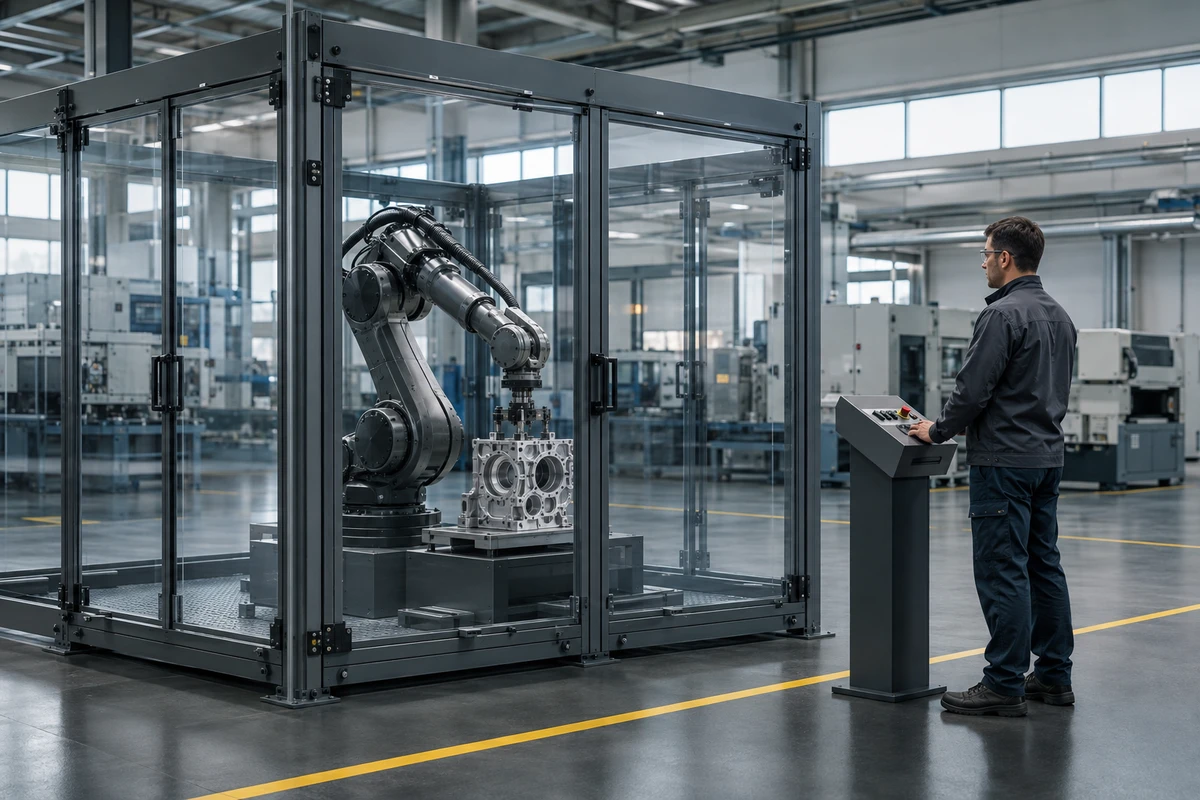
Ten minutes before the machine tool entered its maintenance window, the plant safety lead retaped the floor’s yellow line outside the guardrail. The “close-up of the tool engaging the material” in the shot list was also split into two shots: capture the position with energy isolated, then capture the result from the observation point after operations resumed. That change is the most concrete example of industrial equipment video safety on set.
This field note is for brand marketing, procurement, and project leads preparing content about machine tools, automated production lines, inspection equipment, and robotic workstations. It does not offer a universal safety checklist. Instead, following the production record of this two-second shot, it explains how equipment shutdown filming, hazardous energy isolation, personnel authorization, and safety rehearsal enter the shot list, production notice, and acceptance process. Actual execution remains subject to local requirements, equipment manuals, the plant’s risk assessment, and the decisions of an authorized safety lead.
After the yellow line was retaped, the shot list gained an equipment-status column
The original shot list contained only shot size, action, and duration. After the location scout, the producer added an “equipment status” column after every shot: energy isolated, standby, setup, normal production, or no on-site filming. The team also recorded whether guards were closed, whether personnel could approach, whether residual pressure and inertial movement had reached zero, and who issued start and stop authorization. What the camera crew saw was no longer a string of attractive shots, but a set of on-site conditions that could not be mixed.
The U.S. NIOSH Hierarchy of Controls places elimination, substitution, and engineering controls ahead of administrative controls and personal protective equipment. Applied to industrial filming, the order is to remove unnecessary hazardous approaches, use shutdown states or substitute shots, and then arrange camera positions, callouts, and protective equipment. Hard hats and safety shoes are part of site requirements, but they do not automatically make an unsuitable position safe for filming.
The plant floor plan was revised along with the shot list. The equipment’s range of motion and the area inside the guardrail were marked red; points requiring shutdown, isolation, or low-energy rehearsal were marked yellow; existing visitor routes and fixed observation points were marked green. Each camera position listed the shot number, focal length, number of camera crew members, and direction of movement. If an extra shot was added during the day, the producer first checked which equipment status it belonged to instead of taking the cinematographer over to test an angle.
The two-second tool close-up was split into cold-state and running footage
Tools, fixtures, internal sensors, and changeover interfaces must be seen up close to be understood, but that does not mean the crew should approach while the equipment is running. The information was split into two parts: cold-state footage explains the positional relationship between the tool and material, while running footage shows the cutting result, material change, and equipment rhythm. The former was captured under plant-confirmed shutdown and isolation conditions; the latter was filmed from the existing safe observation point.
The U.K. HSE equipment maintenance safety guidance states that moving equipment should be stopped, and that electricity plus energy sources such as pressure, gas, and steam should be isolated according to risk. The U.S. OSHA Control of Hazardous Energy standard provides general reference points for lockout, tagging, authorized personnel, and re-energization. These two sources illustrate control principles; they do not replace local procedures. Isolation and reset are performed only by authorized plant personnel. The camera crew does not touch switches or replace the operator in confirming a zero-energy state.
The continuity log for this shot therefore used four status codes: cold state, isolated, reset, and normal operation. After the cold-state close-up was captured, the camera and crew first moved outside the yellow line. The plant restored the guards, checked the tools, and completed the reset. Only after the site lead gave explicit authorization did the team film the running wide shot and telephoto shot. The footage filenames shared the same action number but retained different status suffixes, so post-production would not mistakenly cut hand footage captured with energy isolated into an operation shown as running.
A reshoot cannot simply copy the previous authorization. If the shift, material, equipment parameters, or position changes, the original confirmation must be checked again. Procurement quotes should list the isolation window, reset time, and time allocated to the operator and safety lead separately, preventing the on-site discovery that a supposed “single close-up” requires reopening the entire production setup.
The crew stays outside the guardrail, and the image works through three distances
Staying outside the yellow line does not mean the image can only be a flat distant view. The first distance is an environmental wide shot, bringing the complete guardrail, equipment scale, personnel route, and finished-product exit into the frame. The second is a telephoto shot from a fixed observation point, bringing the end of the robotic arm, material changes, or indicator status closer. The third is a cold-state close-up after energy isolation, establishing the relationships among interfaces, textures, and fixtures. Combined in factual sequence, the three distances let viewers understand the action without sending the camera into the automation cell.
Any fixed or remote camera that must remain inside the area must be installed, composition locked, and approved by the plant before the equipment is re-energized, after which all personnel withdraw. The camera position must not obstruct sensors, routes, or warnings, and temporary cables must not cross personnel paths. Machine sound is recorded separately from an approved position, with filenames corresponding to the equipment, action, and status. Sound from another machine cannot be used as a substitute.
Canceled shots also have alternatives. Tool details can use a same-model sample and a cold-state position shot; enclosed internal structures can use a plant-approved transparent demonstration unit or 3D materials; a sense of high speed can be conveyed through movement trails in a complete wide shot, finished-product rhythm, and accurate sound. Substitute footage must keep the model, material direction, surface condition, and action number consistent. The voice-over should describe only functions that the image can genuinely prove.
People are assigned by responsibility as well. The actual operator performs the approved process, the engineer explains the technical judgment, and the actor handles only scale or non-control actions. Wearing workwear does not grant equipment operating authority. The complementary industrial equipment promotional video crew role guide can help procurement teams separate operation, judgment, and performance, avoiding a situation where the wrong person touches the machine for visual consistency.
Guards cannot be opened for composition, and callouts cannot remain only in the production notice
The requests most easily underestimated on set are not large actions, but requests to “just make a small adjustment”: open a guard to reduce reflections, have an actor press the real start button once, have a camera assistant reach in to rearrange a cable while the machine is running, or ask an operator to change the normal rhythm for slow motion. The U.K. HSE machinery safety guide emphasizes preventing personnel from contacting hazardous parts and using safety devices, auxiliary tools, training, and supervision when existing safeguards are insufficient. A filming requirement cannot justify bypassing the equipment’s original protection.
The phrase “safety officer present” in a production notice must therefore become a set of actionable callouts. Before filming, the plant confirms the equipment status, personnel positions, and action range. The camera and operating personnel each repeat their assigned positions. If anyone notices a material jam, a person crossing the boundary, a change in guard status, or an unfamiliar sound, everyone uses the same stop-filming call. After filming stops, the plant handles the issue and reset; the crew waits in place and does not cross the yellow line to investigate.
The pre-start confirmation package should stay concise but complete: an equipment-status sheet with shot numbers, a red-yellow-green zone map, a list of authorized personnel and actions, camera and personnel routes, the stop-filming call and site contact, and the post-filming reset and footage-release scope. These do not need to become thick documents, but the director, cinematographer, producer, operator, and plant lead must all read the same version. ONCE’s corporate film and industrial video production scope shows how location scouting, scripting, on-site execution, and multilingual delivery connect, while corporate and industrial case studies can be used to compare the visual treatment of equipment scale, spatial order, and process details.
The review returns to the real sequence; only then is the shot delivered
The tool close-up in the rough cut is highly impactful, but acceptance cannot judge impact alone. The continuity log must connect the footage numbers for the cold-state position, guard reset, equipment start, material change, and finished-product output, checking that post-production has not edited different states into one continuous operation. Screen parameters, material batches, and personnel gloves must also match; similar shot sizes are not a reason to interchange them.
The permitted release scope is also rechecked during review. Customer names, personal badges, formula data, equipment serial numbers, and third-party marks are retained or processed according to the scope confirmed during the location scout. After removing one piece of information, the team must check whether the voice-over and adjacent shots remain accurate. If a substitute image can show only structure, the copy cannot present it as a real operating result.
The final delivery may retain an equipment master with status notes, approved personnel sequences, a clean engineer interview edit, reusable B-roll, subtitle files, and a media log. When producing a shorter trade-show version or a multilingual version later, the editor can still tell which images show the cold state and which come from normal operation, preventing a second edit from rewriting the facts.
If you are preparing an industrial equipment promotional video, send ONCE your equipment list, preliminary shot list, plant permission process, and intended distribution channels. We will begin with one specific shot to verify equipment status, personnel authorization, and alternative visual expressions, then define a filming scope that can enter the production notice and acceptance process.