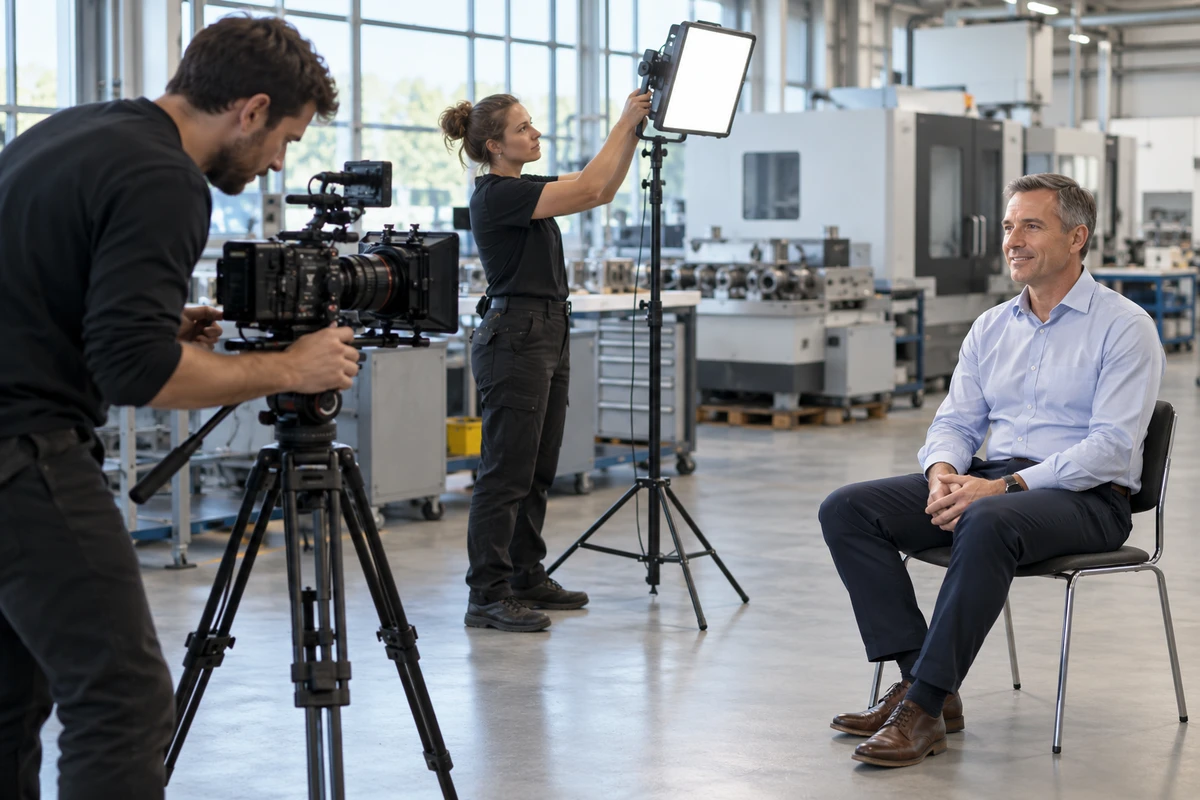
The hardest part of a corporate video production process is rarely the familiar sequence of pre-production, filming and post. It is the fact that different people change different things at different times: leadership adjusts the message, business teams add facts, an interviewee becomes unavailable, or a new use case appears after the rough cut.
A more reliable process uses three progressive locks: lock the corporate facts, lock the production scope, then lock the edit structure. A lock does not mean that nothing can ever change. It means that every new request must now disclose its effect on resources, versions and the launch date.
The timeline below uses a hypothetical case with 45 days remaining before a trade show. Forty-five days is not an industry standard. A single-interview film may need less time; a multi-city, multilingual or heavily regulated project may need much more. The example is simply a way to make dependencies visible.
Lock 1: Decide What the Company Is Ready to Say Publicly
The first task is not writing voice-over. It is defining what the film needs a particular audience to understand. Website visitors, overseas buyers, investors and potential employees arrive with different questions. The same corporate deck cannot automatically become the same film.
Discovery interviews should produce four things: the primary audience and use case, three to five core messages, a public fact behind each message, and one final approver. Facts include more than founding dates and business scope. Teams also need to identify numbers still being updated, client names that cannot appear, processes that may be filmed and areas subject to confidentiality.
Sort the source material into three groups: already public and ready to use; true but awaiting internal approval; and unverified or unsuitable for publication. Only the first group enters the script immediately. The second gets a deadline. The third is not hidden inside vague wording and left for post-production to solve.
The first lock is complete when the decision owner approves one page covering the audience, use, core messages, fact sources, restricted subjects and final decision authority.
Lock 2: Turn the Script into a Shootable Scope
Once the facts are stable, the concept can become a script, interview guide, storyboard or shot list. Amazon Ads' current video production guide treats the brief, concept, script, storyboard, pre-production, production, post, licensing, localisation and channel delivery as connected dependencies. It also notes that deliverables defined later can affect timing and budget. Although written for advertising, the dependency is equally useful for a corporate film.
Before filming, lock five scarce resources:
- People: confirmed contributors, backups and the time available from executives and frontline staff.
- Places: access windows, shutdowns, clean-up requirements and production restrictions.
- Objects: products, prototypes, tools, archives and brand assets in a camera-ready state.
- Actions: the R&D, testing, quality, service or delivery processes that can genuinely happen on camera.
- Versions: the master, cutdowns, aspect ratios, caption languages and clean versions that require specific original coverage.
Only after these are confirmed can a production plan move from visual ambition to specific times, locations, people and shots. A detailed shot list may replace a storyboard for an interview-led film, but access, availability and unrepeatable actions still need written confirmation.
The second lock is complete when the script or content outline, call sheet, locations, contributors, shot list, deliverables and usage conditions agree with one another.
On the Shoot Day, Capture What Cannot Be Repeated First
The shoot order should follow immovable resources, not the order of the final film. An executive available for thirty minutes, a production line running only before a shift change, or a lab opening in the afternoon will shape the call sheet more than scene numbers do.
The brand should provide one on-set decision interface. That person does not replace the director's visual judgment; they confirm business facts, contributor status and location permissions. Other departmental comments are consolidated through that interface instead of producing contradictory instructions beside a ready camera.
After every critical scene, confirm three things: the fact is accurate, the action is complete, and the framing covers later versions. A beautiful shot cannot substitute for any of them. Missing content should be logged immediately and resolved as a reshoot, rewrite or deletion—not left for the edit to invent.
Lock 3: Approve Structure Before Polishing Detail
The rough cut answers whether a viewer can follow the relationship between the company, its people and its capabilities. Review information order, interview selection, factual accuracy and missing coverage first. Colour, music level, caption styling and every transition can wait.
Separate review roles. Fact reviewers verify business statements. Brand reviewers check tone and visual consistency. One final approver resolves conflicts. The production team should receive one consolidated set of comments rather than infer authority across multiple message threads.
Once structure is approved, the project can move through fine cut, voice-over, graphics, colour, mix and captions. W3C's current caption guidance explains that captions include dialogue, speaker identification where needed and meaningful sounds, all synchronized with the visual content. Captions therefore belong in the planned review and delivery scope, not as an improvised final attachment.
If the film will appear on LinkedIn or another corporate channel, record the intended use when versions are locked and verify the current export rules before delivery. LinkedIn's current Page video specifications cover file size, duration, resolution, aspect ratio and frame-rate ranges; these changing parameters should be checked rather than copied from an old preset.
The third lock is complete when the final approver accepts the structure, factual review is finished and the remaining work improves execution inside the approved structure. For a more detailed review sequence, see ONCE's guide to accepting a premium brand film from rough cut to delivery.
Use a Traffic Light for Requests After a Lock
Change will still happen. The mistake is calling every request a minor revision.
- Green: no change to facts, footage or structure—caption punctuation, line breaks or small colour refinements. Keep the plan.
- Amber: one approved module changes—replace an interview segment, add a language version or revise the end card. Assess the effect on edit, voice, captions and approvals before protecting the original date.
- Red: new facts, locations, people, filming or a rebuilt narrative. This is a scope change and needs a new resource, cost and schedule decision.
The point is to turn “Can we change it?” into “What does the change require?” Many requests are possible, but the original scope, date and cost cannot always remain fixed at the same time.
A Hypothetical 45-Day Reverse Plan
If the film must play on the opening day of a trade show, one illustrative schedule could be: discovery, material review and fact lock in week one; script, recce and contributor confirmation in week two; scope lock and filming in week three; rough cut and structure lock in week four; fine cut, sound, captions and required versions in week five; final approval, exports, playback tests and contingency in the final week.
This does not force every project into six weeks. It protects time for approvals, filming and review that cannot be compressed indefinitely. If internal approvals take two weeks, executives are uncertain or multiple cities are involved, start earlier. If the film uses one contributor and existing footage, the schedule can contract while the three locks still apply.
A corporate video production process should not merely protect a Gantt chart. It should make clear what is settled, who can decide and what any change will affect. When the launch date cannot move, early visibility into uncertainty leaves more room for the creative decisions that genuinely matter.
If your corporate film already has a trade show, website relaunch or partner event attached to it, send ONCE VISUAL the audience, use case, launch date, available locations and internal approver to request a corporate video production needs assessment.
Production examples and next steps
Build a factory-film brief around observable work and approved access. The Jiyang equipment and automated-manufacturing film provides an example of industrial subjects.
Review Factory and corporate video production in China and Jiyang Zhuyun: New Energy Equipment and Automated Manufacturing Corporate Film. To discuss your project, send the processes to show, filming permissions, interview roles and sales uses through the English project enquiry form.