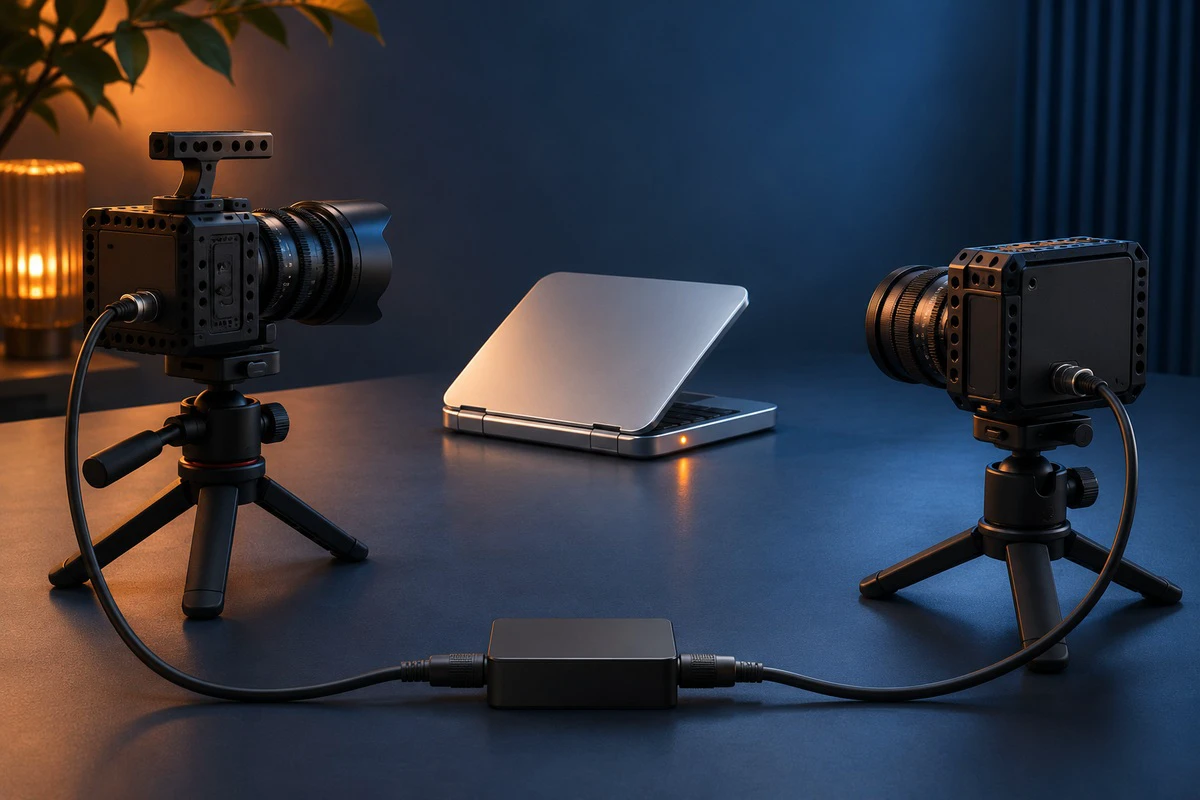
Your production partner in China delivers a front view and an overhead view of the same product demonstration. Both files carry matching timecode. Your overseas editor can line them up quickly—but may the brand now use that split screen to demonstrate an instantaneous response?
That hypothetical handoff exposes an ambiguity in many multicamera briefs. “Synchronized” can mean convenient editing, coordinated capture timing, or footage suitable for a particular comparison. Those are different deliverables. ONCE recommends buying a defined use and an acceptance method before choosing the equipment.
Alignment metadata and capture timing do different jobs
PTZOptics’ official Genlock and Timecode Explained, checked on November 9, 2026, distinguishes common timestamps for post-production alignment from genlock’s coordination of video-frame timing. A matching timecode display alone should therefore not be accepted as proof that acquisition timing is locked.
At 25fps, one frame period is 40 milliseconds: simply 1,000 divided by 25. That calculation describes the sampling interval. It neither establishes your actual offset nor supplies an acceptable tolerance for a product claim.
There is an important equipment-specific qualification. The ALEXA 35 User Manual, SUP 5.2.0, dated November 2025 on its cover, describes a sensor-synchronization mode using the TC input, subject to frame-rate conditions. Do not reduce procurement to “a timecode cable can never synchronize a sensor.” Verify what the selected camera and mode actually do.
More compact options do not remove the system question
As checked for this article, Blackmagic Design’s Blackmagic Camera technical specifications list separate timecode and genlock inputs on ProDock and restrict its genlock support to iPhone 17 Pro and 17 Pro Max. Compatibility with other dock functions on other models is not equivalent to genlock support.
This is evidence of one available configuration, not evidence that every phone can replace a production camera or that an industry transition is complete. ONCE’s inference is narrower: a brand has more configurations to evaluate, but should compare a tested production system rather than handset prices.
The ONCE brief: use, tolerance, acceptance
This proposed framework is a purchasing method, not a report of a completed ONCE client test. The brand defines what the footage must communicate; the producer explains which conditions can be achieved and checked.
| Intended use | Question for the producer | Acceptance material |
|---|---|---|
| Cutting between a presenter and product details | How will alignment and picture-to-sound consistency be checked over the intended duration? Is coordinated capture timing necessary? | An editable sequence and playback check across the actual recording length |
| Comparing a button, mechanism or moving part across angles | Which event is being compared, what difference is acceptable, and how will it be checked? | Original-speed trial footage, synchronization settings and an observable common event |
| Filming a product against a moving display background | How will capture, playback and the display work together, including any phase or offset adjustment? | A recorded check of background motion, ghosting and transitions at production settings |
For a response-time claim, involve the product testing owner before accepting “frame accurate” as sufficient. Ordinary footage and visual frame inspection may lack the time resolution needed. A synchronized demonstration does not automatically become a performance measurement.
Test the handoff, not just the connector
Use the planned cameras, firmware, apps, recording modes and editing software. Choose a physical event visible from all required viewpoints—for example, the same hinge closing. Include reference events near the beginning, middle and end of a recording comparable to the intended take length. This is a proposed inspection procedure, not a guaranteed precision specification.
Check the actual reference-lock status on set, import the originals into the intended editor, and export the target format. Record a fixed offset, a changing difference and an unobservable event as different findings. Do not first conceal a timing problem with retiming, interpolation or generated frames. Keep the original-timing inspection version separately from a polished advertising edit.
Display backgrounds need their own check. Apple’s Set up for virtual production with Apple devices and genlock, published November 1, 2026, explains that processing and connection delays can still produce ghosting and describes recording tests to adjust genlock offset. Its specific configuration is not a guarantee for every display setup.
Even a successful check has limits. Exposure duration, rolling readout and where an event appears in the image affect what can be inferred. Frame timing lock is not a promise that every pixel exposes simultaneously, nor is a trial of one configuration a certification of every future setup.
Ask for a quote that separates the work
Request four scopes: synchronization design and compatibility trial; on-set reference and supporting equipment; alignment and inspection; and final editing. Identify which scope delivers original test files and settings, and which delivers only a finished video. An equipment rental line is not an acceptance report.
For conventional cuts, a satisfactory full-duration check may justify keeping the existing configuration. For a transient comparison that fails the agreed requirement, change the capture setup or the creative treatment before authorizing production. If the budget cannot support the comparison, remove that unverified claim and make an accurate functional demonstration instead.
For teams working with Chinese manufacturers, nominate one product owner to approve the demonstration’s meaning and one post-production owner to approve the usable handoff. They should review the same trial, not separate attractive clips.
ONCE’s longer-term service recommendation is to retain the product revision, intended use, hardware and software combination, inspection method, accepted conditions and reuse limits. That record can make the next briefing more precise; it does not eliminate retesting or establish a realized margin improvement.
Start your next brief by identifying one action that needs multiple viewpoints. State whether the footage is for editing, comparison or measurement. Explore more video production planning guidance, or bring that specific requirement to ONCE before locking a shoot in China.