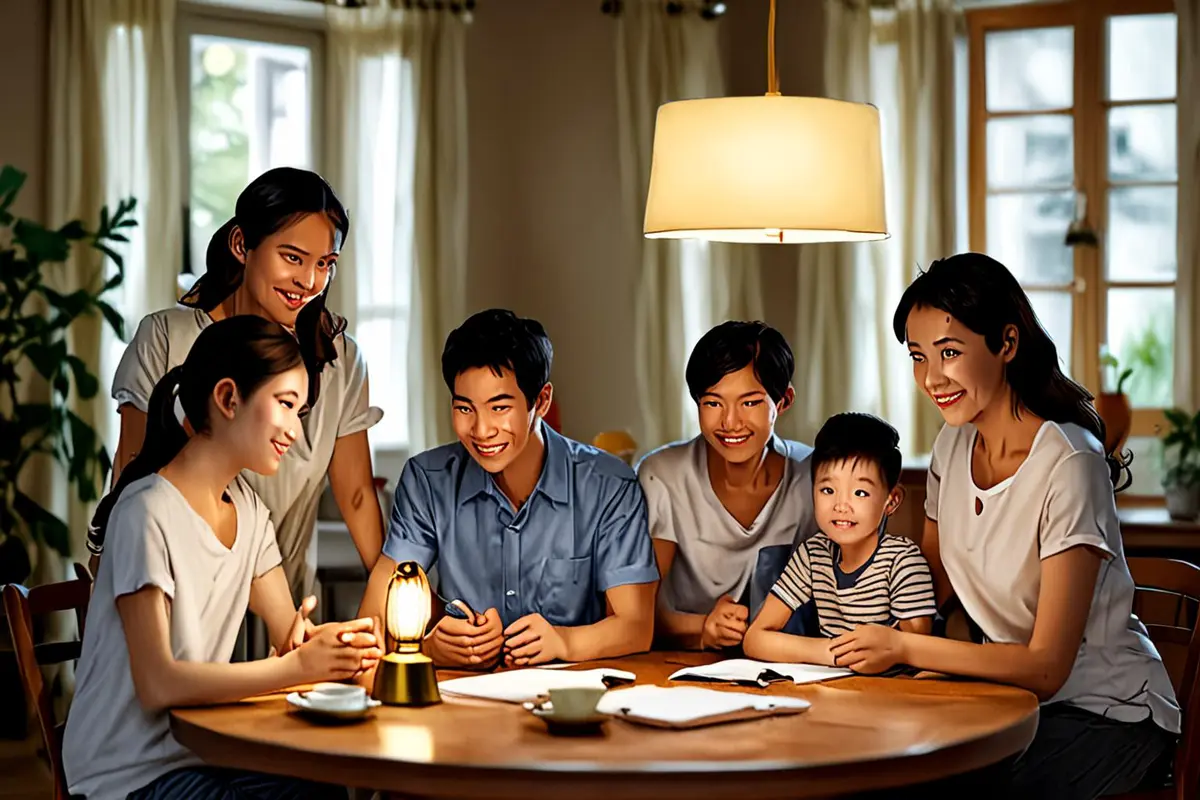
At the same table, an older person turns a lamp toward a newspaper, a younger adult moves it beside a notebook, and a child gently places a drawing in its light. The product is the same, but the three people are not doing the same thing. A family brand film can move beyond “everyone likes it” by showing a more specific relationship.
A multigenerational household need not automatically mean a cheerful reunion, nor is it a template for every market. The lamp and people below are a fictional creative exercise. The question is how to give each person agency and a reason for using the same object.
Give each person something of their own to do
Before staging all three looking at the product, imagine the older person identifying an old photograph, the younger adult revising a piece of work, and the child drawing a plant they have just seen. The tasks can happen at one table without needing one person to initiate or explain them all. Age provides background; the action comes from what each person is trying to do.
Then ask whether the lamp needs to participate. If the events remain identical without it, it may be a beautiful prop. If everyone must repeat the same demonstration gesture, the people become a succession of feature presenters. Let the product take part in the tasks while preserving different purposes.
One action can mean different things
Suppose the lamp really has an adjustable direction. The older person turns it toward the photograph to see a detail; the younger adult clears space before taking it to continue working; the child moves the paper instead of the lamp so the light falls on another color. The function is unchanged, but each choice reveals a different relationship.
A shared spatial reference, such as the table edge or window, can help connect the actions in one place. Sound can draw from turning paper, a pencil and conversation without accenting every movement. These are storytelling choices, not evidence that a particular shot improves memory or sales.
Let a relationship change
If three separate scenes merely repeat “this person uses it too,” the film shows audience coverage rather than a relationship. Let one choice affect the next: after looking at the photograph, the older person leaves the lamp by the table; the younger adult works in its light, notices the drawing needs room and moves their own things so the child can spread it out.
The change can be small and need not be a conflict. People may discuss, misunderstand, wait or remain quiet; each should have a reason for an action. Avoid making one person present only to express surprise, nod or prove that someone else's product choice was correct.
Make age one part of a character
An older character need not always stand for nostalgia, a younger one need not perform every technical operation, and a child need not deliver the concluding line. Temporarily hide age labels in the treatment and see whether interests, abilities and actions still make sense. Then return to casting, language and specific living conditions. Local creators familiar with the intended audience can help check whether the characters feel complete rather than reduced to age symbols.
Space, use and product facts also matter. Table height, distance between people and the lamp's real operation affect whether movement feels natural. Claims about brightness, eye comfort or other effects need brand-confirmed support; a warm smile is not product evidence. Explore ONCE video production insights for related approaches.
Keep the connection in the short cut
A longer film can establish three tasks. A short version need not compress them equally, but should preserve how one choice affects another person. One hand moves its paper, another opens a drawing and the lamp remains in the same frame as both actions. The short cut still contains a relationship rather than three smiling faces and a product close-up.
Show a test edit to people unfamiliar with the project and ask what each person is doing, who changed what and what role the object played. A few responses can reveal a character who has disappeared; they cannot represent an entire age group or establish advertising performance.
If you are developing a family brand film or product campaign, contact ONCE to discuss characters, the real product and visual ideas.