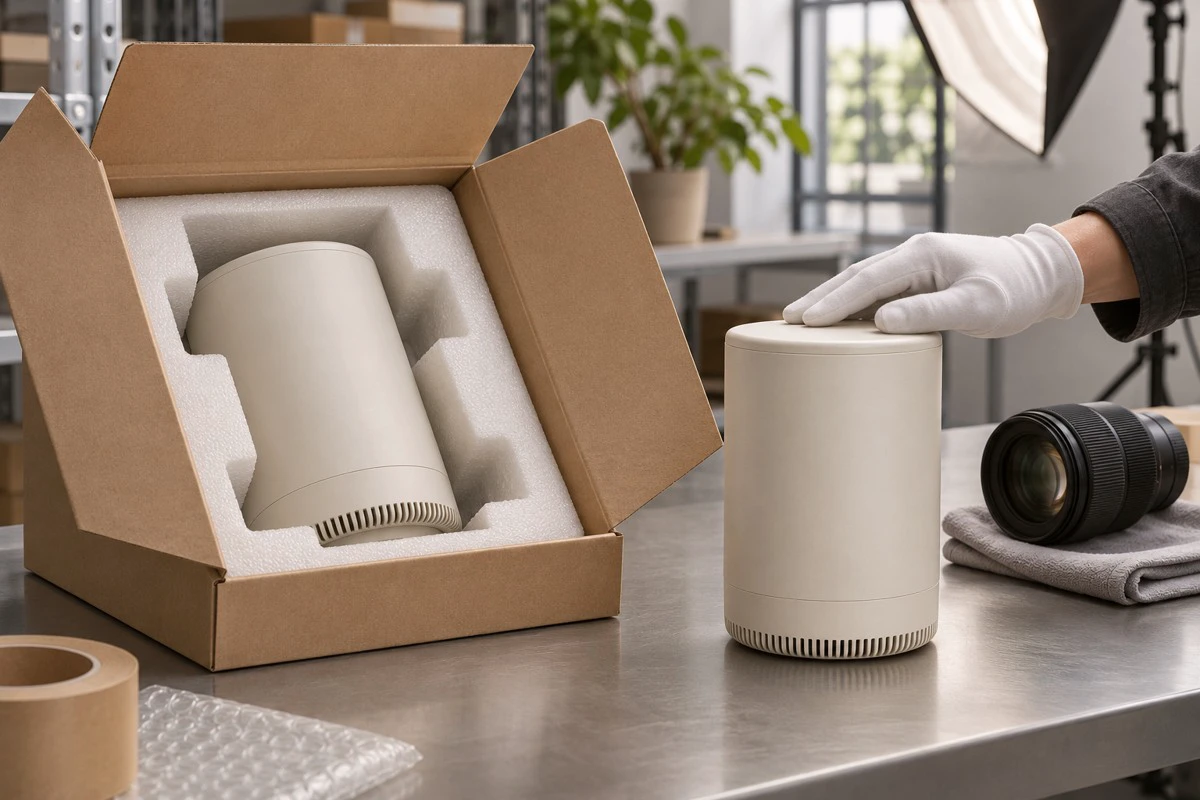
Consider a hypothetical shoot: your marketing team has approved a prototype at a Chinese supplier. A production studio is ready to book the set, talent and equipment. Before releasing the shipment, someone asks whether the sample is protected. The answer comes back: “We entered its declared value.” That answers only part of the planning question.
Even if a financial recovery were available after damage, the campaign would still need a shoot-ready replacement. ONCE recommends treating loss arrangements and production continuity as separate decisions, particularly when a China shoot depends on an unreleased unit that cannot be bought locally.
What the carrier’s declaration actually establishes
The US FedEx page FedEx Declared Value & Limits of Liability for Shipments, checked on November 8, 2026, distinguishes declared value from shipping insurance. It also says declaring a value does not guarantee reimbursement or reimbursement of that exact amount. This is a US-site source; the applicable terms must be confirmed for the actual origin, destination and service.
Ask the carrier what liability applies to that shipment and check any separately arranged insurance against its own terms. Neither an entry on a shipping form nor the existence of a policy establishes that a disrupted shoot will be made whole. This article does not assess a particular claim or assume that rescheduling costs are covered.
Use ONCE’s Item, Replacement and Schedule worksheet
Before the studio commits resources, have the supplier or brand’s sample owner and the producer complete three columns. Give each unanswered question an owner. An unresolved replacement date should remain visibly unresolved.
| Column | Information to obtain | Decision it supports |
|---|---|---|
| Item | The exact unit, its condition and version, value documentation, and the relevant transport or separate coverage terms | What information supports handling a loss, without promising a payout |
| Replacement | Who can supply an equivalent unit, matching finish, operation and accessories, and when the studio can inspect it | The earliest date the critical shots can actually resume |
| Schedule | Shots dependent on that unit, affected bookings, and dates when rescheduling conditions change | When to commit, what can proceed, and when to activate an alternative |
A clear item value does not create another approved prototype. Factory stock does not establish that the stocked version matches the campaign. A replacement arriving on time does not restore an actor’s availability. These are production dependencies, not predictions about shipment failure rates.
Let recovery time determine the backup
“Send two” is too blunt to be a universal purchasing rule. Start with the shots that require the physical unit. If it became unusable today, when could those shots resume? Count sourcing, version approval, transport and inspection. A delivery scan is an intermediate milestone.
Consider a hypothetical overseas brand filming an unreleased appliance near its China supplier. A second unit may exist, but with a different surface finish. If the hero close-ups must match the launch product, that unit is not yet a usable substitute. The studio and brand need an approved replacement or a schedule that does not depend on its immediate availability.
For an ordinary retail product readily available near the studio, an additional international shipment may offer little benefit if the bookings are flexible. For a scarce prototype tied to a fixed talent day, a confirmed backup or a revised commitment may be worth arranging before that day is booked. No accident probability is implied by either example.
A backup can be a locally available matching sample, a separate day for the dependent shots, or an agreed sequence that starts with work requiring no physical sample. Check the alternative shot by shot. An unapproved substitute must not silently change what a functional demonstration represents; generated imagery cannot establish real product performance.
Compare preparation costs with conditional disruption costs
Keep two groups in the procurement worksheet. The first contains known preparation expenses: quoted backup units, packing, transport and receiving inspection where applicable. The second contains expenses that could arise if the sample cannot be used: repair or replacement, another shipment, and the affected studio, crew, equipment or talent bookings under their actual rescheduling terms.
Do not invent a failure probability to produce a persuasive expected-loss number. Do not treat the entire shoot budget as automatically lost, either. Some bookings can move, some tasks can proceed, and some commitments have not been made. Include only affected costs supported by quotes or booking conditions, identify who would pay them, and record when another decision becomes necessary.
The commercial comparison is whether a known preparation expense keeps the critical shots achievable by the target date. A second unit vulnerable to the same unresolved bottleneck may not do so. Extra inventory is useful only when it creates a usable recovery option.
Rehearse the recovery before confirming the shoot
Run a short discussion rather than a damage simulation. Ask the sample owner: “If the hero unit cannot be filmed today, where is the replacement, who approves it, and when can the studio inspect it?” Ask the producer which work can proceed and the latest time to release or change dependent bookings. “We will coordinate later” is an unresolved scheduling assumption.
Document condition, version and packing before dispatch; check the parcel, unit, accessories and filming readiness on arrival. These records help the handover and any subsequent investigation, but do not guarantee a claim outcome. Confirm claim requirements and deadlines with the actual service provider.
For teams commissioning work around a China supply chain, the useful next step is to identify the least replaceable sample and map its dependent shots before committing resources. Our video production planning articles provide further workflow context. For ONCE, repeatable sample handovers and booking decisions are a service development opportunity: they could make a production proposal easier to assess before money is committed. That is an operating recommendation, not a claim of demonstrated savings or existing client results.