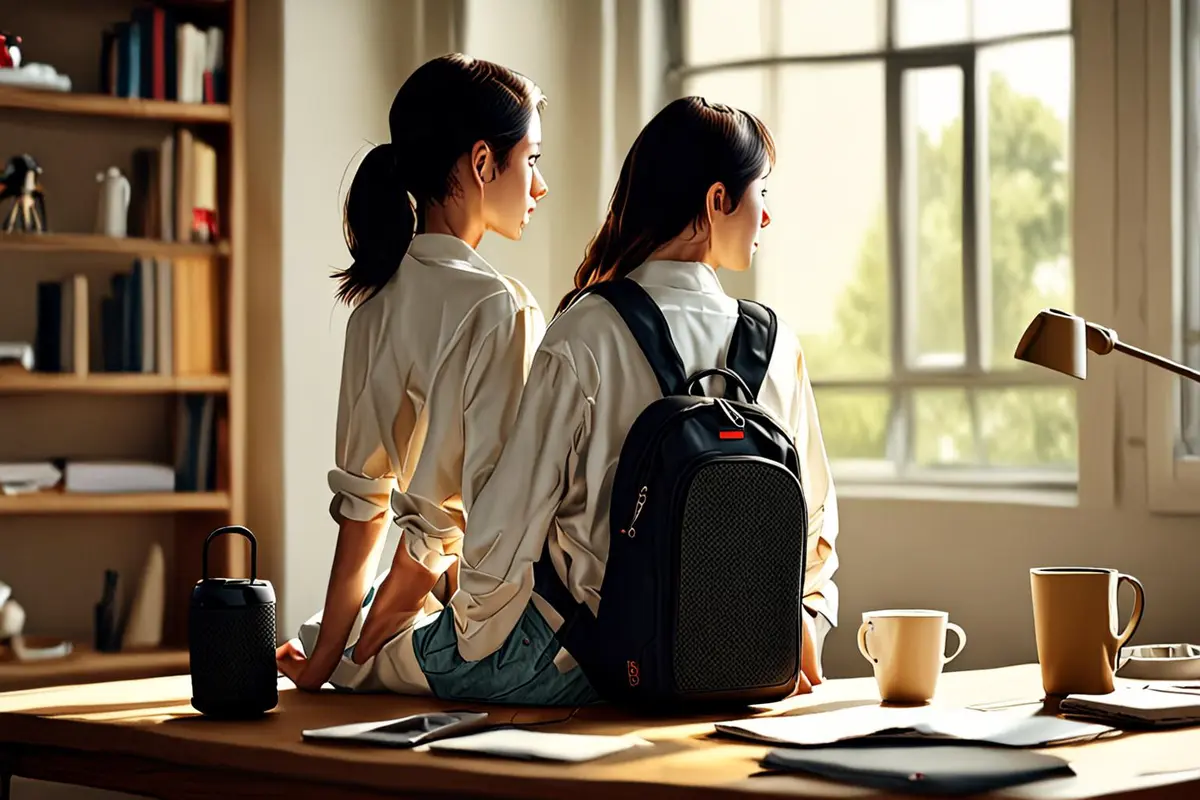
The same person may rush out in the morning and take time arranging a desk in the evening. With the same portable speaker, they might first care whether it fits quickly into a bag, then wonder how it can become part of an evening with friends. Neither the person nor the product has changed; the task has. That change can be more useful to a product-video team than adding another demographic label.
Move from a persona to a moment
Imagine a fictional brand launching a portable speaker. “Young city dwellers who enjoy life” sounds plausible, but gives a director little guidance for the first shot. “Before leaving in the morning, a person holds keys in one hand and puts the speaker into a bag with the other” opens up observable choices about the bag opening, grip, and storage. Later, when friends arrive, the question becomes where to place the speaker so everyone can use it. These are creative hypotheses, not claims about real customers or a product.
Context is more than a location. Time, the task at hand, available space, companions, and what a person already knows can change the information they need. On a commute one hand might hold coffee; at home both hands may be free. Different actions can express that distinction rather than merely placing the same demonstration against another background.
One product can answer different questions
Write two questions for the same person: “Will it take too much room when I leave?” and “How does it fit naturally into an evening with friends?” The first needs a readable size relationship and a storage action. The second needs people, placement, and use. One supports a functional judgment; the other helps viewers imagine a situation. Both should use the product as it actually exists.
Not every difference needs a new film. If both scenes answer the same storage question and only change from an office to a cafe, one representative demonstration may suffice. If the situation changes the constraints and choices, such as carrying alone versus sharing with others, a different story can offer something new.
Show the trade-off in the situation
A context becomes meaningful when a character has a constraint to manage. A crowded bag asks a portable product to share space with keys, a computer, or a bottle. A crowded table raises the question of where to put it without getting in someone else's way. The product need not solve every problem, but its role in the person's choice should be clear.
If a brand wants to emphasize portability, confirm the actual dimensions, weight, and approved use first. Do not create a misleading impression with an unusually small reference object or omitted steps. Atmospheric images can be freer; claims about performance, compatibility, or safety still need support. A product demonstration can answer a question through an observable process.
Keep a shared brand across two stories
The morning version might feel brisk; the evening version might leave room for conversation and pauses. Consistency need not mean copying the same opening. It can come from the actual product form, an approved brand voice, and a coherent visual approach. Each piece should stand on its own, so a first-time viewer understands how the product relates to the immediate task.
Before production, compare simple written ideas or storyboards: what did the person want to do, which part changed because of the product, and what new information did the viewer receive? Ask someone unfamiliar with the project to describe both. If they recall different sets but cannot name different questions, the actions may need revision rather than more footage.
Use real feedback to refine the hypothesis
Customer inquiries, support questions, interviews, and sales conversations can point to useful moments, but one comment does not represent every user. Treat it as a lead to investigate, combine it with the product team's understanding of actual use, and select a scene worth testing. When no feedback is available, identify the context as a hypothesis rather than presenting it as validated customer behavior.
Strong product content helps viewers recognize something they are doing and helps a brand see that a person's life is not one fixed identity. If you are planning a launch or several usage scenarios, contact ONCE to discuss the creative approach and production.