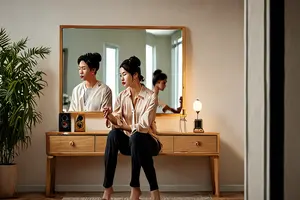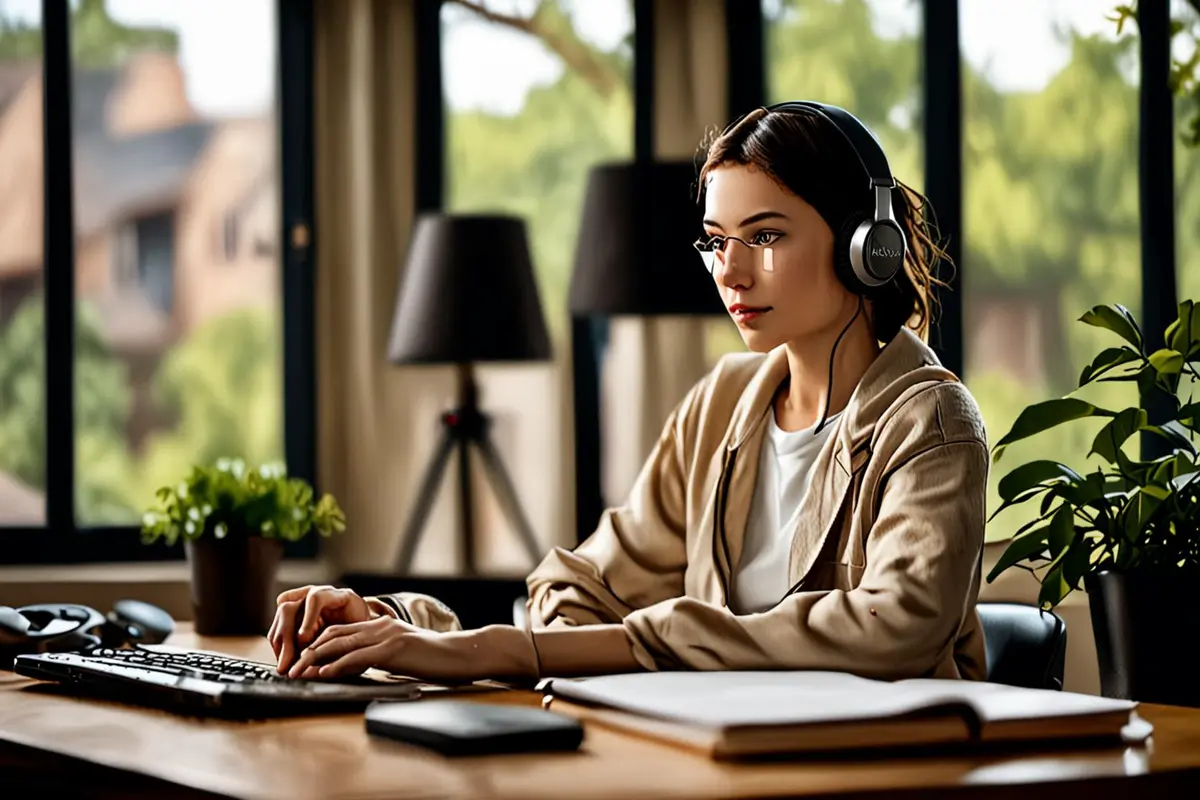
In a kitchen early in the morning, a kettle, footsteps, and traffic outside coexist. Someone picks up a pair of headphones and looks toward the window. Music enters gradually; the kettle recedes, while a bird outside remains audible. The room has not disappeared. The way the audience hears it has changed. Subjective sound can bring viewers closer to what a character is attending to.
Decide what the character notices
Imagine a fictional headphone film in which someone prepares to work at home. Rather than presenting the environment as an enemy, the opening gives the kettle, keyboard, and street their own places. After the character puts on headphones, music and the nearby keyboard become more prominent while other sounds recede. This illustrates a storytelling choice, not a client project or proof that a particular headset blocks or preserves specific sounds.
Subjective sound does not require every background noise to vanish. Even when someone is focused, sounds can remain present without dominating the mix. Decide what the passage should reveal: concentration, a memory, or attention shifting to another person. The same reduction in ambience can mean different things alongside different actions.
Give the change a physical cue
The shift might happen as someone puts on headphones, closes a door, looks toward a window, or hears a friend say their name. An action gives the sound change a reason. If music has been playing for some time, a subtle environmental sound entering as the character looks up can also suggest they have noticed something new.
Not every transition needs total silence followed by a burst of sound. A gradual retreat of ambience leaves room for reflection. A sudden change can mark a clear turn, but without a corresponding visual action it may feel like a device or player malfunction. Capture complete moments before, during, and after the change so the editor can choose its timing.
Keep options from the recording
Performance and spatial relationships influence the soundtrack from the shoot onward. Record details such as a hand touching the headphones, a cup being set down, and a chair moving. Capture a period of room ambience without dialogue to help maintain continuity later. Sounds that cannot be recorded cleanly may be recreated in post, but should suit the material, action, and setting.
Keep dialogue, music, ambience, and action sounds separately controllable in the mix. Music need not cover every detail. Sometimes a small button sound or breath reconnects an abstract shift in attention to the character's body. A version that does not rely on music can also reveal whether action and expression still explain what is happening.
Creative sound is not a product test
A changing mix can communicate a character's experience, but it does not prove a headset's noise reduction, transparency mode, or safety performance. Specific product claims need support from the brand for the relevant model and conditions. Do not lower environmental sound in post and imply that the result is an untreated functional demonstration.
A brand film can use deliberate mixing and emotional transitions. A video intended to explain actual product performance needs a separately designed demonstration with clear conditions. They can share a character and setting while doing different informational jobs. For another way of connecting sound, people, and products to a scene, see our article on practical lights in lifestyle storytelling.
Make the story understandable in different listening situations
Listen on headphones and a small speaker, then watch with the sound off. Can viewers see when the product is put on, why attention changes, and how the scene ends? Captions should convey dialogue and sound information needed to follow the story without covering the product action. Responses will vary across devices and environments, so these are comprehension checks, not guarantees of how every viewer will react.
Sound perspective can make a character's choice feel present rather than simply adding an attractive music bed. If you are planning a brand film or audio product content, contact ONCE to discuss the creative approach and production.