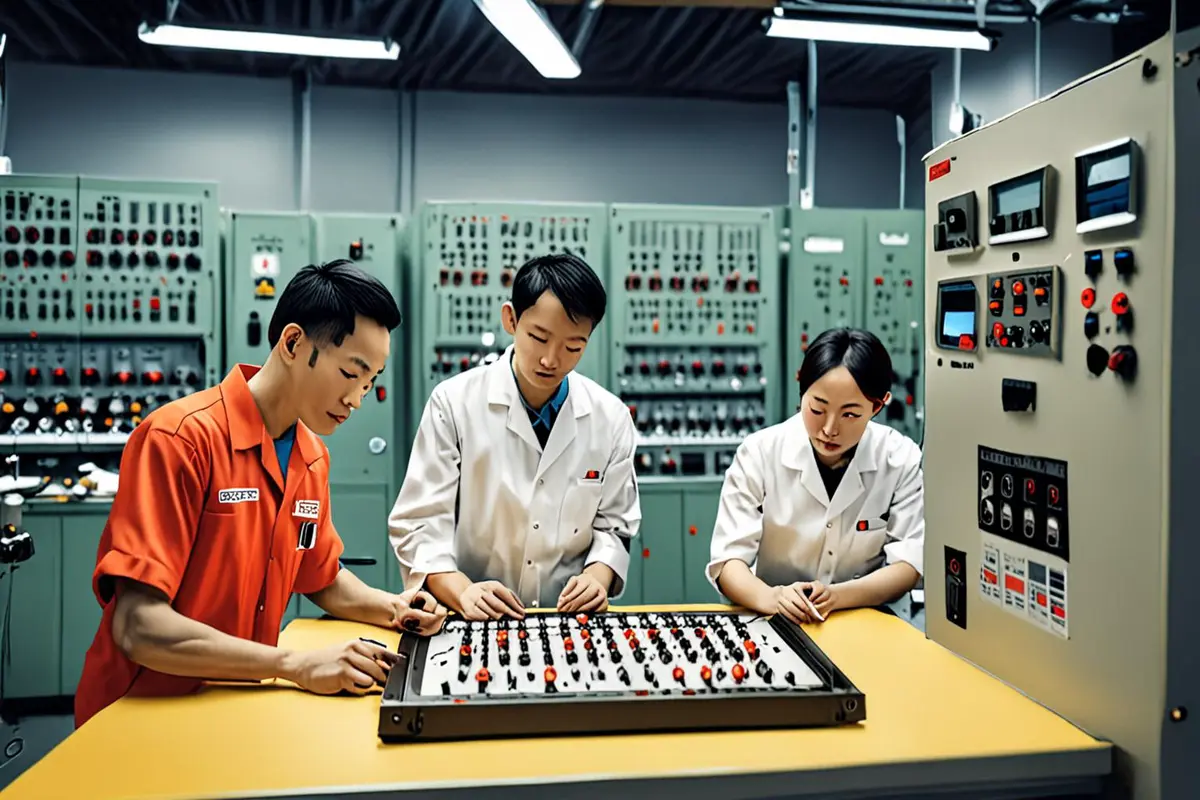
An engineer completes a measurement and passes a sample to a colleague. The colleague checks the reading, marks the result, and sends the sample to the next stage. In real life, the sequence takes only a few seconds. In many corporate films, however, the whole exchange is slowed down: an arm reaches forward, a glance lingers, and an ordinary nod begins to look like a major decision. The image may feel more ceremonial, but the logic of the work disappears.
Real employees are convincing because they know what happens next, not because they perform like actors. Corporate film pacing should first let viewers understand professional action, then decide which moments deserve more time. Slow motion is an observation tool, not a universal quality filter.
Keep key work at real speed when the process matters
When a shot needs to explain who did what, why they did it, and what changed, real speed is usually more useful. It preserves cause and effect, the handoff between roles, and the confidence with which employees use tools and follow a process.
Slow motion redistributes viewing time, but it does not automatically add information. If a scene contains only walking, page turning, typing, and nodding, stretching the duration still leaves viewers with the same actions while making the real pace of work harder to judge. A corporate brand film can gain weight from composition, lighting, sound, and narrative position without making every person complete routine work in slow motion.
Real speed proves three things
First, actions have an order. An operator may check machine status, position a part, and record the result. Keeping that order intact shows that expertise comes from decisions and process rather than a collection of unrelated mood shots.
Second, employees have fluency. Fluency does not mean moving as fast as possible. It means working without unnecessary hesitation. Slowing an entire action can turn a natural handoff into a deliberate pause and may even make an experienced person look uncertain.
Third, an organization has a working tempo. Offices, laboratories, production lines, and service environments each have their own sense of time. Real tempo places different roles inside the same operating system. When every scene plays at one uniform slow speed, those differences disappear.
Three moments when slow motion earns its place
Reveal a physical change that happens too quickly
A splash, a material bending, a mechanical contact point, or a package seal may happen too quickly to study at normal speed. Slow motion can reveal shape, force, and result. It adds information rather than merely extending information that was already visible. Sony's official guidance explains that footage becomes slow motion when the shooting frame rate is higher than the recording frame rate. That is a reason to decide before the shoot what the viewer needs to see, rather than slowing ordinary footage at random in post-production.
Mark a clear narrative transition
One brief slow-motion beat can punctuate a move from research to manufacturing or from individual work to collaboration. The best point is usually where a change actually occurs: a sample leaves the test bench, a finished product enters its first controlled light, or two employees exchange a confirming glance after a critical step. Returning quickly to real speed gives that transition contrast.
Isolate a genuine human reaction
Employees are not professional actors, and their most natural emotions often pass quickly: relief after a successful check, a response when a colleague catches an object, or a smile after a demonstration. A slight slowdown can make that reaction visible, provided it happened naturally. Asking people to repeat a supposedly spontaneous reaction for the sake of slow motion often produces the opposite result.
Some shots look more staged as they get slower
Walking side by side down a corridor, nodding through a meeting, sliding fingers across a keyboard, or staring into the distance already lack a clear outcome. When prolonged, they resemble character introductions rather than evidence of how a company works.
Safety-related action deserves particular care. Viewers may need to understand the order of operations, the distance between a person and a machine, and the timing of a required pause. If a detail needs emphasis, place a close-up after a complete real-time view instead of using slow motion as a substitute for the full process.
Adobe's Premiere Pro tutorial recommends high-frame-rate source footage for time remapping. That reinforces a practical production point: good slow motion begins on set. Stretching standard-frame-rate footage later can introduce interpolation artifacts and cannot recover details the camera never captured.
Record two versions of time on set
The answer is not to shoot everything at a high frame rate. Record both a complete process and selected details that can be extended.
- First, film the full action chain at normal speed, including the starting condition, decision, operation, and result.
- Then capture a high-frame-rate version of details that genuinely deserve closer study, such as material contact, fluid movement, or a handoff.
- Give each action a clean beginning and ending so the edit can move naturally between real speed and slow motion.
- Record room tone and key action sounds separately. Some variable-frame-rate camera modes do not record audio, as Sony's documentation notes.
Very high frame rates also involve trade-offs. ARRI's description of the ALEXA 35 Xtreme explains that its extreme high-speed mode changes dynamic range, base sensitivity, and lighting requirements. Most corporate films do not need the largest possible number. The right frame rate is the one that fits the speed of the action, the available light, and the intended release.
Sound decides whether slow motion still feels like work
Much of a workplace's credibility comes from sound: a short tool contact, the continuous tone of a machine, the weight of a sample being set down, or the reflections of a room. If those sounds are mechanically stretched with the picture, an ordinary action can become an exaggerated effect. If music covers them completely, the work loses its physical presence.
A more natural approach keeps one real action sound before the slowdown, maintains spatial continuity with room tone, and uses designed detail sounds only for the key moment. Synchronized sound can take over again when the image returns to real speed. Slow motion then becomes a brief act of observation instead of replacing the workplace with a different set of physical rules.
Review the finished film with three questions
Can viewers describe the task? If they remember only that it looked professional but cannot say what the employee did, atmosphere may have replaced meaning.
Did slow motion add new information? If it did not reveal change, strengthen a transition, or preserve a genuine reaction, restore real speed or shorten the shot.
Do different roles have different rhythms? Research involves observation, manufacturing involves continuous operation, and service often requires immediate response. They should not all be edited into the same solemn tempo. Their differences are part of the organization's capability.
In ONCE's corporate film production work, action design, capture frame rates, location sound, and multi-format editing are treated as one narrative decision. If you are planning a corporate brand film with real employees, share your industry, locations, and primary channels through our project inquiry. We can first identify which work must remain understandable at real speed, then design the few moments that truly deserve to slow down.