Move the camera a few inches lower and the same product can suddenly feel heavier, stronger, or even intimidating. Raise the camera and the top controls become easier to read, but the object may begin to look like inventory laid out for inspection. Camera height in product ads is not a minor on-set adjustment. It decides where the viewer stands in relation to the product.
Adobe's guidance on film angles explains that low angles often strengthen a subject's sense of power, high angles can make a subject appear smaller or more vulnerable, and eye level feels closer to ordinary, objective viewing. Those ideas were developed around characters, so they should not be copied mechanically onto products. They do reveal a useful principle: a camera records the object and assigns the viewer a position at the same time.
Separate product clarity from product character
A product film usually performs two jobs. The first is explanation: shape, scale, interfaces, controls, and use actions have to be understood. The second is expression: the product should feel dependable, approachable, agile, precise, or powerful. Explanation protects physical truth; expression gives the image an attitude.
Problems appear when one shot is forced to do both. A floor appliance is photographed from a very low angle to make it imposing, but its top control panel disappears. A top-down shot clearly shows the inside of an earbud case, but the product loses weight and presence. A stronger sequence lets a character shot and a fact shot perform separate tasks, then joins them through editing.
A low camera adds power and enlarges the base
A low camera places the viewer below the product or close to its base. It can create rising lines, a large foreground, and a stronger sense of presence. That makes it useful for floor appliances, tools, robots, or products whose support structure matters. When a brand needs the object to feel stable, durable, or professionally engineered, a low angle can establish that character quickly.
The power is not free. The base, wheels, or front edge closest to the lens may dominate, top-facing information can disappear, and vertical lines may converge. Add a close wide-angle lens and the perspective exaggeration increases. The viewer may remember a monumental silhouette but miss the actual benefit.
Questions a low angle can answer
- How does the product stand in the space, and does its support structure feel credible?
- Where does a moving component begin, and in which direction does it release force?
- Does the brand need an image of authority, solidity, or professional equipment?
If the main function sits on the top surface, a display needs to remain readable, or the real product is very small, use the low angle as a brief character shot and restore the missing information with eye-level or lightly elevated coverage.
Eye level returns the judgment to the product
Eye level does not mean that the camera must be parallel with the tabletop. For an object, a more useful definition is that the optical axis is close to the product's visual center and the main face is neither strongly looked down upon nor looked up at. Adobe describes eye level as a more neutral angle, closer to everyday observation. In a product ad, it often says, “This is what the object actually looks like in front of you.”
Eye-level coverage protects front proportions, logo placement, and the relationship between major shapes. It works well for a product's first full reveal, specification comparisons, and functional claims that need credibility. It also has limits: the top surface, port depth, or hand operation may remain hidden, and a static eye-level frame can feel like a catalog image without movement, foreground, or changing light.
Its most useful role is to establish a proportional baseline for the whole film. Once viewers understand the basic form, the edit can use lower and higher angles more aggressively without losing them.
A high camera explains relationships but can reduce mass
A lightly elevated angle reveals top surfaces, control layouts, accessories in a package, and the path of a hand entering from above. A true top-down shot flattens products and props into one plane, which is useful for arrangement, steps, and combinations. For unboxing, desktop devices, food, and beauty products, it can carry more usable information than a low angle.
The trade-off is reduced thickness and volume. The product can shift from a character into a diagram. High angles can also make a subject appear smaller within its environment, consistent with Adobe's description of their narrative effect. That may support precision, lightness, or order. It works against the idea when the product needs to feel powerful, durable, or physically substantial.
Check three things before moving overhead
- Does the value really live on the top surface, or is the angle only convenient for the crew?
- Will the entering hand cover the brand mark or the control being demonstrated?
- Does the angle alter apparent thickness, capacity, or weight enough to create the wrong expectation?
Camera height, distance, and focal length are one decision
Recording only how far the tripod was raised is not enough to reproduce a shot. Perspective is primarily determined by camera position. To preserve the same framing with a wider lens, the camera normally moves closer, making near parts larger and far parts smaller. Adobe also notes that extreme high or low angles become more distorted when combined with a close wide-angle view.
Put four values on the same camera card: the lens-center height relative to the product center, pitch angle, camera distance, and focal length. Add the product's frame occupancy, the surfaces that must remain visible, and the entry path of the key action. The conversation then changes from “go a little lower” to a repeatable shot design.
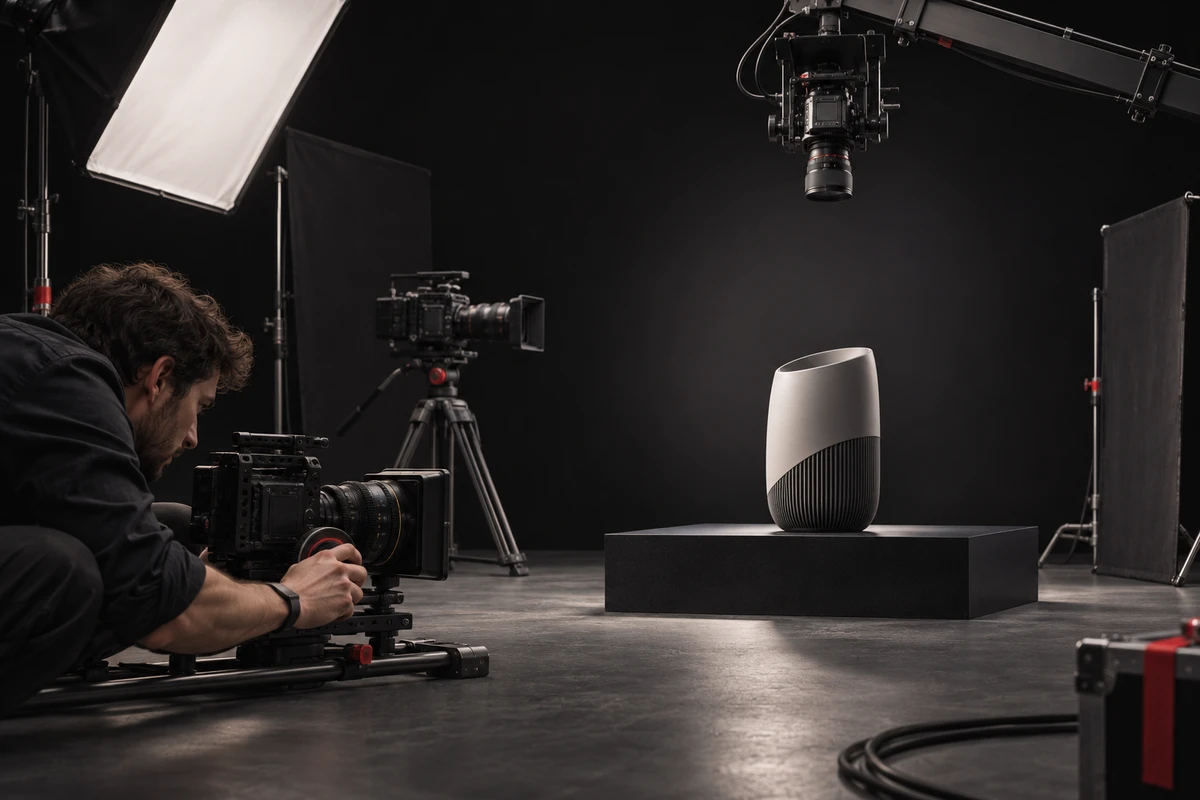
For every selected height, capture a static reference before adding movement. A push-in, slider move, or handheld pass continuously changes the viewer-product relationship. If height and distance both change during the move, confirm that the proportional shift serves the idea rather than merely following the equipment path.
Capture a fact line before pushing the character line
Start the camera-height test with a fact line: front, lightly elevated, and side reference views from a distance that does not overstate perspective. Make sure the form, interfaces, and action can all be explained. Then create the character line: lower for force, overhead for order, or closer to the operating surface for intimacy.
During review, do not only ask which frame looks more cinematic. Ask what personality the product now has, which features disappeared, whether the proportions remain credible, and whether the action direction can be understood without voice-over. The stronger the character line becomes, the more useful the fact line is as calibration.
The same discipline applies to AIGC concept frames. Adobe Firefly's video settings distinguish eye-level, high-angle, low-angle, aerial, and top-down shots. An AI storyboard prompt should define camera height, distance, focal-length tendency, and the product surfaces that must remain visible. The resulting geometry still needs to be checked against a real sample before it becomes a production reference.
An angle that works in landscape may fail in vertical
A landscape low angle can hold both the product and its environment. Crop it vertically and the frame may become a huge base with empty space above. A landscape overhead view can organize a full accessory set, while a vertical crop removes the left-right relationships. Camera height and aspect ratio need to be tested together.
Within one lighting state, record product center, camera height, and action entrance separately for landscape and vertical frames. The landscape version can preserve spatial context, while the vertical version may need a more level camera or greater distance to keep the product face and hand action intact. For a related production method, see ONCE's guide to deriving multiple assets from one brand shoot. For accurate scale and grip, compare the separate guide to filming product size and handling.
The best angle matches the product relationship
Low, eye-level, and high angles do not carry fixed labels such as premium or cheap. They change where the viewer stands: looking up to the product, meeting it as an equal, or understanding it from above. Brand character appears when that relationship agrees with the physical truth of the object.
If you are planning a product commercial, functional demonstration, or multi-format short-form campaign, ONCE can test camera height, focal length, action paths, and landscape-to-vertical framing in one setup. Explore our product video production insights, or send product drawings, sample photos, and target channels through the project enquiry page. We will establish the fact shots first, then decide how far the character shots should go.
Sources: Adobe, Different types of shots and camera angles in film; Adobe guidance on high-angle and low-angle shots; Adobe Firefly shot-angle settings; Sony's official B-roll guidance. This article reflects public information available in November 2026.