Your product team in China has approved a sculptural platform for the campaign. The North American production partner now needs the same visual setting, while a European shoot is approaching. Should the brand move one finished object between countries, or commission several local builds from a shared model?
The useful purchase is not simply a printable file. It is a repeatable filmed appearance. ONCE recommends local fabrication only when a regional supplier can reproduce the important surfaces under the intended shots, and the complete cost still makes sense. This article proposes a procurement method; it does not report an ONCE client project or measured savings.
What the Disney example actually establishes
Disney's November 3, 2026 Demo Day report describes Haddy's printed set pieces and prototypes, including a replica of a prop canoe already installed at Disneyland's Jungle Cruise. Disney had discussed the installed printed canoe on January 15. The November exhibit is therefore not evidence of a first installation that month, or of a new global replication service.
Neither report supplies a comparative production budget. The narrower signal is still useful: a distinctive scenic shape can progress into a physical application. Brands can consider retaining a fabrication package alongside the finished object, without assuming that printing is cheaper or that any supplier can reproduce the result.
Send three references, rather than one model
A global brand may approve the silhouette centrally and leave execution to local production partners. That arrangement needs more than geometry. ONCE's proposed three-reference method makes the handoff explicit.
| Reference | What travels with the brief | Decision it supports |
|---|---|---|
| Geometry | Approved version, real units, dimensions, orientation, sections and joint positions | Whether the regional object has the intended shape and scale |
| Finish | A physical color sample, gloss and texture reference, coating steps and a finished joint sample | Whether the surfaces respond similarly, beyond sharing a color name |
| Camera use | Critical shots, visible faces, closest framing, camera movement, reference lighting and approved sample footage | Where a difference matters in the finished campaign |
The references form a package. Changing the material, fabrication sections or coating process requires checking the affected photographed surfaces again. File approval cannot serve as blanket approval for every manufacturing route.
As a first-party description of its own practice, Hollywood 3D Printing's September 28 guide separates modeling and fabrication from sanding, finishing and checks under lighting. Its stated lead times and finish claims should not become universal specifications. The production buyer still needs a quote and an approved sample for the actual brief.
Commission the difficult section before the whole set
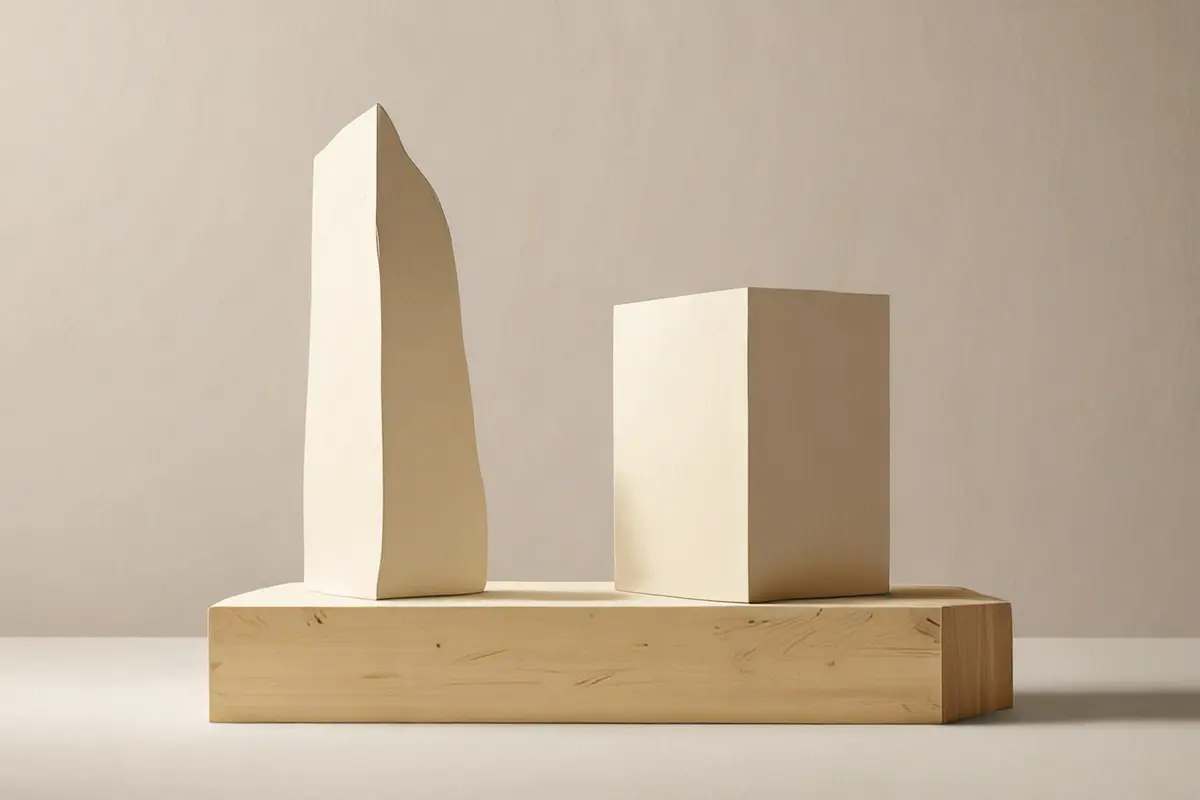
Consider a hypothetical homeware campaign using a curved plinth. The front catches a traveling highlight; the back is normally off camera; the top holds the real product. Rather than starting with a miniature of the complete object, ask the regional maker for a section containing the curve, a joint, the top corner and the proposed coating.
Film that section in the closest planned framing and a lighting setup that reveals the likely differences. This is a proposed test, not one ONCE has conducted. It asks whether the joint, texture and highlight remain acceptable where the campaign will actually see them.
Map the areas requiring detailed finishing on the drawing. An unseen rear face may need less cosmetic work, but an orbiting camera, a vertical composition or behind-the-scenes footage could reveal it. Confirm those uses first. Cosmetic priorities do not reduce structural requirements for support, loads or contact with people.
If the finished build still requires extensive sanding, repainting or seam repair at the studio, log that labor. Moving work from a workshop into an expensive shooting day is not evidence that replication has become economical.
Compare complete routes to a ready-to-shoot object
Use the same shot requirements, dates and number of uses in both estimates. Price each destination separately. A generic international freight allowance can conceal the very difference being evaluated.
Ship-the-original cost = initial build + packing and round-trip freight + applicable taxes and procedures + storage + assembly and repair at each location.
Local-build cost = transferable design and process development + regional samples and approval + fabrication, finishing and assembly at each location + local transport and storage + identified revisions.
These are decision formulas, not ONCE prices or industry averages. Keep currencies and tax treatment consistent. Separate sunk design expenditure that neither option can recover so it is not counted again in only one route. For unpriced rework or delay, record the trigger, responsibility and fallback; do not invent a failure probability to manufacture a precise expected-cost figure.
Check the calendar as well as the total. One original cannot serve overlapping shoots in distant locations. Multiple local builds may permit parallel work, provided sampling, manufacturing and studio preparation all fit the schedule. Instant file transfer provides no such assurance by itself.
Make the first regional build a purchase decision
A recurring shape, burdensome freight, an available maker who passes the section test and a maintained process package favor a limited local pilot. A one-off small object, an unusually distinctive handmade finish or a very low tolerance for visible variation may favor retaining and shipping the original. Compare actual estimates and samples before choosing either route.
For an overseas brand working with a Chinese supply chain, the next brief should therefore distinguish the centrally controlled design from the tasks commissioned in each market. Decide who approves the sample, who pays for a finish change and who maintains the package after the first production.
Also specify ownership of the object, permitted use of the files, which fabrication partners may receive them and who funds subsequent revisions. Possession of a model does not automatically grant unlimited reproduction or onward sharing. Any product represented in the commercial needs its own accurate treatment; a scenic fabrication workflow does not validate a product replica's claims.
For ONCE, this is a route from isolated set builds toward maintained production assets and a qualified regional network. That is our strategic analysis, not a claim that such a network already exists. Bring the destination schedule, critical shots, product dimensions and current set information to an ONCE production discussion. The first output should be two comparable scopes, rather than a promise that a file will travel better than an object.
Sources and limits
Checked November 5, 2026, Beijing time. Primary sources: The Walt Disney Company, Disney Accelerator's 2026 Demo Day Explores New Frontiers in Storytelling, Robotics, and Guest Experiences (November 3, 2026); Disney at CES 2026: Building Worlds Big and Small (January 15, 2026); Hollywood 3D Printing, Custom Props for Film, TV, and Commercials: How Hero Props Are Made (September 28, 2026). The proposed framework does not establish cross-country visual equivalence or predict savings. The original AI cover is a fictional commercial illustration, unrelated to Disney or Haddy's actual work.